Description:
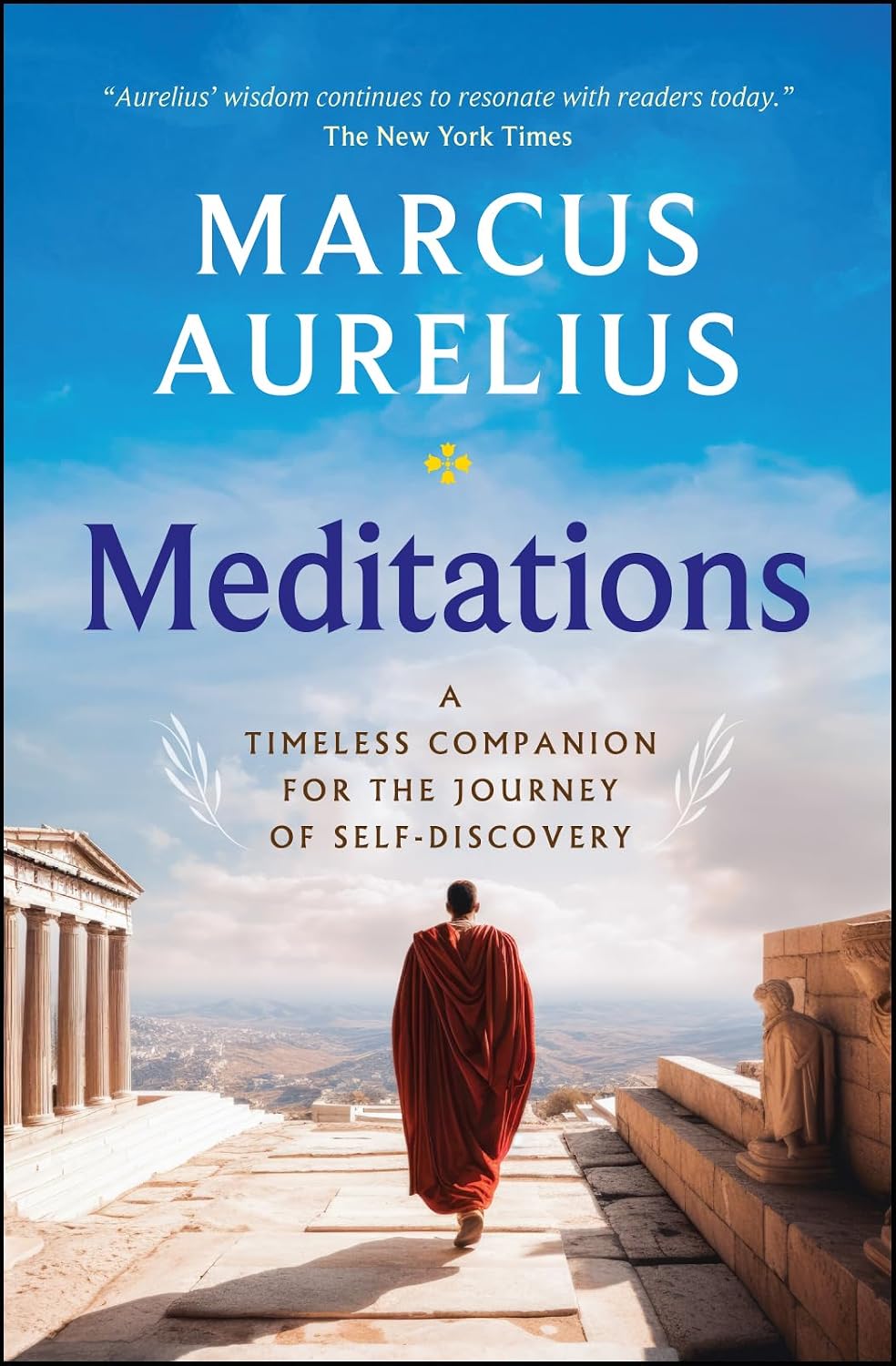
Structured as a personal journal, the book presents short, thoughtful passages in which Marcus advises himself on how to live with integrity, rationality, and purpose. He reflects on the impermanence of life, the importance of self-discipline, the value of kindness, and the need for resilience in adversity. Through these meditations, he confronts his own doubts, frustrations, and responsibilities, striving to remain humble and compassionate despite the immense pressures of leadership.
At its core, the work embodies the principles of Stoicism—focusing on what one can control, accepting what one cannot, and meeting every challenge with calmness and virtue. Marcus reminds himself to avoid anger, rise above trivial concerns, and act with moral clarity in all situations.
Universally relatable and endlessly insightful, Meditations continues to resonate with modern readers. Its honesty and practicality offer guidance for anyone seeking inner peace, emotional strength, and a deeper understanding of how to live a meaningful life.
Other Bestsellers in the 100 MustReads Series:
• Meditations by Marcus Aurelius | B0G6D4QM99
• The Art of War bt Sun Tzu | B0G6D44T8H
• The Little Prince | Antoine De Saint-Exupéry | B0G6D6X82C
• The Richest Man in Babylon by George S. Clason | B0G6CV7JP2
Review
Book One:
1)
From my grandfather Verus I learned good morals and the government of my temper.
2)
From the reputation and remembrance of my father, modesty and a manly character.
3)
From my mother, piety and beneficence, and abstinence not only from evil deeds, but even from evil thoughts; and further, simplicity in my way of living, far removed from the habits of the rich.
4)
From my great-grandfather, not to have frequented public schools, and to have had good teachers at home, and to know that on such things a man should spend liberally.
5)
From my governor, to be neither of the green nor of the blue party at the games in the Circus, nor a partisan either of the Parmularius or the Scutarius at the gladiators’ fights; from him too I learned endurance of labour, and to want little, and to work with my own hands, and not to meddle with other people’s affairs, and not to be ready to listen to slander.
6)
From Diognetus, not to busy myself about trifling things, and not to give credit to what was said by miracle-workers and jugglers about incantations and the driving away of daemons and such things; and not to breed quails for fighting, nor to give myself up passionately to such things; and to endure freedom of speech; and to have become intimate with philosophy; and to have been a hearer, first of Bacchius, then of Tandasis and Marcianus; and to have written dialogues in my youth; and to have desired a plank bed and skin (cloak/rug), and whatever else of the kind belongs to the Grecian discipline.
7)
From Rusticus I received the impression that my character required improvement and discipline; and from him I learned not to be led astray to sophistic emulation, nor to writing on speculative matters, nor to delivering little hortatory orations, nor to showing myself off as a man who practises much discipline, or does benevolent acts in order to make a display; and to abstain from rhetoric, and poetry, and fine writing; and not to walk about in the house in my outdoor dress, nor to do other things of the kind; and to write my letters with simplicity, like the letter which Rusticus wrote from Sinuessa to my mother; and with respect to those who have offended me by words, or done me wrong, to be easily disposed to be pacified and reconciled, as soon as they have shown a readiness to be reconciled; and to read carefully, and not to be satisfied with a superficial understanding of a book; nor hastily to give my assent to those who talk overmuch; and I am indebted to him for being acquainted with the discourses of Epictetus, which he communicated to me out of his own collection.
8)
From Apollonius I learned freedom of will and undeviating steadiness of purpose; and to look to nothing else, not even for a moment, except to reason; and to be always the same, in sharp pains, on the occasion of the loss of a child, and in long illness; and to see clearly in a living example that the same man can be both most resolute and yielding, and not peevish in giving his instruction; and to have had before my eyes a man who clearly considered his experience and his skill in expounding philosophical principles as the smallest of his merits; and from him I learned how to receive from friends what are esteemed favours, without being either humbled by them or letting them pass unnoticed.
9)
From Sextus, a benevolent disposition, and the example of a family governed in a fatherly manner, and the idea of living conformably to nature; and gravity without affectation, and to look carefully after the interests of friends, and to tolerate ignorant persons, and those who form opinions without consideration: he had the power of readily accommodating himself to all, so that intercourse with him was more agreeable than any flattery; and at the same time he was most highly venerated by those who associated with him: and he had the faculty both of discovering and ordering, in an intelligent and methodical way, the principles necessary for life; and he never showed anger or any other passion, but was entirely free from passion, and also most affectionate; and he could express approbation without noisy display, and he possessed much knowledge without ostentation.
10)
From Alexander the grammarian, to refrain from fault-finding, and not in a reproachful way to chide those who uttered any barbarous or solecistic or strange-sounding expression; but dexterously to introduce the very expression which ought to have been used, and in the way of answer or giving confirmation, or joining in an inquiry about the thing itself, not about the word, or by some other fit suggestion.
11)
From Fronto I learned to observe what envy, and duplicity, and hypocrisy are in a tyrant, and that generally those among us who are called Patricians are rather deficient in paternal affection.
12)
From Alexander the Platonic, not frequently nor without necessity to say to any one, or to write in a letter, that I have no leisure; nor continually to excuse the neglect of duties required by our relation to those with whom we live, by alleging urgent occupations.
13)
From Catulus, not to be indifferent when a friend finds fault, even if he should find fault without reason, but to try to restore him to his usual disposition; and to be ready to speak well of teachers, as it is reported of Domitius and Athenodotus; and to love my children truly.
14)
From my brother Severus, to love my kin, and to love truth, and to love justice; and through him I learned to know Thrasea, Helvidius, Cato, Dion, Brutus; and from him I received the idea of a polity in which there is the same law for all, a polity administered with regard to equal rights and equal freedom of speech, and the idea of a kingly government which respects most of all the freedom of the governed; I learned from him also consistency and undeviating steadiness in my regard for philosophy; and a disposition to do good, and to give to others readily, and to cherish good hopes, and to believe that I am loved by my friends; and in him I observed no concealment of his opinions with respect to those whom he condemned, and that his friends had no need to conjecture what he wished or did not wish, but it was quite plain.
About the Author
In his early life, Marcus dedicated himself to extensive education in rhetoric, law, and especially philosophy. He embraced Stoicism from a young age, choosing a life rooted in simplicity, self-control, and virtue. His middle life began with his ascension to the throne in 161 AD, where he ruled alongside his adoptive brother, Lucius Verus. His reign was marked by significant challenges, including the Parthian War, invasions along the Danube, and the devastating Antonine Plague. Despite these difficulties, he ruled with fairness, patience, and deep philosophical insight, earning him a lasting reputation as one of Rome’s “Five Good Emperors.”
Marcus’s most famous work, Meditations, was written during his military campaigns. This collection of personal reflections—never meant for publication—reveals his inner struggles, moral principles, and devotion to Stoic philosophy. It remains one of the most important philosophical texts of all time for its wisdom on resilience, virtue, and emotional discipline.
Beyond Meditations, Marcus implemented administrative reforms, supported education, and worked to strengthen the empire’s legal and social structures. His leadership balanced strength with compassion, making him a model philosopher-king.
Marcus Aurelius died on March 17, 180 AD, likely from illness, while on campaign near the Danube. His death marked the end of Rome’s golden age. His legacy endures through his writing and his example of principled, thoughtful leadership.
Details:
Visit the 100 MustReads Store
Meditations (Hardcover Book)
QAR12046
Quantity:
Order today to get by 7-14 business days
Delivery fee of QAR 20. Free for orders above QAR 200.
 Imported From: United States
At BOLO, we work hard to ensure the products you receive are new, genuine, and sourced from reputable suppliers.
Every product in the BOLO catalogue is sourced through our Verified Global Supply Network of verified sellers, authorized distributors or directly from the manufacturer.
Each product undergoes thorough inspection and verification at our consolidation and fulfilment centers to ensure it meets our strict authenticity and quality standards before being shipped and delivered to you.
If you ever have concerns regarding the authenticity of a product purchased from us, please contact Bolo Support. We will review your inquiry promptly and, if necessary, provide documentation verifying authenticity or offer a suitable resolution.
Your trust is our top priority, and we are committed to maintaining transparency and integrity in every transaction.
While we strive to display accurate information, variations in packaging, labeling, instructions, or formulation may occasionally occur due to regional differences or supplier updates. For detailed or manufacturer-specific information, please contact the brand directly or reach out to BOLO Support for assistance.
Unless otherwise stated, all prices displayed on the product page include applicable taxes and import duties.
BOLO operates in accordance with the laws and regulations of Qatar. Any items found to be restricted or prohibited for sale within the Qatar will be cancelled prior to shipment. We take proactive measures to ensure that only products permitted for sale in Qatar are listed on our website.
All items are shipped by air, and any products classified as “Dangerous Goods (DG)” under IATA regulations will be removed from the order and cancelled.
All orders are processed manually, and we make every effort to process them promptly once confirmed. Products cancelled due to the above reasons will be permanently removed from listings across the website.
More from this brand
Similar items from “Greece”
Share with
Or share with link
https://www.bolo.qa/products/UO0T6Q4DZ99
Visit the 100 MustReads Store
Meditations (Hardcover Book)
QAR12046
Quantity:
Order today to get by 7-14 business days
Delivery fee of QAR 20. Free for orders above QAR 200.
Imported From: United States
At BOLO, we work hard to ensure the products you receive are new, genuine, and sourced from reputable suppliers.
Every product in the BOLO catalogue is sourced through our Verified Global Supply Network of verified sellers, authorized distributors or directly from the manufacturer.
Each product undergoes thorough inspection and verification at our consolidation and fulfilment centers to ensure it meets our strict authenticity and quality standards before being shipped and delivered to you.
If you ever have concerns regarding the authenticity of a product purchased from us, please contact Bolo Support. We will review your inquiry promptly and, if necessary, provide documentation verifying authenticity or offer a suitable resolution.
Your trust is our top priority, and we are committed to maintaining transparency and integrity in every transaction.
While we strive to display accurate information, variations in packaging, labeling, instructions, or formulation may occasionally occur due to regional differences or supplier updates. For detailed or manufacturer-specific information, please contact the brand directly or reach out to BOLO Support for assistance.
Unless otherwise stated, all prices displayed on the product page include applicable taxes and import duties.
BOLO operates in accordance with the laws and regulations of Qatar. Any items found to be restricted or prohibited for sale within the Qatar will be cancelled prior to shipment. We take proactive measures to ensure that only products permitted for sale in Qatar are listed on our website.
All items are shipped by air, and any products classified as “Dangerous Goods (DG)” under IATA regulations will be removed from the order and cancelled.
All orders are processed manually, and we make every effort to process them promptly once confirmed. Products cancelled due to the above reasons will be permanently removed from listings across the website.
Description:
Structured as a personal journal, the book presents short, thoughtful passages in which Marcus advises himself on how to live with integrity, rationality, and purpose. He reflects on the impermanence of life, the importance of self-discipline, the value of kindness, and the need for resilience in adversity. Through these meditations, he confronts his own doubts, frustrations, and responsibilities, striving to remain humble and compassionate despite the immense pressures of leadership.
At its core, the work embodies the principles of Stoicism—focusing on what one can control, accepting what one cannot, and meeting every challenge with calmness and virtue. Marcus reminds himself to avoid anger, rise above trivial concerns, and act with moral clarity in all situations.
Universally relatable and endlessly insightful, Meditations continues to resonate with modern readers. Its honesty and practicality offer guidance for anyone seeking inner peace, emotional strength, and a deeper understanding of how to live a meaningful life.
Other Bestsellers in the 100 MustReads Series:
• Meditations by Marcus Aurelius | B0G6D4QM99
• The Art of War bt Sun Tzu | B0G6D44T8H
• The Little Prince | Antoine De Saint-Exupéry | B0G6D6X82C
• The Richest Man in Babylon by George S. Clason | B0G6CV7JP2
Review
Book One:
1)
From my grandfather Verus I learned good morals and the government of my temper.
2)
From the reputation and remembrance of my father, modesty and a manly character.
3)
From my mother, piety and beneficence, and abstinence not only from evil deeds, but even from evil thoughts; and further, simplicity in my way of living, far removed from the habits of the rich.
4)
From my great-grandfather, not to have frequented public schools, and to have had good teachers at home, and to know that on such things a man should spend liberally.
5)
From my governor, to be neither of the green nor of the blue party at the games in the Circus, nor a partisan either of the Parmularius or the Scutarius at the gladiators’ fights; from him too I learned endurance of labour, and to want little, and to work with my own hands, and not to meddle with other people’s affairs, and not to be ready to listen to slander.
6)
From Diognetus, not to busy myself about trifling things, and not to give credit to what was said by miracle-workers and jugglers about incantations and the driving away of daemons and such things; and not to breed quails for fighting, nor to give myself up passionately to such things; and to endure freedom of speech; and to have become intimate with philosophy; and to have been a hearer, first of Bacchius, then of Tandasis and Marcianus; and to have written dialogues in my youth; and to have desired a plank bed and skin (cloak/rug), and whatever else of the kind belongs to the Grecian discipline.
7)
From Rusticus I received the impression that my character required improvement and discipline; and from him I learned not to be led astray to sophistic emulation, nor to writing on speculative matters, nor to delivering little hortatory orations, nor to showing myself off as a man who practises much discipline, or does benevolent acts in order to make a display; and to abstain from rhetoric, and poetry, and fine writing; and not to walk about in the house in my outdoor dress, nor to do other things of the kind; and to write my letters with simplicity, like the letter which Rusticus wrote from Sinuessa to my mother; and with respect to those who have offended me by words, or done me wrong, to be easily disposed to be pacified and reconciled, as soon as they have shown a readiness to be reconciled; and to read carefully, and not to be satisfied with a superficial understanding of a book; nor hastily to give my assent to those who talk overmuch; and I am indebted to him for being acquainted with the discourses of Epictetus, which he communicated to me out of his own collection.
8)
From Apollonius I learned freedom of will and undeviating steadiness of purpose; and to look to nothing else, not even for a moment, except to reason; and to be always the same, in sharp pains, on the occasion of the loss of a child, and in long illness; and to see clearly in a living example that the same man can be both most resolute and yielding, and not peevish in giving his instruction; and to have had before my eyes a man who clearly considered his experience and his skill in expounding philosophical principles as the smallest of his merits; and from him I learned how to receive from friends what are esteemed favours, without being either humbled by them or letting them pass unnoticed.
9)
From Sextus, a benevolent disposition, and the example of a family governed in a fatherly manner, and the idea of living conformably to nature; and gravity without affectation, and to look carefully after the interests of friends, and to tolerate ignorant persons, and those who form opinions without consideration: he had the power of readily accommodating himself to all, so that intercourse with him was more agreeable than any flattery; and at the same time he was most highly venerated by those who associated with him: and he had the faculty both of discovering and ordering, in an intelligent and methodical way, the principles necessary for life; and he never showed anger or any other passion, but was entirely free from passion, and also most affectionate; and he could express approbation without noisy display, and he possessed much knowledge without ostentation.
10)
From Alexander the grammarian, to refrain from fault-finding, and not in a reproachful way to chide those who uttered any barbarous or solecistic or strange-sounding expression; but dexterously to introduce the very expression which ought to have been used, and in the way of answer or giving confirmation, or joining in an inquiry about the thing itself, not about the word, or by some other fit suggestion.
11)
From Fronto I learned to observe what envy, and duplicity, and hypocrisy are in a tyrant, and that generally those among us who are called Patricians are rather deficient in paternal affection.
12)
From Alexander the Platonic, not frequently nor without necessity to say to any one, or to write in a letter, that I have no leisure; nor continually to excuse the neglect of duties required by our relation to those with whom we live, by alleging urgent occupations.
13)
From Catulus, not to be indifferent when a friend finds fault, even if he should find fault without reason, but to try to restore him to his usual disposition; and to be ready to speak well of teachers, as it is reported of Domitius and Athenodotus; and to love my children truly.
14)
From my brother Severus, to love my kin, and to love truth, and to love justice; and through him I learned to know Thrasea, Helvidius, Cato, Dion, Brutus; and from him I received the idea of a polity in which there is the same law for all, a polity administered with regard to equal rights and equal freedom of speech, and the idea of a kingly government which respects most of all the freedom of the governed; I learned from him also consistency and undeviating steadiness in my regard for philosophy; and a disposition to do good, and to give to others readily, and to cherish good hopes, and to believe that I am loved by my friends; and in him I observed no concealment of his opinions with respect to those whom he condemned, and that his friends had no need to conjecture what he wished or did not wish, but it was quite plain.
About the Author
In his early life, Marcus dedicated himself to extensive education in rhetoric, law, and especially philosophy. He embraced Stoicism from a young age, choosing a life rooted in simplicity, self-control, and virtue. His middle life began with his ascension to the throne in 161 AD, where he ruled alongside his adoptive brother, Lucius Verus. His reign was marked by significant challenges, including the Parthian War, invasions along the Danube, and the devastating Antonine Plague. Despite these difficulties, he ruled with fairness, patience, and deep philosophical insight, earning him a lasting reputation as one of Rome’s “Five Good Emperors.”
Marcus’s most famous work, Meditations, was written during his military campaigns. This collection of personal reflections—never meant for publication—reveals his inner struggles, moral principles, and devotion to Stoic philosophy. It remains one of the most important philosophical texts of all time for its wisdom on resilience, virtue, and emotional discipline.
Beyond Meditations, Marcus implemented administrative reforms, supported education, and worked to strengthen the empire’s legal and social structures. His leadership balanced strength with compassion, making him a model philosopher-king.
Marcus Aurelius died on March 17, 180 AD, likely from illness, while on campaign near the Danube. His death marked the end of Rome’s golden age. His legacy endures through his writing and his example of principled, thoughtful leadership.
Details:
More from this brand
Similar items from “Greece”
Share with
Or share with link
https://www.bolo.qa/products/UO0T6Q4DZ99