Description:
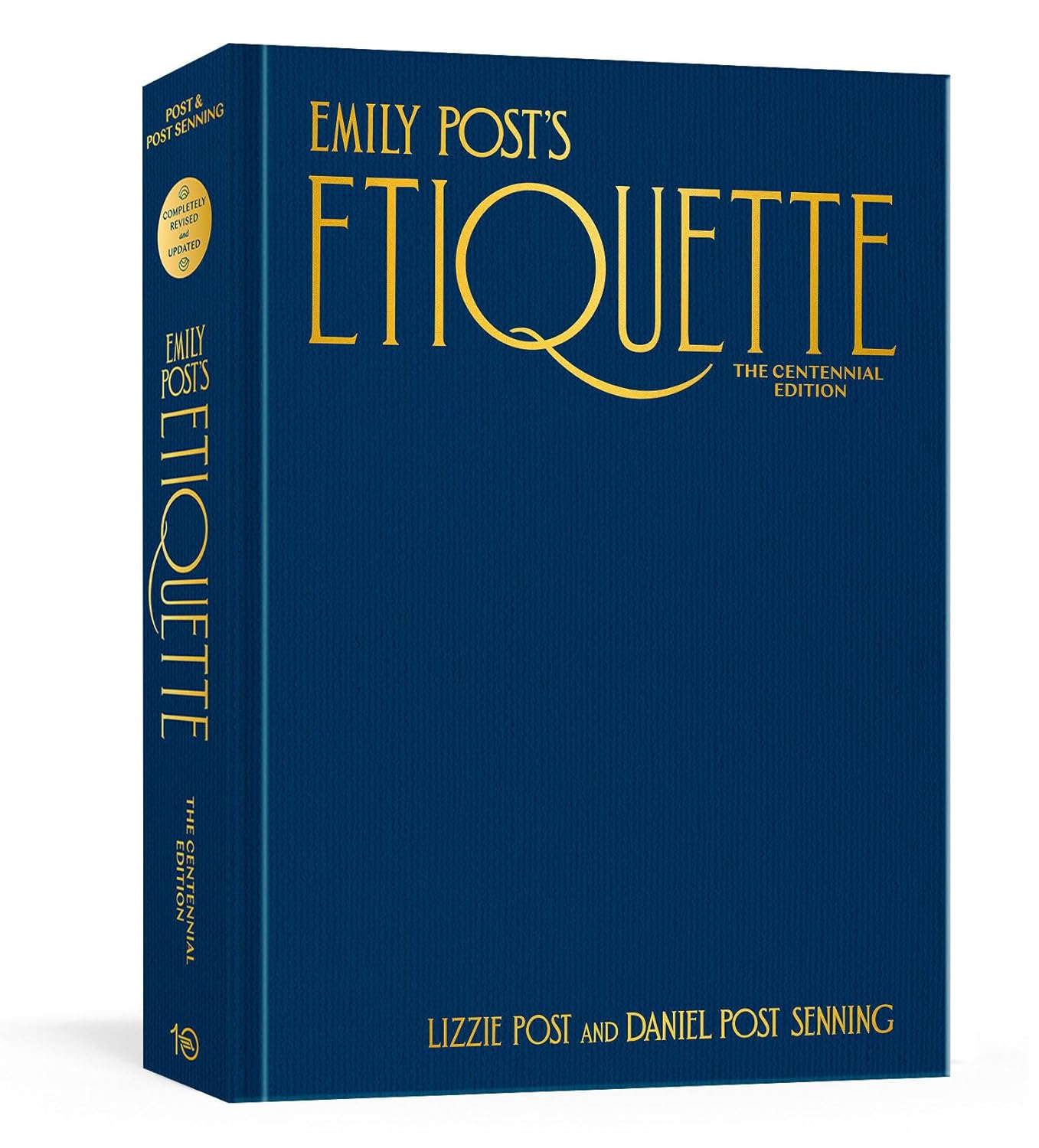
For the past one hundred years, Emily Post has been America’s definitive source for how to navigate—and enhance—every social interaction. In an increasingly diverse and intersectional world, the need for a trusted primer on how to put people at ease and treat others with confidence and kindness has never been greater.
Lizzie Post and Daniel Post Senning—the great-great grandchildren of Emily Post and co-presidents of The Emily Post Institute—provide a fully updated and relatable guide. From advice on entertaining, table manners, and using titles and pronouns, to personal and professional communication etiquette, this stylish and essential reference provides thoughtful guidance on how to do it all well. Rooted in a foundation of consideration, respect, and honesty, this edition continues the Post family legacy of upholding traditions while moving forward with the times. The book covers:
- Etiquette classics like table manners, gift-giving, thank-you notes, greetings and introductions, and everyday conversation
- How to be a good host and a good guest, from handling invitations and setting yourself up for success to plus-ones and dealing with mishaps
- Tech etiquette including video meetings, parties and classes, and how to politely handle devices, home security, and AI
- Managing hard times, from what to say (and what not to say), to the tradition of condolence notes and how to offer support following a death, miscarriage, or tragedy
- Tipping practices in the age of rideshares, tough times, and ever-prominent payment screens.
This book also includes handy reference guides for each chapter that make it easy to find the Posts’ most searched for content, like a gender-free attire guide, a soup-to-nuts entertaining chart, sample invitations, and more.
With Emily Post's Etiquette, The Centennial Edition you’ll have everything you need to build successful relationships in all aspects of life as you move through your world with confidence and ease.
About the Author
Daniel Post Senning is the great-great-grandson of Emily Post and the author of Manners in a Digital World and co-author of past editions of Emily Post’s Etiquette and The Etiquette Advantage in Business. Dan teaches business etiquette seminars worldwide and co-hosts the Awesome Etiquette podcast with his cousin Lizzie Post.
Excerpt. © Reprinted by permission. All rights reserved.
What is Etiquette?
“Whenever two people come together and their behavior affects one another, you have etiquette . . . it is not some rigid code of manners; it’s simply how persons’ lives touch one another.” —Emily Post
Etiquette is for everyone. We experience it whenever people interact. It is the social expectation that we have of ourselves and others. Contrary to the clichéd images of staffed homes, Stepford wives, and silver dining sets, etiquette can be seen in the most humble and simple of interactions and spaces, and even between perfect strangers. While it can be fun to daydream about throwing elaborate parties, good etiquette is, at its core, about treating everyone we encounter well. You don’t need money, power, a “higher” education, or deportment classes to demonstrate it. There is no particular time in history or place in the world that defines “real” etiquette. Good etiquette isn’t formed in a particular type of household or with one version of parenting. Having good etiquette skills isn’t a product of any particular background, class, identity, or religion. No. Etiquette can be learned and employed by anyone, at any stage in life, and is a choice that is available to all of us.
CONSIDERATION, RESPECT, AND HONESTY
Good etiquette rests on a foundation of consideration, respect, and honesty. We might think we know what these words mean—we certainly hear them enough—but viewing them through the lens of etiquette allows us to see that, together, they guide us toward good behavior (or, at least, give us a shot at it).
CONSIDERATION
With regard to etiquette, consideration is thinking about others, as well as yourself, before acting. It’s about cultivating an awareness of the people, places, and things around us and our impact on them. Through consideration we show our sympathy and/or empathy for others by exploring how a particular action might affect them. We aren’t necessarily making a judgment about a situation, just recognizing the people involved and the impact it may create.
RESPECT
As human beings we deserve regard for our feelings, rights, abilities, perspectives, and traditions. By recognizing this, we can see when our actions or words impact someone positively (upholding respect for them) or negatively (disrespecting them). By following the principle of respect, we honor others, not necessarily because of any special talents, qualities, or ideas they may have, or because we like or understand them, but simply because they exist. Respect builds on consideration by encouraging us to understand how the actions we are weighing impact others. By choosing to show respect for others, ourselves, and the world we live in, we make choices based on our potential impact, and when we choose actions that positively impact others, we build relationships—whether with a stranger as we hold a door, in a boardroom with colleagues, or at the dinner table.
HONESTY
The principle of honesty and how it is applied can make or break our polite path forward. In honesty we find both truth and the ability to build trust by being sincere. As we look at who is involved in a given situation, how they are affected, and how possible actions might positively or negatively impact them, honesty can guide us to make the best choice for that moment. With honesty present in our actions and words, we are believable and genuine. By being honest we can facilitate and maintain trust.
CHARM
There is a certain quality you might say wraps all the above together—charm. Any action can be strong when it is founded upon consideration, respect, and honesty, but when our expression of the action is also wrapped in charm—not a false charm used to trick an audience, but a sincere charm of warmth, wit, humor, tact, kindness, and patience—it will likely result in a smooth and comfortable interaction.
MANNERS AND PRINCIPLES
While many people consider manners and etiquette to be one and the same, we teach that they are more like parts of an equation, with etiquette being the sum of manners and principles. Manners are the behaviors that when executed well can demonstrate the principles in action. Employing one without the other may serve you, but only together can they really result in good etiquette.
ETIQUETTE = MANNERS + PRINCIPLES
The principles of consideration, respect, and honesty can help guide us toward good interactions when the specific manners to follow aren’t clear or known. For example, it will always be “polite” or “good etiquette” to greet someone with a genuine feeling of welcome and respect. The gestures and words we use may change over time (and will certainly vary among cultures), but the sentiment we wish to convey (respect and welcome) is universal regardless of the particular manners we use to express it.
Manners are specific behaviors. They help us know what is expected of us, and what to expect of others. They change over time and differ by country, culture, and even social group or family. As a culture evolves, new manners emerge, and others become traditions that we either uphold or let become obsolete. Emily’s 1922 edition of Etiquette, for example, discusses chaperones and “at home” invitations, neither of which are in this edition, as they are not current customs. Think of the traditional global greetings of the kiss on the cheek, the bow, and the handshake. Each is preferred in different parts of the world. All three are meant to indicate welcome, respect, and a sense of trust. While these manners vary across the globe, the principle behind them is the same: a respectful and considerate greeting.
The three principles of consideration, respect, and honesty can be applied to any situation you find yourself in where you don’t know the proper manners. Of course, people will have slightly different interpretations of these principles, but when we base our actions on them, even when things go badly, others are likely to understand our good intent. If you think about the people involved in the situation and how they might be affected (consideration), acknowledge the worth and value of those involved by recognizing the effects of possible actions (respect), and choose to move forward in a way you feel authentically good about and that genuinely benefits the most people in the situation (honesty), you’re likely to respond appropriately and also to honor and improve your relationship with those involved. In our Emily Post business etiquette programs, we use three goals to easily translate the above principles into action: think before you act, make choices that build relationships, and be sincere in your actions.
Details:
Visit the Ten Speed Press Store
Emily Post's Etiquette, The Centennial Edition
QAR15074
Quantity:
Order today to get by 7-14 business days
Delivery fee of QAR 20. Free for orders above QAR 200.
 Imported From: United States
At BOLO, we work hard to ensure the products you receive are new, genuine, and sourced from reputable suppliers.
Every product in the BOLO catalogue is sourced through our Verified Global Supply Network of verified sellers, authorized distributors or directly from the manufacturer.
Each product undergoes thorough inspection and verification at our consolidation and fulfilment centers to ensure it meets our strict authenticity and quality standards before being shipped and delivered to you.
If you ever have concerns regarding the authenticity of a product purchased from us, please contact Bolo Support. We will review your inquiry promptly and, if necessary, provide documentation verifying authenticity or offer a suitable resolution.
Your trust is our top priority, and we are committed to maintaining transparency and integrity in every transaction.
While we strive to display accurate information, variations in packaging, labeling, instructions, or formulation may occasionally occur due to regional differences or supplier updates. For detailed or manufacturer-specific information, please contact the brand directly or reach out to BOLO Support for assistance.
Unless otherwise stated, all prices displayed on the product page include applicable taxes and import duties.
BOLO operates in accordance with the laws and regulations of Qatar. Any items found to be restricted or prohibited for sale within the Qatar will be cancelled prior to shipment. We take proactive measures to ensure that only products permitted for sale in Qatar are listed on our website.
All items are shipped by air, and any products classified as “Dangerous Goods (DG)” under IATA regulations will be removed from the order and cancelled.
All orders are processed manually, and we make every effort to process them promptly once confirmed. Products cancelled due to the above reasons will be permanently removed from listings across the website.


Similar suggestions by Bolo
More from this brand
Similar items from “Etiquette Guides & Advice”
Share with
Or share with link
https://www.bolo.qa/products/U1984859390
Visit the Ten Speed Press Store
Emily Post's Etiquette, The Centennial Edition
QAR15074
Quantity:
Order today to get by 7-14 business days
Delivery fee of QAR 20. Free for orders above QAR 200.
Imported From: United States
At BOLO, we work hard to ensure the products you receive are new, genuine, and sourced from reputable suppliers.
Every product in the BOLO catalogue is sourced through our Verified Global Supply Network of verified sellers, authorized distributors or directly from the manufacturer.
Each product undergoes thorough inspection and verification at our consolidation and fulfilment centers to ensure it meets our strict authenticity and quality standards before being shipped and delivered to you.
If you ever have concerns regarding the authenticity of a product purchased from us, please contact Bolo Support. We will review your inquiry promptly and, if necessary, provide documentation verifying authenticity or offer a suitable resolution.
Your trust is our top priority, and we are committed to maintaining transparency and integrity in every transaction.
While we strive to display accurate information, variations in packaging, labeling, instructions, or formulation may occasionally occur due to regional differences or supplier updates. For detailed or manufacturer-specific information, please contact the brand directly or reach out to BOLO Support for assistance.
Unless otherwise stated, all prices displayed on the product page include applicable taxes and import duties.
BOLO operates in accordance with the laws and regulations of Qatar. Any items found to be restricted or prohibited for sale within the Qatar will be cancelled prior to shipment. We take proactive measures to ensure that only products permitted for sale in Qatar are listed on our website.
All items are shipped by air, and any products classified as “Dangerous Goods (DG)” under IATA regulations will be removed from the order and cancelled.
All orders are processed manually, and we make every effort to process them promptly once confirmed. Products cancelled due to the above reasons will be permanently removed from listings across the website.
Description:
For the past one hundred years, Emily Post has been America’s definitive source for how to navigate—and enhance—every social interaction. In an increasingly diverse and intersectional world, the need for a trusted primer on how to put people at ease and treat others with confidence and kindness has never been greater.
Lizzie Post and Daniel Post Senning—the great-great grandchildren of Emily Post and co-presidents of The Emily Post Institute—provide a fully updated and relatable guide. From advice on entertaining, table manners, and using titles and pronouns, to personal and professional communication etiquette, this stylish and essential reference provides thoughtful guidance on how to do it all well. Rooted in a foundation of consideration, respect, and honesty, this edition continues the Post family legacy of upholding traditions while moving forward with the times. The book covers:
- Etiquette classics like table manners, gift-giving, thank-you notes, greetings and introductions, and everyday conversation
- How to be a good host and a good guest, from handling invitations and setting yourself up for success to plus-ones and dealing with mishaps
- Tech etiquette including video meetings, parties and classes, and how to politely handle devices, home security, and AI
- Managing hard times, from what to say (and what not to say), to the tradition of condolence notes and how to offer support following a death, miscarriage, or tragedy
- Tipping practices in the age of rideshares, tough times, and ever-prominent payment screens.
This book also includes handy reference guides for each chapter that make it easy to find the Posts’ most searched for content, like a gender-free attire guide, a soup-to-nuts entertaining chart, sample invitations, and more.
With Emily Post's Etiquette, The Centennial Edition you’ll have everything you need to build successful relationships in all aspects of life as you move through your world with confidence and ease.
About the Author
Daniel Post Senning is the great-great-grandson of Emily Post and the author of Manners in a Digital World and co-author of past editions of Emily Post’s Etiquette and The Etiquette Advantage in Business. Dan teaches business etiquette seminars worldwide and co-hosts the Awesome Etiquette podcast with his cousin Lizzie Post.
Excerpt. © Reprinted by permission. All rights reserved.
What is Etiquette?
“Whenever two people come together and their behavior affects one another, you have etiquette . . . it is not some rigid code of manners; it’s simply how persons’ lives touch one another.” —Emily Post
Etiquette is for everyone. We experience it whenever people interact. It is the social expectation that we have of ourselves and others. Contrary to the clichéd images of staffed homes, Stepford wives, and silver dining sets, etiquette can be seen in the most humble and simple of interactions and spaces, and even between perfect strangers. While it can be fun to daydream about throwing elaborate parties, good etiquette is, at its core, about treating everyone we encounter well. You don’t need money, power, a “higher” education, or deportment classes to demonstrate it. There is no particular time in history or place in the world that defines “real” etiquette. Good etiquette isn’t formed in a particular type of household or with one version of parenting. Having good etiquette skills isn’t a product of any particular background, class, identity, or religion. No. Etiquette can be learned and employed by anyone, at any stage in life, and is a choice that is available to all of us.
CONSIDERATION, RESPECT, AND HONESTY
Good etiquette rests on a foundation of consideration, respect, and honesty. We might think we know what these words mean—we certainly hear them enough—but viewing them through the lens of etiquette allows us to see that, together, they guide us toward good behavior (or, at least, give us a shot at it).
CONSIDERATION
With regard to etiquette, consideration is thinking about others, as well as yourself, before acting. It’s about cultivating an awareness of the people, places, and things around us and our impact on them. Through consideration we show our sympathy and/or empathy for others by exploring how a particular action might affect them. We aren’t necessarily making a judgment about a situation, just recognizing the people involved and the impact it may create.
RESPECT
As human beings we deserve regard for our feelings, rights, abilities, perspectives, and traditions. By recognizing this, we can see when our actions or words impact someone positively (upholding respect for them) or negatively (disrespecting them). By following the principle of respect, we honor others, not necessarily because of any special talents, qualities, or ideas they may have, or because we like or understand them, but simply because they exist. Respect builds on consideration by encouraging us to understand how the actions we are weighing impact others. By choosing to show respect for others, ourselves, and the world we live in, we make choices based on our potential impact, and when we choose actions that positively impact others, we build relationships—whether with a stranger as we hold a door, in a boardroom with colleagues, or at the dinner table.
HONESTY
The principle of honesty and how it is applied can make or break our polite path forward. In honesty we find both truth and the ability to build trust by being sincere. As we look at who is involved in a given situation, how they are affected, and how possible actions might positively or negatively impact them, honesty can guide us to make the best choice for that moment. With honesty present in our actions and words, we are believable and genuine. By being honest we can facilitate and maintain trust.
CHARM
There is a certain quality you might say wraps all the above together—charm. Any action can be strong when it is founded upon consideration, respect, and honesty, but when our expression of the action is also wrapped in charm—not a false charm used to trick an audience, but a sincere charm of warmth, wit, humor, tact, kindness, and patience—it will likely result in a smooth and comfortable interaction.
MANNERS AND PRINCIPLES
While many people consider manners and etiquette to be one and the same, we teach that they are more like parts of an equation, with etiquette being the sum of manners and principles. Manners are the behaviors that when executed well can demonstrate the principles in action. Employing one without the other may serve you, but only together can they really result in good etiquette.
ETIQUETTE = MANNERS + PRINCIPLES
The principles of consideration, respect, and honesty can help guide us toward good interactions when the specific manners to follow aren’t clear or known. For example, it will always be “polite” or “good etiquette” to greet someone with a genuine feeling of welcome and respect. The gestures and words we use may change over time (and will certainly vary among cultures), but the sentiment we wish to convey (respect and welcome) is universal regardless of the particular manners we use to express it.
Manners are specific behaviors. They help us know what is expected of us, and what to expect of others. They change over time and differ by country, culture, and even social group or family. As a culture evolves, new manners emerge, and others become traditions that we either uphold or let become obsolete. Emily’s 1922 edition of Etiquette, for example, discusses chaperones and “at home” invitations, neither of which are in this edition, as they are not current customs. Think of the traditional global greetings of the kiss on the cheek, the bow, and the handshake. Each is preferred in different parts of the world. All three are meant to indicate welcome, respect, and a sense of trust. While these manners vary across the globe, the principle behind them is the same: a respectful and considerate greeting.
The three principles of consideration, respect, and honesty can be applied to any situation you find yourself in where you don’t know the proper manners. Of course, people will have slightly different interpretations of these principles, but when we base our actions on them, even when things go badly, others are likely to understand our good intent. If you think about the people involved in the situation and how they might be affected (consideration), acknowledge the worth and value of those involved by recognizing the effects of possible actions (respect), and choose to move forward in a way you feel authentically good about and that genuinely benefits the most people in the situation (honesty), you’re likely to respond appropriately and also to honor and improve your relationship with those involved. In our Emily Post business etiquette programs, we use three goals to easily translate the above principles into action: think before you act, make choices that build relationships, and be sincere in your actions.
Details:
Similar suggestions by Bolo
More from this brand
Similar items from “Etiquette Guides & Advice”
Share with
Or share with link
https://www.bolo.qa/products/U1984859390