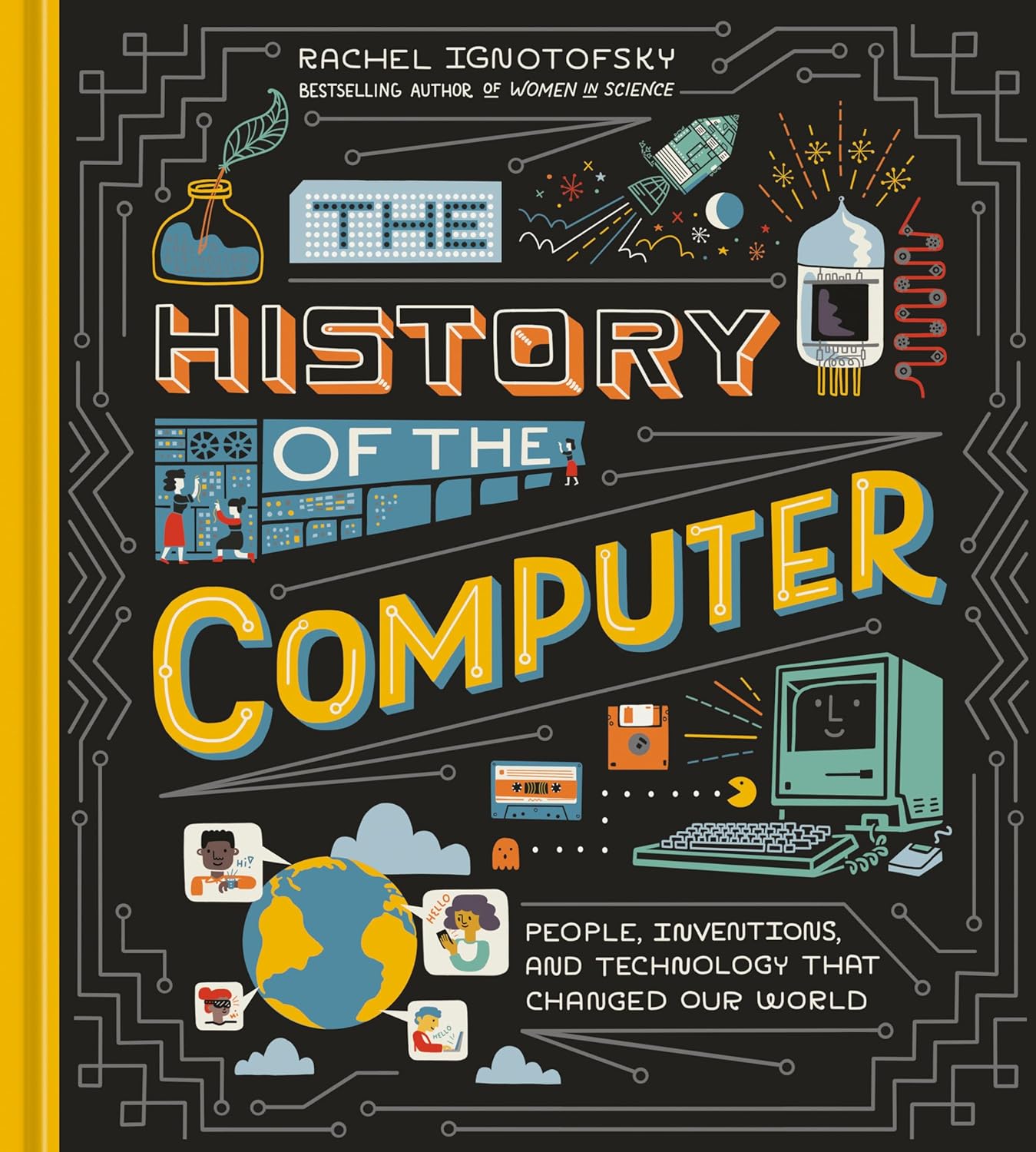
Description:
“A beautifully illustrated journey through the history of computing, from the Antikythera mechanism to the iPhone and beyond—I loved it.”—Eben Upton, Founder and CEO of Raspberry Pi
ONE OF THE BEST BOOKS OF THE YEAR: The New York Public Library
Computers are everywhere and have impacted our lives in so many ways. But who created them, and why? How have they transformed the way that we interact with our surroundings and each other?
Packed with accessible information, fun facts, and discussion starters, this charming and art-filled book takes you from the ancient world to the modern day, focusing on important inventions, from the earliest known counting systems to the sophisticated algorithms behind AI. The History of the Computer also profiles a diverse range of key players and creators—from An Wang and Margaret Hamilton to Steve Jobs and Sir Tim Berners-Lee—and illuminates their goals, their intentions, and the impact of their inventions on our everyday lives.
This entertaining and educational journey will help you understand our most important machines and how we can use them to enhance the way we live. You’ll never look at your phone the same way again!
Review
About the Author
Excerpt. © Reprinted by permission. All rights reserved.
“An Electronic Brain!” That’s what a reporter on live national television called the UNIVAC—right before it performed the task of predicting the results of the 1952 presidential election. It was a risky publicity stunt, and no one, not even the engineers who had constructed this computer, knew what it would do. Beamed into homes nationwide on black-and-white TVs, this was the first time that the public had seen a computer in action. The computers that came before were gigantic, noisy machines, built during World War II and hidden away in top-secret laboratories. The UNIVAC (short for UNIVersal Automatic Computer) was new—built for offices instead of battle—and would now have to prove itself. The American public watched the UNIVAC’s giant blinking console and rows of spinning magnetic tape while it did its calculations. Contrary to the polls, UNIVAC called a landslide victory for Dwight D. Eisenhower. To everyone’s surprise, the UNIVAC was correct! It was sensational! The American audience was enthralled—it was sci-fi in real life! This TV event propelled computers into pop culture and the public imagination.
Computers have come a long way since 1952! We now have access to the entire sum of human knowledge with devices that fit in the palms of our hands. The inventions that have gotten us to this point are part of a technological journey that starts as far back as the Stone Age. Before we dive into the history of computers, let’s define what a computer is.
A computer is a machine that stores, retrieves, and processes data by following a set of instructions.
At its core, a computer is a tool that expands the capacity of the human mind. We are all familiar with the idea that tools enhance our physical abilities to do more work—a hammer helps our arm strike a nail. A computer is a tool that enhances our mental abilities. Computers help us solve complicated math equations, store and sort vast libraries of information, and even help us find our new favorite restaurant!
The internet, combined with the creation of the World Wide Web in 1990, turned computers into media machines. The web is an integral part of the global economy and, for many, an extension of a personal identity. Computers have become so integrated into our lives that, in 2011, the United Nations declared access to the internet a human right.
Billions of people have smartphones that are 100,000 times more powerful than the computer that flew the first astronauts to the moon. But a computer in nearly every pocket has not always been the case. For the majority of history, computing machines were used by very few people—scientists doing research, governments managing bureaucracies, militaries fighting wars, and large corporations looking to maximize their profits. Early computers were incredibly expensive and physically massive and required specialized technical knowledge to use. It wasn’t until the personal computer revolution of the 1970s that the power of computing became more accessible to the average person.
This book will highlight the milestones of computer history and explore the idea that technological knowledge is power. It will not teach you how to code or go into the weeds of computer science. Instead, this book focuses on the intent, purpose, and impact of the people and machines that changed our world. While this book profiles innovators in technology, there is no such thing as a “lone genius.” The origin of computers came from the work of thousands of people and a social climate that prioritized the funding of scientific advancement. The study of computer history is the study of humanity.
Details:
Visit the Ten Speed Press Store
The History of the Computer: People, Inventions, and Technology that Changed Our World
QAR11646
Quantity:
Order today to get by 7-14 business days
Delivery fee of QAR 20. Free for orders above QAR 200.
 Imported From: United States
At BOLO, we work hard to ensure the products you receive are new, genuine, and sourced from reputable suppliers.
Every product in the BOLO catalogue is sourced through our Verified Global Supply Network of verified sellers, authorized distributors or directly from the manufacturer.
Each product undergoes thorough inspection and verification at our consolidation and fulfilment centers to ensure it meets our strict authenticity and quality standards before being shipped and delivered to you.
If you ever have concerns regarding the authenticity of a product purchased from us, please contact Bolo Support. We will review your inquiry promptly and, if necessary, provide documentation verifying authenticity or offer a suitable resolution.
Your trust is our top priority, and we are committed to maintaining transparency and integrity in every transaction.
While we strive to display accurate information, variations in packaging, labeling, instructions, or formulation may occasionally occur due to regional differences or supplier updates. For detailed or manufacturer-specific information, please contact the brand directly or reach out to BOLO Support for assistance.
Unless otherwise stated, all prices displayed on the product page include applicable taxes and import duties.
BOLO operates in accordance with the laws and regulations of Qatar. Any items found to be restricted or prohibited for sale within the Qatar will be cancelled prior to shipment. We take proactive measures to ensure that only products permitted for sale in Qatar are listed on our website.
All items are shipped by air, and any products classified as “Dangerous Goods (DG)” under IATA regulations will be removed from the order and cancelled.
All orders are processed manually, and we make every effort to process them promptly once confirmed. Products cancelled due to the above reasons will be permanently removed from listings across the website.


Similar suggestions by Bolo
More from this brand
Similar items from “Patents & Inventions”
Share with
Or share with link
https://www.bolo.qa/products/U1984857428
Visit the Ten Speed Press Store
The History of the Computer: People, Inventions, and Technology that Changed Our World
QAR11646
Quantity:
Order today to get by 7-14 business days
Delivery fee of QAR 20. Free for orders above QAR 200.
Imported From: United States
At BOLO, we work hard to ensure the products you receive are new, genuine, and sourced from reputable suppliers.
Every product in the BOLO catalogue is sourced through our Verified Global Supply Network of verified sellers, authorized distributors or directly from the manufacturer.
Each product undergoes thorough inspection and verification at our consolidation and fulfilment centers to ensure it meets our strict authenticity and quality standards before being shipped and delivered to you.
If you ever have concerns regarding the authenticity of a product purchased from us, please contact Bolo Support. We will review your inquiry promptly and, if necessary, provide documentation verifying authenticity or offer a suitable resolution.
Your trust is our top priority, and we are committed to maintaining transparency and integrity in every transaction.
While we strive to display accurate information, variations in packaging, labeling, instructions, or formulation may occasionally occur due to regional differences or supplier updates. For detailed or manufacturer-specific information, please contact the brand directly or reach out to BOLO Support for assistance.
Unless otherwise stated, all prices displayed on the product page include applicable taxes and import duties.
BOLO operates in accordance with the laws and regulations of Qatar. Any items found to be restricted or prohibited for sale within the Qatar will be cancelled prior to shipment. We take proactive measures to ensure that only products permitted for sale in Qatar are listed on our website.
All items are shipped by air, and any products classified as “Dangerous Goods (DG)” under IATA regulations will be removed from the order and cancelled.
All orders are processed manually, and we make every effort to process them promptly once confirmed. Products cancelled due to the above reasons will be permanently removed from listings across the website.
Description:
“A beautifully illustrated journey through the history of computing, from the Antikythera mechanism to the iPhone and beyond—I loved it.”—Eben Upton, Founder and CEO of Raspberry Pi
ONE OF THE BEST BOOKS OF THE YEAR: The New York Public Library
Computers are everywhere and have impacted our lives in so many ways. But who created them, and why? How have they transformed the way that we interact with our surroundings and each other?
Packed with accessible information, fun facts, and discussion starters, this charming and art-filled book takes you from the ancient world to the modern day, focusing on important inventions, from the earliest known counting systems to the sophisticated algorithms behind AI. The History of the Computer also profiles a diverse range of key players and creators—from An Wang and Margaret Hamilton to Steve Jobs and Sir Tim Berners-Lee—and illuminates their goals, their intentions, and the impact of their inventions on our everyday lives.
This entertaining and educational journey will help you understand our most important machines and how we can use them to enhance the way we live. You’ll never look at your phone the same way again!
Review
About the Author
Excerpt. © Reprinted by permission. All rights reserved.
“An Electronic Brain!” That’s what a reporter on live national television called the UNIVAC—right before it performed the task of predicting the results of the 1952 presidential election. It was a risky publicity stunt, and no one, not even the engineers who had constructed this computer, knew what it would do. Beamed into homes nationwide on black-and-white TVs, this was the first time that the public had seen a computer in action. The computers that came before were gigantic, noisy machines, built during World War II and hidden away in top-secret laboratories. The UNIVAC (short for UNIVersal Automatic Computer) was new—built for offices instead of battle—and would now have to prove itself. The American public watched the UNIVAC’s giant blinking console and rows of spinning magnetic tape while it did its calculations. Contrary to the polls, UNIVAC called a landslide victory for Dwight D. Eisenhower. To everyone’s surprise, the UNIVAC was correct! It was sensational! The American audience was enthralled—it was sci-fi in real life! This TV event propelled computers into pop culture and the public imagination.
Computers have come a long way since 1952! We now have access to the entire sum of human knowledge with devices that fit in the palms of our hands. The inventions that have gotten us to this point are part of a technological journey that starts as far back as the Stone Age. Before we dive into the history of computers, let’s define what a computer is.
A computer is a machine that stores, retrieves, and processes data by following a set of instructions.
At its core, a computer is a tool that expands the capacity of the human mind. We are all familiar with the idea that tools enhance our physical abilities to do more work—a hammer helps our arm strike a nail. A computer is a tool that enhances our mental abilities. Computers help us solve complicated math equations, store and sort vast libraries of information, and even help us find our new favorite restaurant!
The internet, combined with the creation of the World Wide Web in 1990, turned computers into media machines. The web is an integral part of the global economy and, for many, an extension of a personal identity. Computers have become so integrated into our lives that, in 2011, the United Nations declared access to the internet a human right.
Billions of people have smartphones that are 100,000 times more powerful than the computer that flew the first astronauts to the moon. But a computer in nearly every pocket has not always been the case. For the majority of history, computing machines were used by very few people—scientists doing research, governments managing bureaucracies, militaries fighting wars, and large corporations looking to maximize their profits. Early computers were incredibly expensive and physically massive and required specialized technical knowledge to use. It wasn’t until the personal computer revolution of the 1970s that the power of computing became more accessible to the average person.
This book will highlight the milestones of computer history and explore the idea that technological knowledge is power. It will not teach you how to code or go into the weeds of computer science. Instead, this book focuses on the intent, purpose, and impact of the people and machines that changed our world. While this book profiles innovators in technology, there is no such thing as a “lone genius.” The origin of computers came from the work of thousands of people and a social climate that prioritized the funding of scientific advancement. The study of computer history is the study of humanity.
Details:
Similar suggestions by Bolo
More from this brand
Similar items from “Patents & Inventions”
Share with
Or share with link
https://www.bolo.qa/products/U1984857428