Description:
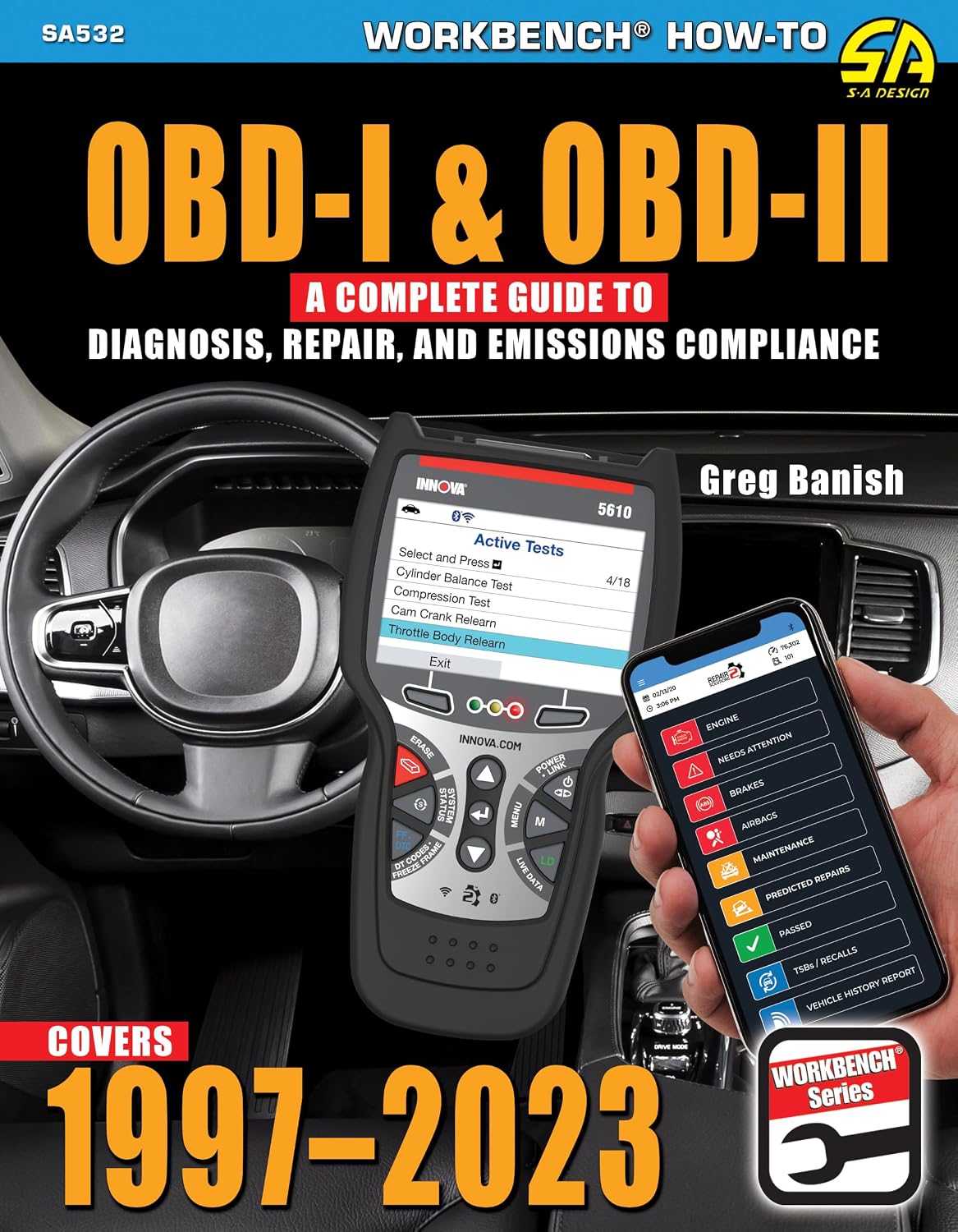
Modern diagnostics systems can be a blessing or a curse, depending on your level of understanding. This book helps you harness the power of the diagnostics inside the ECU to improve the ability to find and make the right repair the first time. This book shows that by using commonly available electronic tools, the consumer has the power to access a wealth of information about his or her vehicle. It also helps those who are looking to improve performance do so without compromise to the environment or enforcement agencies. Whether you want to repair the vehicle yourself or simply want to possess an understanding of how these systems work while dealing with service professionals, this is the guide you need.
Review
About the Author
Details:
Visit the SA Design Store
OBD-I and OBD-II: A Complete Guide to Diagnosis, Repair, and Emissions Compliance
QAR31611
Quantity:
Order today to get by 7-14 business days
This item qualifies for free delivery
 Imported From: United States
At BOLO, we work hard to ensure the products you receive are new, genuine, and sourced from reputable suppliers.
Every product in the BOLO catalogue is sourced through our Verified Global Supply Network of verified sellers, authorized distributors or directly from the manufacturer.
Each product undergoes thorough inspection and verification at our consolidation and fulfilment centers to ensure it meets our strict authenticity and quality standards before being shipped and delivered to you.
If you ever have concerns regarding the authenticity of a product purchased from us, please contact Bolo Support. We will review your inquiry promptly and, if necessary, provide documentation verifying authenticity or offer a suitable resolution.
Your trust is our top priority, and we are committed to maintaining transparency and integrity in every transaction.
While we strive to display accurate information, variations in packaging, labeling, instructions, or formulation may occasionally occur due to regional differences or supplier updates. For detailed or manufacturer-specific information, please contact the brand directly or reach out to BOLO Support for assistance.
Unless otherwise stated, all prices displayed on the product page include applicable taxes and import duties.
BOLO operates in accordance with the laws and regulations of Qatar. Any items found to be restricted or prohibited for sale within the Qatar will be cancelled prior to shipment. We take proactive measures to ensure that only products permitted for sale in Qatar are listed on our website.
All items are shipped by air, and any products classified as “Dangerous Goods (DG)” under IATA regulations will be removed from the order and cancelled.
All orders are processed manually, and we make every effort to process them promptly once confirmed. Products cancelled due to the above reasons will be permanently removed from listings across the website.

Backgrounds & Origins
The malfunction indicator lamp (MIL), also commonly referred to as the check engine light, is tested at every startup to make sure it is working. After that, it is used to alert the driver to a condition that needs to be addressed to keep the engine running properly.

Uses of OBD
Some auto-parts stores allow you to connect a scan tool to your vehicle for free while you’re there in hopes that you will also purchase the parts necessary to repair the vehicle on the same visit. Of course, they also sell several versions of these tools.

CAN & Other Networks
The introduction of SAE J1962 brought a common connection point to all vehicles along with common power and ground locations within that connector. Early data pins varied, but eventually became standardized with the introduction of CAN.

I’ve been preaching it for years: proper calibration requires a fair amount of steady-state measurement on a load-bearing dyno to build the base maps. Thus, a Mustang dynamometer with an eddy current absorber lets the user hold the engine at a constant RPM while the driver controls engine load with the accelerator pedal to get the necessary measurements.

Basic Engine Controls
Manufacturers have gone from single knock sensors to the most sensitive applications having one almost touching each individual cylinder to better capture the noise at the source. Raw knock-sensor signals are filtered for timing relative to those cylinders’ combustion events and the frequency of the expected noise.

Fault Code Fundamentals
If a wheel-speed sensor is unplugged or failing, it should show up as a C code on the scan tool. This may have a direct impact on powertrain behavior because so many engine and transmission controls are tied to vehicle speed inputs.

Generic SAE Fault Codes
Looking at this data shows both banks of this engine maxed out with 2-percent positive fuel trims and still more positive adjustment happening in the short-term trims. This is normal for a case where the P0171/P0174 faults have been set for “Bank 1/Bank 2 Lean” as the ECU tries to correct the error.

More from this brand
Similar items from “Fuel Systems”
Share with
Or share with link
https://www.bolo.qa/products/U161325752K
Visit the SA Design Store
OBD-I and OBD-II: A Complete Guide to Diagnosis, Repair, and Emissions Compliance
QAR31611
Quantity:
Order today to get by 7-14 business days
This item qualifies for free delivery
Imported From: United States
At BOLO, we work hard to ensure the products you receive are new, genuine, and sourced from reputable suppliers.
Every product in the BOLO catalogue is sourced through our Verified Global Supply Network of verified sellers, authorized distributors or directly from the manufacturer.
Each product undergoes thorough inspection and verification at our consolidation and fulfilment centers to ensure it meets our strict authenticity and quality standards before being shipped and delivered to you.
If you ever have concerns regarding the authenticity of a product purchased from us, please contact Bolo Support. We will review your inquiry promptly and, if necessary, provide documentation verifying authenticity or offer a suitable resolution.
Your trust is our top priority, and we are committed to maintaining transparency and integrity in every transaction.
While we strive to display accurate information, variations in packaging, labeling, instructions, or formulation may occasionally occur due to regional differences or supplier updates. For detailed or manufacturer-specific information, please contact the brand directly or reach out to BOLO Support for assistance.
Unless otherwise stated, all prices displayed on the product page include applicable taxes and import duties.
BOLO operates in accordance with the laws and regulations of Qatar. Any items found to be restricted or prohibited for sale within the Qatar will be cancelled prior to shipment. We take proactive measures to ensure that only products permitted for sale in Qatar are listed on our website.
All items are shipped by air, and any products classified as “Dangerous Goods (DG)” under IATA regulations will be removed from the order and cancelled.
All orders are processed manually, and we make every effort to process them promptly once confirmed. Products cancelled due to the above reasons will be permanently removed from listings across the website.
Description:
Modern diagnostics systems can be a blessing or a curse, depending on your level of understanding. This book helps you harness the power of the diagnostics inside the ECU to improve the ability to find and make the right repair the first time. This book shows that by using commonly available electronic tools, the consumer has the power to access a wealth of information about his or her vehicle. It also helps those who are looking to improve performance do so without compromise to the environment or enforcement agencies. Whether you want to repair the vehicle yourself or simply want to possess an understanding of how these systems work while dealing with service professionals, this is the guide you need.
Review
About the Author
Details:
Backgrounds & Origins
The malfunction indicator lamp (MIL), also commonly referred to as the check engine light, is tested at every startup to make sure it is working. After that, it is used to alert the driver to a condition that needs to be addressed to keep the engine running properly.
Uses of OBD
Some auto-parts stores allow you to connect a scan tool to your vehicle for free while you’re there in hopes that you will also purchase the parts necessary to repair the vehicle on the same visit. Of course, they also sell several versions of these tools.
CAN & Other Networks
The introduction of SAE J1962 brought a common connection point to all vehicles along with common power and ground locations within that connector. Early data pins varied, but eventually became standardized with the introduction of CAN.
I’ve been preaching it for years: proper calibration requires a fair amount of steady-state measurement on a load-bearing dyno to build the base maps. Thus, a Mustang dynamometer with an eddy current absorber lets the user hold the engine at a constant RPM while the driver controls engine load with the accelerator pedal to get the necessary measurements.
Basic Engine Controls
Manufacturers have gone from single knock sensors to the most sensitive applications having one almost touching each individual cylinder to better capture the noise at the source. Raw knock-sensor signals are filtered for timing relative to those cylinders’ combustion events and the frequency of the expected noise.
Fault Code Fundamentals
If a wheel-speed sensor is unplugged or failing, it should show up as a C code on the scan tool. This may have a direct impact on powertrain behavior because so many engine and transmission controls are tied to vehicle speed inputs.
Generic SAE Fault Codes
Looking at this data shows both banks of this engine maxed out with 2-percent positive fuel trims and still more positive adjustment happening in the short-term trims. This is normal for a case where the P0171/P0174 faults have been set for “Bank 1/Bank 2 Lean” as the ECU tries to correct the error.
More from this brand
Similar items from “Fuel Systems”
Share with
Or share with link
https://www.bolo.qa/products/U161325752K