Deliver toQatar
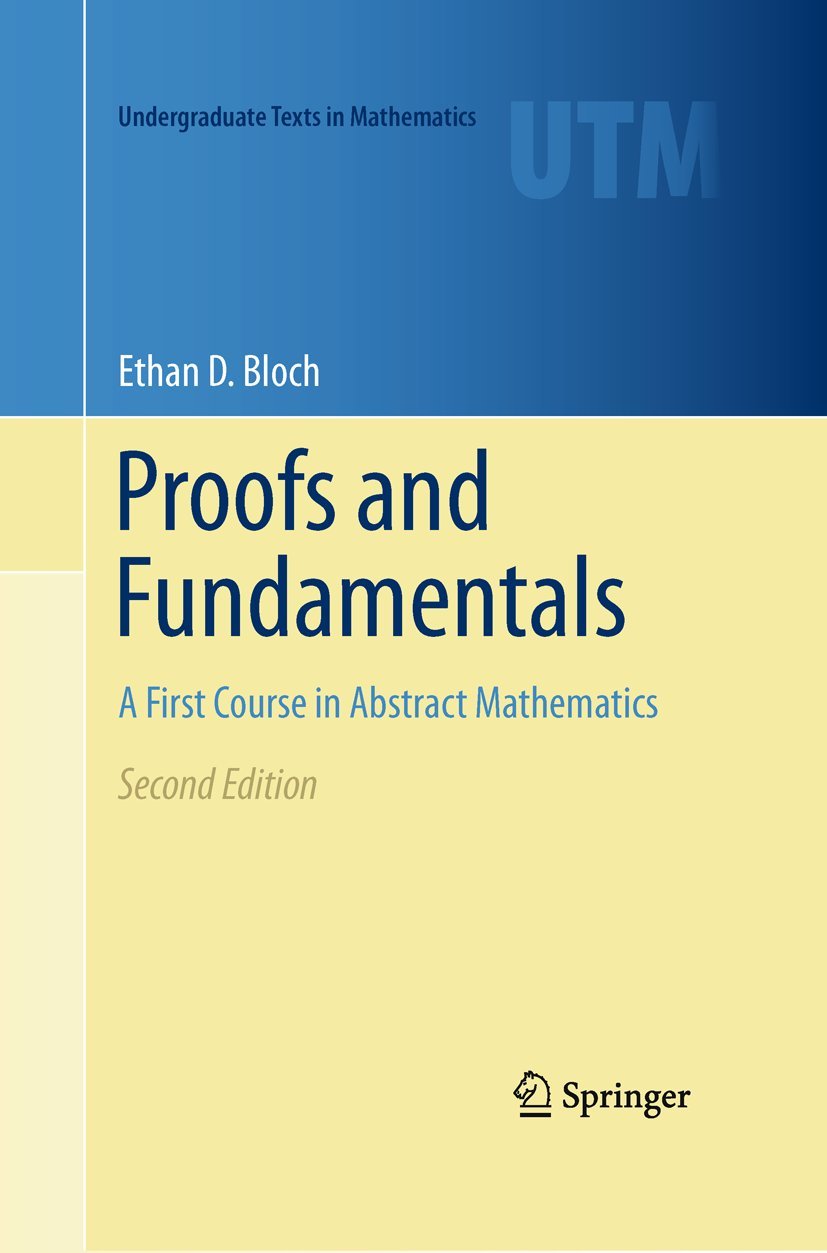
Proofs and Fundamentals (Undergraduate Texts in Mathematics)

Description:

“Proofs and Fundamentals: A First Course in Abstract Mathematics” 2nd edition is designed as a "transition" course to introduce undergraduates to the writing of rigorous mathematical proofs, and to such fundamental mathematical ideas as sets, functions, relations, and cardinality. The text serves as a bridge between computational courses such as calculus, and more theoretical, proofs-oriented courses such as linear algebra, abstract algebra and real analysis. This 3-part work carefully balances Proofs, Fundamentals, and Extras. Part 1 presents logic and basic proof techniques; Part 2 thoroughly covers fundamental material such as sets, functions and relations; and Part 3 introduces a variety of extra topics such as groups, combinatorics and sequences. A gentle, friendly style is used, in which motivation and informal discussion play a key role, and yet high standards in rigor and in writing are never compromised. New to the second edition: 1) A new section about the foundations ofset theory has been added at the end of the chapter about sets. This section includes a very informal discussion of the Zermelo– Fraenkel Axioms for set theory. We do not make use of these axioms subsequently in the text, but it is valuable for any mathematician to be aware that an axiomatic basis for set theory exists. Also included in this new section is a slightly expanded discussion of the Axiom of Choice, and new discussion of Zorn's Lemma, which is used later in the text. 2) The chapter about the cardinality of sets has been rearranged and expanded. There is a new section at the start of the chapter that summarizes various properties of the set of natural numbers; these properties play important roles subsequently in the chapter. The sections on induction and recursion have been slightly expanded, and have been relocated to an earlier place in the chapter (following the new section), both because they are more concrete than the material found in the other sections of the chapter, and because ideas from the sections on induction and recursion are used in the other sections. Next comes the section on the cardinality of sets (which was originally the first section of the chapter); this section gained proofs of the Schroeder–Bernstein theorem and the Trichotomy Law for Sets, and lost most of the material about finite and countable sets, which has now been moved to a new section devoted to those two types of sets. The chapter concludes with the section on the cardinality of the number systems. 3) The chapter on the construction of the natural numbers, integers and rational numbers from the Peano Postulates was removed entirely. That material was originally included to provide the needed background about the number systems, particularly for the discussion of the cardinality of sets, but it was always somewhat out of place given the level and scope of this text. The background material about the natural numbers needed for the cardinality of sets has now been summarized in a new section at the start of that chapter, making the chapter both self-contained and more accessible than it previously was. 4) The section on families of sets has been thoroughly revised, with the focus being on families of sets in general, not necessarily thought of as indexed. 5) A new section about the convergence of sequences has been added to the chapter on selected topics. This new section, which treats a topic from real analysis, adds some diversity to the chapter, which had hitherto contained selected topics of only an algebraic or combinatorial nature. 6) A new section called ``You Are the Professor'' has been added to the end of the last chapter. This new section, which includes a number of attempted proofs taken from actual homework exercises submitted by students, offers the reader the opportunity to solidify her facility for writing proofs by critiquing these submissions as if she were the instructor for the course. 7) All known errors have been corrected. 8) Many minor adjustments of wording have been made throughout the text, with the hope of improving the exposition.


Editorial Reviews

Review

“This is a well-written book, based on very sound pedagogical ideas. It would be an excellent choice as a textbook for a ‘transition’ course.” (Margret Höft, zbMATH 1012.00013, 2021)

“The contents of the book is organized in three parts … . this is a nice book, which also this reviewer has used with profit in his teaching of beginner students. It is written in a highly pedagogical style and based upon valuable didactical ideas.” (R. Steinbauer, Monatshefte für Mathematik, Vol. 174, 2014)

“Books in this category are meant to teach mathematical topics and techniques that will become valuable in more advanced courses. This book meets these criteria. … This book is well suited as a textbook for a transitional course between calculus and more theoretical courses. I also recommend it for academic libraries.” (Edgar R. Chavez, ACM Computing Reviews, February, 2012)

“This is an improved edition of a good book that can serve in the undergraduate curriculum as a bridge between computationally oriented courses like calculus and more abstract courses like algebra.” (Teun Koetsier, Zentralblatt MATH, Vol. 1230, 2012)

From the Back Cover

This textbook is designed to introduce undergraduates to the writing of rigorous mathematical proofs, and to fundamental mathematical ideas such as sets, functions, relations, and cardinality. The book serves as a bridge between computational courses such as calculus and more theoretical courses such as linear algebra, abstract algebra, and real analysis.

This second edition has been significantly enhanced, while maintaining the balance of topics and careful writing of the previous edition. Part 1 presents logic and basic proof techniques; Part 2 thoroughly covers fundamental material such as sets, functions and relations; and Part 3 introduces a variety of extra topics such as groups, combinatorics and sequences, and suggests avenues for independent student explorations.

A gentle, friendly style is used, in which motivation and informal discussion play a key role, and yet high standards in rigor and in writing are never compromised.

Reviews of the first edition:

This is a well-written book, based on very sound pedagogical ideas. It would be an excellent choice as a textbook for a 'transition' course.
―Zentralblatt Math

'Proofs and Fundamentals' has many strengths. One notable strength is its excellent organization... There are large exercise sets throughout the book... the exercises are well integrated with the text and vary appropriately from easy to hard... Perhaps the book’s greatest strength is the author’s zeal and skill for helping students write mathematics better.
―MAA Online

Details:

Proofs and Fundamentals (Undergraduate Texts in Mathematics)

Product ID: U1441971262
Condition: New

QAR33009

Price includes VAT & Import Duties
Type: Hardcover
Availability: In Stock

Quantity:

|

Order today to get by 7-14 business days

This item qualifies for free delivery

Returns & Warranty policies

Imported From: United States

At BOLO, we work hard to ensure the products you receive are new, genuine, and sourced from reputable suppliers.

Every product in the BOLO catalogue is sourced through our Verified Global Supply Network of verified sellers, authorized distributors or directly from the manufacturer.

Each product undergoes thorough inspection and verification at our consolidation and fulfilment centers to ensure it meets our strict authenticity and quality standards before being shipped and delivered to you.

If you ever have concerns regarding the authenticity of a product purchased from us, please contact Bolo Support. We will review your inquiry promptly and, if necessary, provide documentation verifying authenticity or offer a suitable resolution.

Your trust is our top priority, and we are committed to maintaining transparency and integrity in every transaction.

While we strive to display accurate information, variations in packaging, labeling, instructions, or formulation may occasionally occur due to regional differences or supplier updates. For detailed or manufacturer-specific information, please contact the brand directly or reach out to BOLO Support for assistance.

Unless otherwise stated, all prices displayed on the product page include applicable taxes and import duties.

BOLO operates in accordance with the laws and regulations of Qatar. Any items found to be restricted or prohibited for sale within the Qatar will be cancelled prior to shipment. We take proactive measures to ensure that only products permitted for sale in Qatar are listed on our website.

All items are shipped by air, and any products classified as “Dangerous Goods (DG)” under IATA regulations will be removed from the order and cancelled.

All orders are processed manually, and we make every effort to process them promptly once confirmed. Products cancelled due to the above reasons will be permanently removed from listings across the website.

Proofs and Fundamentals (Undergraduate Texts in Mathematics)

Product ID: U1441971262
Condition: New
Proofs and Fundamentals (Undergraduate Texts in Mathematics)-0
Type: Hardcover

QAR33009

Price includes VAT & Import Duties
Availability: In Stock

Quantity:

|

Order today to get by 7-14 business days

This item qualifies for free delivery

Returns & Warranty policies

Imported From: United States

At BOLO, we work hard to ensure the products you receive are new, genuine, and sourced from reputable suppliers.

Every product in the BOLO catalogue is sourced through our Verified Global Supply Network of verified sellers, authorized distributors or directly from the manufacturer.

Each product undergoes thorough inspection and verification at our consolidation and fulfilment centers to ensure it meets our strict authenticity and quality standards before being shipped and delivered to you.

If you ever have concerns regarding the authenticity of a product purchased from us, please contact Bolo Support. We will review your inquiry promptly and, if necessary, provide documentation verifying authenticity or offer a suitable resolution.

Your trust is our top priority, and we are committed to maintaining transparency and integrity in every transaction.

While we strive to display accurate information, variations in packaging, labeling, instructions, or formulation may occasionally occur due to regional differences or supplier updates. For detailed or manufacturer-specific information, please contact the brand directly or reach out to BOLO Support for assistance.

Unless otherwise stated, all prices displayed on the product page include applicable taxes and import duties.

BOLO operates in accordance with the laws and regulations of Qatar. Any items found to be restricted or prohibited for sale within the Qatar will be cancelled prior to shipment. We take proactive measures to ensure that only products permitted for sale in Qatar are listed on our website.

All items are shipped by air, and any products classified as “Dangerous Goods (DG)” under IATA regulations will be removed from the order and cancelled.

All orders are processed manually, and we make every effort to process them promptly once confirmed. Products cancelled due to the above reasons will be permanently removed from listings across the website.

Description:

“Proofs and Fundamentals: A First Course in Abstract Mathematics” 2nd edition is designed as a "transition" course to introduce undergraduates to the writing of rigorous mathematical proofs, and to such fundamental mathematical ideas as sets, functions, relations, and cardinality. The text serves as a bridge between computational courses such as calculus, and more theoretical, proofs-oriented courses such as linear algebra, abstract algebra and real analysis. This 3-part work carefully balances Proofs, Fundamentals, and Extras. Part 1 presents logic and basic proof techniques; Part 2 thoroughly covers fundamental material such as sets, functions and relations; and Part 3 introduces a variety of extra topics such as groups, combinatorics and sequences. A gentle, friendly style is used, in which motivation and informal discussion play a key role, and yet high standards in rigor and in writing are never compromised. New to the second edition: 1) A new section about the foundations ofset theory has been added at the end of the chapter about sets. This section includes a very informal discussion of the Zermelo– Fraenkel Axioms for set theory. We do not make use of these axioms subsequently in the text, but it is valuable for any mathematician to be aware that an axiomatic basis for set theory exists. Also included in this new section is a slightly expanded discussion of the Axiom of Choice, and new discussion of Zorn's Lemma, which is used later in the text. 2) The chapter about the cardinality of sets has been rearranged and expanded. There is a new section at the start of the chapter that summarizes various properties of the set of natural numbers; these properties play important roles subsequently in the chapter. The sections on induction and recursion have been slightly expanded, and have been relocated to an earlier place in the chapter (following the new section), both because they are more concrete than the material found in the other sections of the chapter, and because ideas from the sections on induction and recursion are used in the other sections. Next comes the section on the cardinality of sets (which was originally the first section of the chapter); this section gained proofs of the Schroeder–Bernstein theorem and the Trichotomy Law for Sets, and lost most of the material about finite and countable sets, which has now been moved to a new section devoted to those two types of sets. The chapter concludes with the section on the cardinality of the number systems. 3) The chapter on the construction of the natural numbers, integers and rational numbers from the Peano Postulates was removed entirely. That material was originally included to provide the needed background about the number systems, particularly for the discussion of the cardinality of sets, but it was always somewhat out of place given the level and scope of this text. The background material about the natural numbers needed for the cardinality of sets has now been summarized in a new section at the start of that chapter, making the chapter both self-contained and more accessible than it previously was. 4) The section on families of sets has been thoroughly revised, with the focus being on families of sets in general, not necessarily thought of as indexed. 5) A new section about the convergence of sequences has been added to the chapter on selected topics. This new section, which treats a topic from real analysis, adds some diversity to the chapter, which had hitherto contained selected topics of only an algebraic or combinatorial nature. 6) A new section called ``You Are the Professor'' has been added to the end of the last chapter. This new section, which includes a number of attempted proofs taken from actual homework exercises submitted by students, offers the reader the opportunity to solidify her facility for writing proofs by critiquing these submissions as if she were the instructor for the course. 7) All known errors have been corrected. 8) Many minor adjustments of wording have been made throughout the text, with the hope of improving the exposition.


Editorial Reviews

Review

“This is a well-written book, based on very sound pedagogical ideas. It would be an excellent choice as a textbook for a ‘transition’ course.” (Margret Höft, zbMATH 1012.00013, 2021)

“The contents of the book is organized in three parts … . this is a nice book, which also this reviewer has used with profit in his teaching of beginner students. It is written in a highly pedagogical style and based upon valuable didactical ideas.” (R. Steinbauer, Monatshefte für Mathematik, Vol. 174, 2014)

“Books in this category are meant to teach mathematical topics and techniques that will become valuable in more advanced courses. This book meets these criteria. … This book is well suited as a textbook for a transitional course between calculus and more theoretical courses. I also recommend it for academic libraries.” (Edgar R. Chavez, ACM Computing Reviews, February, 2012)

“This is an improved edition of a good book that can serve in the undergraduate curriculum as a bridge between computationally oriented courses like calculus and more abstract courses like algebra.” (Teun Koetsier, Zentralblatt MATH, Vol. 1230, 2012)

From the Back Cover

This textbook is designed to introduce undergraduates to the writing of rigorous mathematical proofs, and to fundamental mathematical ideas such as sets, functions, relations, and cardinality. The book serves as a bridge between computational courses such as calculus and more theoretical courses such as linear algebra, abstract algebra, and real analysis.

This second edition has been significantly enhanced, while maintaining the balance of topics and careful writing of the previous edition. Part 1 presents logic and basic proof techniques; Part 2 thoroughly covers fundamental material such as sets, functions and relations; and Part 3 introduces a variety of extra topics such as groups, combinatorics and sequences, and suggests avenues for independent student explorations.

A gentle, friendly style is used, in which motivation and informal discussion play a key role, and yet high standards in rigor and in writing are never compromised.

Reviews of the first edition:

This is a well-written book, based on very sound pedagogical ideas. It would be an excellent choice as a textbook for a 'transition' course.
―Zentralblatt Math

'Proofs and Fundamentals' has many strengths. One notable strength is its excellent organization... There are large exercise sets throughout the book... the exercises are well integrated with the text and vary appropriately from easy to hard... Perhaps the book’s greatest strength is the author’s zeal and skill for helping students write mathematics better.
―MAA Online

Details: