Deliver toQatar
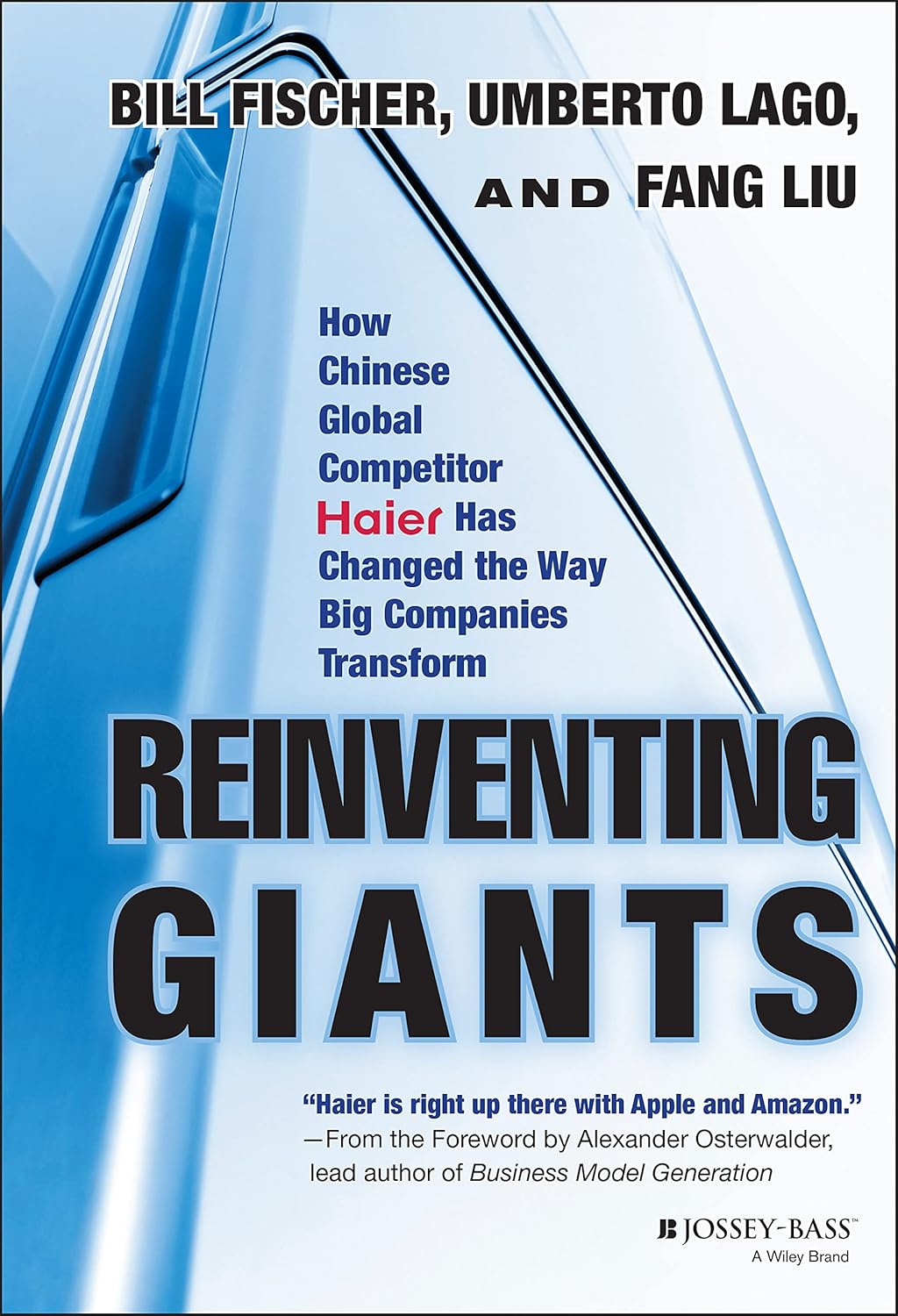
Reinventing Giants: How Chinese Global Competitor Haier Has Changed the Way Big Companies Transform

Description:

A compelling profile of an emerging Chinese competitor

Chinese firms are reinventing their business models, their corporate cultures, and themselves, becoming global competitors who increasingly offer knowledge rather than cheap labour in their quest to join the ranks of the "world's best" companies. This book offers a compelling profile of the most ambitious of these emerging Chinese competitors, the Haier Corporation (the world's largest manufacturer of home appliances), and shares insights on how one organization has repeatedly reinvented its business model and corporate culture in an effort to sustain its success.

Reinventing Giants provides an exclusive look within the Haier Corporation and shows how managerial accountability and responsibility have been repositioned at every level of the organization, with the core value of market-centricity, while aligning strategy on each level of management. It includes actual work reports that show this process in detail from the ground up. The authors emphasize how a belief in the liberation of employee talent has consistently been the driving force underlying Haier's success.

  • Includes the remarkable story of Haier's turnaround and how these lessons can be applied to other organizations
  • Contains information for any company grappling with competition in the global marketplace
  • Shows how to liberate employees' talent to drive business success
  • Written by Bill Fischer, Professor of Innovation Management at IMD in Switzerland, Umberto Lago, Professor of Management at Bologna University, Italy, and Fang Liu, Research Associate of IMD

Reinventing Giants helps global managers rethink their own business models and accompanying corporate cultures in order to be able to apply Haier's lessons directly to their own organizations.


Editorial Reviews

Amazon.com Review

Q & A with the Authors of Reinventing Giants

What are the overall themes of Reinventing Giants?

This is the story of a company, Haier, that has successfully reinvented its business model and corporate culture at least three times over the past three decades. We detail how this was done, in sufficient detail as to be instructive to any executive wanting to rethink how his or her organization is meeting the challenges of dynamic competitive market environments.

This is also the story of a long-running belief in the power of talent to emerge as a sustaining differential advantage. Nearly every strategic move that Haier has made over the past three decades has been to unleash the potential of human talent.

The fact that these two themes are playing out in an organization that is competing in an "old economy" commodity market, and which comes out of an emerging market as well, makes the story that much more remarkable.

What is so special about Haier?

We think that there are four key characteristics of the Haier story that make it valuable to managers around the world:

  1. They have always launched efforts to reinvent their business model and corporate culture before they find themselves in competitive trouble, rather than after. This requires both strategic acumen and great self-confidence to move in a daring fashion at the very moment when the firm is seemingly most successful.
  2. They have never made a move, no matter how revolutionary, without relying on what they already know. Haier's story is "revolution by accretion," rather than revolution without reference to the past. As a result, despite the boldness of their moves, they have taken place within a supporting environment that raises, rather than reduces, the probability of success.
  3. Haier's story of ambitious, sustainable success, in very difficult competitive situations, has been made possible by the power of strong, top-down, self-confident, and visionary leadership.
  4. As visionary as Haier's leadership has been, it has also been the interweaving of many granular managerial choices, each reinforcing the others, that has built the successive organizational cultures that have supported its revolutionary change. Haier's story is repeatedly one of both dreams and details: dreaming bigger than its competitors about what the future might look like, and then being more detailed and disciplined than others in executing those dreams.

In addition, Haier is a BRIC-based company which is almost unique at a time when the "history of globalization" has been largely written by Western corporations.

What are the most important lessons that companies can learn from Haier's evolution?
  1. Successful companies move with the times, or actually just ahead of the times. No single business model could allow companies to succeed forever, but companies that do not anticipate and then adapt to external change are set up to fail. The world is always in flux, and sustainability means being able to adjust to that flux.
  2. An essential question that any successful market leader needs to address if it is to be sustainable is how to be big and fast at the same time. Haier has repeatedly chosen to confront this challenge head-on. The traditional experience is for companies to get slower as they grow bigger. The layers and reporting systems that accumulate over time in traditional organizational hierarchies do not facilitate fast decision-making and fast execution. Haier has attempted to turn the organizational hierarchy on its head in an effort to overcome such "big corporation sickness," with the ultimate goal of unleashing the full potential of each employee.
  3. The stereotypes of Chinese organizations that most people in the West hold--slowness, bureaucracy, nepotism, office politics, and guanxi--are almost nonexistent at Haier. In this highly performance-driven company, equality and transparency are essential to avoiding dysfunctional employee behavior. Haier is attempting to create new norms of working in a company of 80,000 employees.
How would you characterize the key elements of Haier's success?
  • Innovation: Haier has consistently led the appliance industry in product, business model, and corporate culture innovation.
  • Speed: Haier has consistently moved faster than any competitor, foreign or domestic, in its industry.
  • Customer-centricity: A major part of its claim to being an innovation leader and a fast mover has been its ability to connect with its customers, listen to them, and respond appropriately.
  • Talent: Throughout its history, Haier has been a magnet for Chinese talent and has worked to liberate that talent so that it can contribute more to the achievement of the company's goals.
  • Leadership: Without the exceptional leadership that Haier has had, none of this would have been conceivably possible.
Do you see large Western companies that are experimenting with similar approaches?

Yes. Neither reinventing corporate cultures to support bold business model change, nor liberating talent as a key differentiating advantage, are new, even in old-economy, commodity-type markets. We provide several such examples of Western firms including the Swiss-Swedish giant ABB in power technologies, the American tomato-packing firm Morning Star, the Danish hearing aid producer Oticon, and a disguised European fast-moving consumer goods company, all of which have tried similar approaches, but which were all either less comprehensive in their scope or more modest in their duration. At the moment, we are watching Nestlé's Continuous Excellence program as another example of using know-how to out-compete in markets where success has traditionally been based on lower costs. The difference with Haier is both the scale of its ambition (80,000 employees) and the duration (30-plus years) of its efforts.

How did you get such extensive access to Haier?

Haier was remarkably open and did not interfere in our investigation of their story. We believe that they are justly proud of what they have accomplished, and their story provides instructive lessons for managers in many different industries around the world. Haier's willingness to allow Fang Liu to spend a week inside of the company was the invitation that clinched the deal for us regarding whether or not such a book was possible.

From the Inside Flap

Forward-thinking Chinese companies are reinventing their business models, their corporate cultures, and themselves to become global competitors who offer knowledge rather than cheap labor in their quest to join the ranks of the "world's best" companies.

Reinventing Giants offers a behind-the-scenes profile of one of the most ambitious of these emerging Chinese competitors, the Haier Group--the world's largest manufacturer of home appliances. The book reveals how Haier has repeatedly reinvented its business model and corporate culture in an effort to sustain its success. Haier's success is not about impulsiveness, nor naive philosophical longings, but about ambitious aspirations, strong inspirational leadership, careful strategic observation, detailed adjustments of managerial choices, and abundant trust in the power of employees to really take command of an organization's fate. The authors demonstrate how a giant company of 80,000 employees transformed itself by embracing the contradictions of being simultaneously structured yet entrepreneurial, disciplined yet flexible, tactical yet strategic.

Reinventing Giants offers the critical information, lessons learned, and a substantive model for transforming any company grappling with competition in the global marketplace. The book shows how Haier's managerial accountability and responsibility have been -repositioned at every level in the organization, while maintaining the core value of market-centricity. The authors include actual work reports in order to describe this process in detail from the ground up and emphasize how a belief in the liberation of employee talent has consistently been the driving force underlying Haier's success.

Using Reinventing Giants as a guide, any organization can learn what it takes to open, sustain, and revitalize new markets on a global stage.

Details:

Reinventing Giants: How Chinese Global Competitor Haier Has Changed the Way Big Companies Transform

Product ID: U1118602234
|

Returns & Warranty policies

Imported From: United States

At BOLO, we work hard to ensure the products you receive are new, genuine, and sourced from reputable suppliers.

Every product in the BOLO catalogue is sourced through our Verified Global Supply Network of verified sellers, authorized distributors or directly from the manufacturer.

Each product undergoes thorough inspection and verification at our consolidation and fulfilment centers to ensure it meets our strict authenticity and quality standards before being shipped and delivered to you.

If you ever have concerns regarding the authenticity of a product purchased from us, please contact Bolo Support. We will review your inquiry promptly and, if necessary, provide documentation verifying authenticity or offer a suitable resolution.

Your trust is our top priority, and we are committed to maintaining transparency and integrity in every transaction.

While we strive to display accurate information, variations in packaging, labeling, instructions, or formulation may occasionally occur due to regional differences or supplier updates. For detailed or manufacturer-specific information, please contact the brand directly or reach out to BOLO Support for assistance.

Unless otherwise stated, all prices displayed on the product page include applicable taxes and import duties.

BOLO operates in accordance with the laws and regulations of Qatar. Any items found to be restricted or prohibited for sale within the Qatar will be cancelled prior to shipment. We take proactive measures to ensure that only products permitted for sale in Qatar are listed on our website.

All items are shipped by air, and any products classified as “Dangerous Goods (DG)” under IATA regulations will be removed from the order and cancelled.

All orders are processed manually, and we make every effort to process them promptly once confirmed. Products cancelled due to the above reasons will be permanently removed from listings across the website.

Reinventing Giants: How Chinese Global Competitor Haier Has Changed the Way Big Companies Transform

Product ID: U1118602234
Reinventing Giants: How Chinese Global Competitor Haier Has Changed the Way Big Companies Transform-0
|

Returns & Warranty policies

Imported From: United States

At BOLO, we work hard to ensure the products you receive are new, genuine, and sourced from reputable suppliers.

Every product in the BOLO catalogue is sourced through our Verified Global Supply Network of verified sellers, authorized distributors or directly from the manufacturer.

Each product undergoes thorough inspection and verification at our consolidation and fulfilment centers to ensure it meets our strict authenticity and quality standards before being shipped and delivered to you.

If you ever have concerns regarding the authenticity of a product purchased from us, please contact Bolo Support. We will review your inquiry promptly and, if necessary, provide documentation verifying authenticity or offer a suitable resolution.

Your trust is our top priority, and we are committed to maintaining transparency and integrity in every transaction.

While we strive to display accurate information, variations in packaging, labeling, instructions, or formulation may occasionally occur due to regional differences or supplier updates. For detailed or manufacturer-specific information, please contact the brand directly or reach out to BOLO Support for assistance.

Unless otherwise stated, all prices displayed on the product page include applicable taxes and import duties.

BOLO operates in accordance with the laws and regulations of Qatar. Any items found to be restricted or prohibited for sale within the Qatar will be cancelled prior to shipment. We take proactive measures to ensure that only products permitted for sale in Qatar are listed on our website.

All items are shipped by air, and any products classified as “Dangerous Goods (DG)” under IATA regulations will be removed from the order and cancelled.

All orders are processed manually, and we make every effort to process them promptly once confirmed. Products cancelled due to the above reasons will be permanently removed from listings across the website.

Description:

A compelling profile of an emerging Chinese competitor

Chinese firms are reinventing their business models, their corporate cultures, and themselves, becoming global competitors who increasingly offer knowledge rather than cheap labour in their quest to join the ranks of the "world's best" companies. This book offers a compelling profile of the most ambitious of these emerging Chinese competitors, the Haier Corporation (the world's largest manufacturer of home appliances), and shares insights on how one organization has repeatedly reinvented its business model and corporate culture in an effort to sustain its success.

Reinventing Giants provides an exclusive look within the Haier Corporation and shows how managerial accountability and responsibility have been repositioned at every level of the organization, with the core value of market-centricity, while aligning strategy on each level of management. It includes actual work reports that show this process in detail from the ground up. The authors emphasize how a belief in the liberation of employee talent has consistently been the driving force underlying Haier's success.

  • Includes the remarkable story of Haier's turnaround and how these lessons can be applied to other organizations
  • Contains information for any company grappling with competition in the global marketplace
  • Shows how to liberate employees' talent to drive business success
  • Written by Bill Fischer, Professor of Innovation Management at IMD in Switzerland, Umberto Lago, Professor of Management at Bologna University, Italy, and Fang Liu, Research Associate of IMD

Reinventing Giants helps global managers rethink their own business models and accompanying corporate cultures in order to be able to apply Haier's lessons directly to their own organizations.


Editorial Reviews

Amazon.com Review

Q & A with the Authors of Reinventing Giants

What are the overall themes of Reinventing Giants?

This is the story of a company, Haier, that has successfully reinvented its business model and corporate culture at least three times over the past three decades. We detail how this was done, in sufficient detail as to be instructive to any executive wanting to rethink how his or her organization is meeting the challenges of dynamic competitive market environments.

This is also the story of a long-running belief in the power of talent to emerge as a sustaining differential advantage. Nearly every strategic move that Haier has made over the past three decades has been to unleash the potential of human talent.

The fact that these two themes are playing out in an organization that is competing in an "old economy" commodity market, and which comes out of an emerging market as well, makes the story that much more remarkable.

What is so special about Haier?

We think that there are four key characteristics of the Haier story that make it valuable to managers around the world:

  1. They have always launched efforts to reinvent their business model and corporate culture before they find themselves in competitive trouble, rather than after. This requires both strategic acumen and great self-confidence to move in a daring fashion at the very moment when the firm is seemingly most successful.
  2. They have never made a move, no matter how revolutionary, without relying on what they already know. Haier's story is "revolution by accretion," rather than revolution without reference to the past. As a result, despite the boldness of their moves, they have taken place within a supporting environment that raises, rather than reduces, the probability of success.
  3. Haier's story of ambitious, sustainable success, in very difficult competitive situations, has been made possible by the power of strong, top-down, self-confident, and visionary leadership.
  4. As visionary as Haier's leadership has been, it has also been the interweaving of many granular managerial choices, each reinforcing the others, that has built the successive organizational cultures that have supported its revolutionary change. Haier's story is repeatedly one of both dreams and details: dreaming bigger than its competitors about what the future might look like, and then being more detailed and disciplined than others in executing those dreams.

In addition, Haier is a BRIC-based company which is almost unique at a time when the "history of globalization" has been largely written by Western corporations.

What are the most important lessons that companies can learn from Haier's evolution?
  1. Successful companies move with the times, or actually just ahead of the times. No single business model could allow companies to succeed forever, but companies that do not anticipate and then adapt to external change are set up to fail. The world is always in flux, and sustainability means being able to adjust to that flux.
  2. An essential question that any successful market leader needs to address if it is to be sustainable is how to be big and fast at the same time. Haier has repeatedly chosen to confront this challenge head-on. The traditional experience is for companies to get slower as they grow bigger. The layers and reporting systems that accumulate over time in traditional organizational hierarchies do not facilitate fast decision-making and fast execution. Haier has attempted to turn the organizational hierarchy on its head in an effort to overcome such "big corporation sickness," with the ultimate goal of unleashing the full potential of each employee.
  3. The stereotypes of Chinese organizations that most people in the West hold--slowness, bureaucracy, nepotism, office politics, and guanxi--are almost nonexistent at Haier. In this highly performance-driven company, equality and transparency are essential to avoiding dysfunctional employee behavior. Haier is attempting to create new norms of working in a company of 80,000 employees.
How would you characterize the key elements of Haier's success?
  • Innovation: Haier has consistently led the appliance industry in product, business model, and corporate culture innovation.
  • Speed: Haier has consistently moved faster than any competitor, foreign or domestic, in its industry.
  • Customer-centricity: A major part of its claim to being an innovation leader and a fast mover has been its ability to connect with its customers, listen to them, and respond appropriately.
  • Talent: Throughout its history, Haier has been a magnet for Chinese talent and has worked to liberate that talent so that it can contribute more to the achievement of the company's goals.
  • Leadership: Without the exceptional leadership that Haier has had, none of this would have been conceivably possible.
Do you see large Western companies that are experimenting with similar approaches?

Yes. Neither reinventing corporate cultures to support bold business model change, nor liberating talent as a key differentiating advantage, are new, even in old-economy, commodity-type markets. We provide several such examples of Western firms including the Swiss-Swedish giant ABB in power technologies, the American tomato-packing firm Morning Star, the Danish hearing aid producer Oticon, and a disguised European fast-moving consumer goods company, all of which have tried similar approaches, but which were all either less comprehensive in their scope or more modest in their duration. At the moment, we are watching Nestlé's Continuous Excellence program as another example of using know-how to out-compete in markets where success has traditionally been based on lower costs. The difference with Haier is both the scale of its ambition (80,000 employees) and the duration (30-plus years) of its efforts.

How did you get such extensive access to Haier?

Haier was remarkably open and did not interfere in our investigation of their story. We believe that they are justly proud of what they have accomplished, and their story provides instructive lessons for managers in many different industries around the world. Haier's willingness to allow Fang Liu to spend a week inside of the company was the invitation that clinched the deal for us regarding whether or not such a book was possible.

From the Inside Flap

Forward-thinking Chinese companies are reinventing their business models, their corporate cultures, and themselves to become global competitors who offer knowledge rather than cheap labor in their quest to join the ranks of the "world's best" companies.

Reinventing Giants offers a behind-the-scenes profile of one of the most ambitious of these emerging Chinese competitors, the Haier Group--the world's largest manufacturer of home appliances. The book reveals how Haier has repeatedly reinvented its business model and corporate culture in an effort to sustain its success. Haier's success is not about impulsiveness, nor naive philosophical longings, but about ambitious aspirations, strong inspirational leadership, careful strategic observation, detailed adjustments of managerial choices, and abundant trust in the power of employees to really take command of an organization's fate. The authors demonstrate how a giant company of 80,000 employees transformed itself by embracing the contradictions of being simultaneously structured yet entrepreneurial, disciplined yet flexible, tactical yet strategic.

Reinventing Giants offers the critical information, lessons learned, and a substantive model for transforming any company grappling with competition in the global marketplace. The book shows how Haier's managerial accountability and responsibility have been -repositioned at every level in the organization, while maintaining the core value of market-centricity. The authors include actual work reports in order to describe this process in detail from the ground up and emphasize how a belief in the liberation of employee talent has consistently been the driving force underlying Haier's success.

Using Reinventing Giants as a guide, any organization can learn what it takes to open, sustain, and revitalize new markets on a global stage.

Details: