Description:
An NPR Best Book of the Year!
A Southwest Book of the Year!
A Texas Observer Book of the Year!
Stories of working-class Mexican America, penned by one of the contemporary legends of Chicanx literature.
"Gilb's familiar signature intimacy brings us face to face with marginal housing, gritty and exhausting jobs, street people, sex, earthquakes, fouled air, physical handicaps, racism. . . . Some of the stories are sidewinders: at first they indicate layers of something juicy and sweet but turn out to pierce the reader with painful splinters of insight."—Annie Proulx, author of "Brokeback Mountain" and The Shipping News
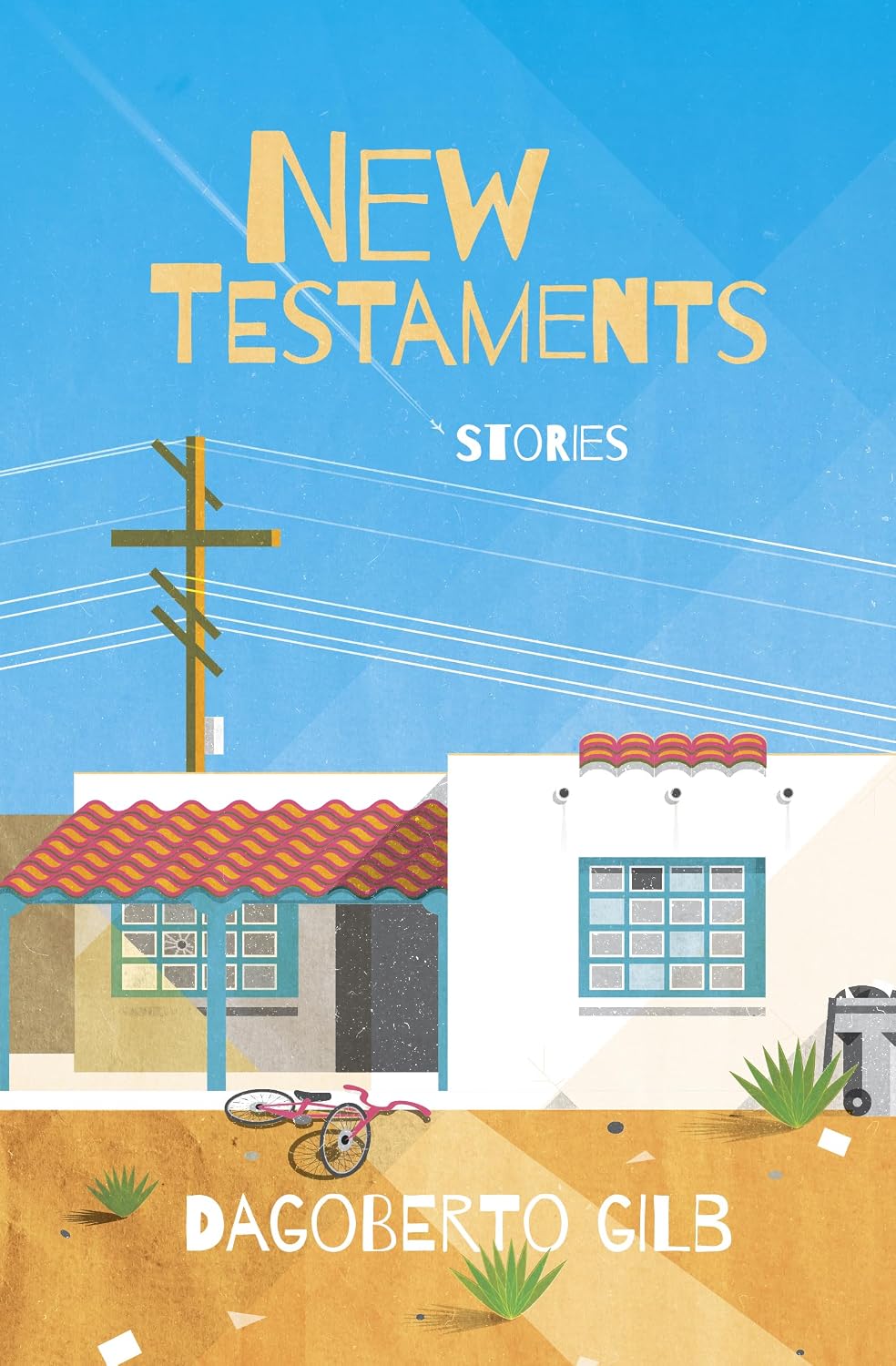
Dagoberto Gilb's latest cast of characters includes a young family whose exposure to a mysterious cloud of gas alters their lives forever; a high school dropout whose choice to learn the ways of the world from the adults at work leads him into a dangerous dalliance; a former high-rise carpenter who meets up with an eager old flame; an aging Chicano, living alone, whose children watch over him for signs of decline; and more. Gilb's distinct narrative voice offers his readers a warm welcome as he peels back the surface of everyday life to seamlessly guide us into realms of of myth and fable.
Review
"What makes these stories particularly powerful is how they frame questions of class, memory, and masculine identity through relationships that should offer connection but instead reveal unbridgeable distances. . . . Gilb's prose style in New Testaments packs a punch that leaves you reeling."—Frederick Aldama, Latinx Pop Magazine
"I can't say enough about the subtle artistry of Gilb's prose that make his stories gripping and haunting. His voice is singular, and I would argue that he's one of the very best U.S. writers from the past fifty years (Yes, his fiction is that good.)"—Oscar Villalon, Editor in Chief, Zyzzyva
"Golden ages are few in Gilb's stories, troubles many: his characters are beaten down by poverty, racism, and all too often by dreams that have gone sour. Yet the characters in Gilb's richly detailed stories endure, surviving atomic clouds and earthquakes, hateful bosses and indifferent teachers, and all the challenges of daily life—but also finding love and connection in little pockets of the world where red foxes run, the food is good, what's lost is found, and, as one character says, despite it all, 'we could make sure we were happy.'"—Gregory McNamee, Southwest Books of the Year
"Texas- and Mexico-based author Dagoberto Gilb doesn't care about ivory towers, but he does know how to build them. He started writing short stories while working a construction job at the University of Texas at El Paso and has been going strong ever since. The stories in his latest collection focus on working-class Mexican Americans and are written with Gilb's signature realism, which manages to be both gritty and beautiful. Looking for accomplished, unpretentious fiction that celebrates real people? This is your man."—Michael Schaub, book critic, NPR's Best Books of the Year
"Gilb's rambunctious voice booms through the pages of these collections with volcanic force and unexpected twists and turns. Nothing he writes is uninteresting. . . . By now, it's clear that the credibility of Gilb's fiction comes from writing out of his own experience, and what distinguishes his work from the autofiction that has recently come into vogue is his artistry."—Frank Bergon, Los Angeles Review of Books
"By the time I finished reading the first story 'Gray Cloud on San Jacinto Plaza,' it was clear to me that New Testaments is a great literary work."—Laura Moreno, Bay Area Reporter
"Gilb's latest collection of stories delves deep into the contemporary Chicanx experience, introducing a wide array of characters, each grappling with their own challenges. A family faces the terrifying aftermath of exposure to a mysterious gas, a man confronts his mortality, and a high school dropout flirts with danger. Blending gritty realism with a mythic sensibility, Gilb provides piercing insight into the working-class Mexican American experience."—Alta Journal
"No one writes like Dagoberto Gilb! I loved these energetic, soulful, and hilarious stories that by the end had me wondering if I'd encountered the sublime on the page."—Kali Fajardo-Anstine, author of Woman of Light
"So alive, so wise, so gritty, sensual, so felt, so many flashes of startling poetry. I kept thinking, I've never encountered a voice quite like this one, it has this reverb that hooks you, that vibrates under the printed words and inside your own blood, what is that? But now I understand: it's pure mastery, truth, beauty, life, it's that power inside this intimate space of a story but that goes on and on and never stops. Dagoberto Gilb is an American great." — Francisco Goldman, author of Monkey Boy: A Novel
"From the first line, Dagoberto Gilb's new story collection captivates readers as if drawn by a perfectly taut silver thread. From one story to the next, each so efficient not a sentence is wasted, readers are swept through youth’s most tantalizing, shining shards of memory until, inescapably, the sandstorms of time render Gilb's characters and their recollections with increasing texture and complexity. By the end, Gilb has fully immersed us in the rich amber depths where pure voice and thought become material, and time, for those precious instants, holds its breath. Dagoberto Gilb again proves to be a masterful mason of literary craft and a foundational storyteller in Chicano and American literature."—Carribean Fragoza, author of Eat the Mouth That Feeds You
"Gilb is a master of stories concerning people who are constantly reinventing themselves, always trying to escape one delicate dilemma or another. Indeed, the title notwithstanding, most of the stories here involve tribulations worthy of Job, if not a few encounters with Delilah, his actors working-class men and women who are running out of options on the hard paths they’ve followed. . . . A well-crafted summoning of people living ordinary lives on la frontera, in all their sorrow and splendor."—Kirkus Reviews
"Decades ago, I read a book on writing from a Buddhist nun. She said something that stuck with me: that writers had to pour their entire selves onto the page. But the crucial work—what made it art, what made it necessary to the spirit—was the writer then burning themselves out—leaving only their essence, leaving only their energy. These stories in New Testaments are the closest I've seen anybody come to doing that in a very, very, very long time. I often had to stop to re-read a sentence and breathe, because the language was so beautiful I had to hold it in my mouth."—ire'ne lara silva, author of the eaters of flowers, 2023 Texas State Poet Laureate
"Identity forms the heart of these stories, not in some chest-thumping 'yo soy Chicano' testament, but with the understatement that defines ordinariness. That's Gilb's specialty—ordinary people faced with everyday exigencies, neither great tragedy nor noble transcendence. Just gente."—Michael Sedano, La Bloga
About the Author
Dagoberto Gilb is the author of eleven books, including The Magic of Blood, The Last Known Residence of Mickey Acuña, Woodcuts of Women, Gritos, The Flowers, and Before the End, After the Beginning. In October 2024, two new books by Gilb will be published: A Passing West: Essays from the Borderland with the University of New Mexico Press, and New Testaments: Stories, with City Lights Publishers. Among his honors are the PEN/Hemingway Award, a Guggenheim Fellowship, a National Endowment for the Arts Fellowship, and a Whiting Writers Award. His work has been a finalist for the National Book Critics’ Circle and PEN/Faulkner Awards and has been honored several times in Texas as a proud part of its literary tradition. His fiction and nonfiction have appeared in The New Yorker, Harper’s, Best American Essays, O'Henry Prize Stories, and much of it widely reprinted in textbooks. He is the founder of Huizache, a groundbreaking literary magazine that features Latino writing. Born and raised in Los Angeles by his Mexican mother, he now lives in both Austin and Mexico City.
Excerpt. © Reprinted by permission. All rights reserved.
From "THE DICK, CASILLAS," a story in New Testaments by Dagoberto Gilb
I like to stop and say hi to Ayisha when I check into the gym. She's usually there, though I'm there more. I come six days a week, either 11 or 1:30. I used to get there at 2 but there's a TV sports show I watch that comes on at 2, lasts an hour. If I want to watch that while I'm on a machine, I get another half hour of exercise without noticing it, almost cheating, if you see what I'm saying. Minimum I want is 60 minutes. I don't know how I or anyone used to do exercise before they had machines with cable TV. I'm not buying a 1000 songs or a 100 CDs. I can't take radio stations anymore, and music there, impossible to find any that aren't old and heard and heard and heard. I feel like a perv listening to the new top-40 station at my age. I go ahead and do that on the low alone in my car. In the gym, TV on the machines wins.
Once in a while Ayisha and I chit-chat. About nothing always. Usually I just take a pause in my step and hey hey, whadaya say?, tap the formica, and I pass on by. She and I have disability in common is why the connection, nothing much else, though that's also enough. I'm an old mother, used to it, but she's too young to not be happy all the time. I get more self-conscious when she's at the desk with Casillas. He's a little dick. So many tats all over his arms and legs and back and even up his chest and neck, his skin color is blue. He thinks he's badass. Accomplished somehow, skilled at whatever. I'm not that old. Can't happen. I don't for one second think he's someone I can't deal with. I don't like that he takes away from my big brotherly feelings for Ayisha. That's what he does though.
I can't do free weights now because I could hurt me or someone else, so I go to the weight machines. I actually prefer them. They're better than they were back in the day, when they began. I have a few I like—quads, calves, abs, deltoids, traps, biceps, triceps, pecs—but I can't always do them all. I'm old. Puts me down for the next day if I'm not careful. I tell people, I've decided not to do the next Olympics, so I go easy. I pick two to four. Unless it's being used, I like to lift. Since I was a baby, that's the one that makes my body feel strong in the ya no weakness that comes with the last lift. I set the pin anywhere from 60lb to 90lb, depending on whether I want to do more per three sets, my usual, or just burst my buttons doing fewer with more.
There are a lot of older folks here at the gym. Could be because of the time of day. Many older even than me by years, even a decade or two. They're all impressive for being here and in their routine. Women and men pretty close to equal numbers. There's this one older guy who, whenever he sees me, stares into my eyes like he knows me, expecting me to…I don't know. Say hi? If he knows me, I'm not sure why he don’t say so. It got so that I started thinking I knew him back. That he began to look familiar to me, too. He was, I saw at a distance as I was approached, on the machine I liked most and went to first. I didn't change my stride—my cane free limp, is better said. It happens, and I'd just move on to another first, and I'd get it tomorrow. But as I got closer, that man stopped. He got up before I could pass by and then stares at me like he does, and I think offered a smile, or close, or it was just kindness. Like to a friend. He didn't say anything but I did. I said hey, real nice, thank you, while he went off.
Not like he couldn't know me. Lots of older men know older sports. I had my days. I was good. Star linebacker, fullback, and I could even play safety until I either got too big or they got way faster by my senior high school year. I played baseball—third base or outfield, I could hit—and roundball, though much as I liked it, I wasn't tall enough or quick enough—I couldn't be a guard—and too hot-headed. High school champion at Dominguez High, which was always terrible back in those days. We just about lost to any team, even the all-whiteboy ones. Except me. I'd win somehow in every story told. And I was a Mexican, so that never happened. I made news everywhere. National. I might've been the first Mexican ever. Or it was that I was taking attention away from all the Compton stars. Which was news. I was recruited across the country. Football and baseball. Local LA schools like UCLA and USC (though not enough there), and Stanford and Cal. Arizona, Washington, Nebraska, Notre Dame, Oklahoma. The teams I liked, that had baseball and football. I wasn't the smartest about colleges. I didn’t know anyone who was. My parents didn't want me to leave town, even our neighborhood, because my dad was having health trouble and couldn’t work, and my mom could barely speak English. It was a tough decision. Really hard. I knew nothing but football, baseball, and eating. I loved my mom's pollo en mole. I loved sirloin con una papa. I loved double cheese burgers. I just took my high school coach's advice, the offer from Oklahoma. My mom, looking up at me because she was such a chaparra, was always about to cry, but my dad had come around. My brother and sister were proud. I'd be back. I'd make money. They thought I'd eventually drive back up in a porcha, which is a Porsche to non-Mexicans.
Make it quick: it wasn't even playing football, which I had just started doing there. Weeks. I was doing good, which is to say they liked me playing both sides of the ball still, and I liked it, and more newspapers were saying that too. National football news. I didn't get a lot of time reading much, but I saw and felt reporters, watching me mostly. I was in the hot gym, on the hot field, sweating, drinking and dousing water, eating a ton of anything that looked like food, and sleeping in what they told me was a dorm room but to me was just a bed. I had barely gone to classes, they were a blur, and I never did buy books. I didn't know what or where but, always hungry, of course I said hell yeah I wanted a giant steak, and the young assistant coach driving turned left in front of a pickup going maybe 50 on a sunny blue Oklahoma street and its front grill came through my door to where I was sitting with no seatbelt on. I didn't die but I was a long time in the first hospital and then came another and then another in a wheelchair and then the wheelchair in no hospital. Like that. Years. It took a while to have no wheelchair. I might not walk too good, but I walk.
Details:
Visit the City Lights Publishers Store
New Testaments: Stories
QAR9153
Quantity:
Order today to get by 7-14 business days
Delivery fee of QAR 20. Free for orders above QAR 200.
 Imported From: United States
At BOLO, we work hard to ensure the products you receive are new, genuine, and sourced from reputable suppliers.
Every product in the BOLO catalogue is sourced through our Verified Global Supply Network of verified sellers, authorized distributors or directly from the manufacturer.
Each product undergoes thorough inspection and verification at our consolidation and fulfilment centers to ensure it meets our strict authenticity and quality standards before being shipped and delivered to you.
If you ever have concerns regarding the authenticity of a product purchased from us, please contact Bolo Support. We will review your inquiry promptly and, if necessary, provide documentation verifying authenticity or offer a suitable resolution.
Your trust is our top priority, and we are committed to maintaining transparency and integrity in every transaction.
While we strive to display accurate information, variations in packaging, labeling, instructions, or formulation may occasionally occur due to regional differences or supplier updates. For detailed or manufacturer-specific information, please contact the brand directly or reach out to BOLO Support for assistance.
Unless otherwise stated, all prices displayed on the product page include applicable taxes and import duties.
BOLO operates in accordance with the laws and regulations of Qatar. Any items found to be restricted or prohibited for sale within the Qatar will be cancelled prior to shipment. We take proactive measures to ensure that only products permitted for sale in Qatar are listed on our website.
All items are shipped by air, and any products classified as “Dangerous Goods (DG)” under IATA regulations will be removed from the order and cancelled.
All orders are processed manually, and we make every effort to process them promptly once confirmed. Products cancelled due to the above reasons will be permanently removed from listings across the website.
Similar suggestions by Bolo
More from this brand
Similar items from “Short Stories”
Share with
Or share with link
https://www.bolo.qa/products/U0872869318
Visit the City Lights Publishers Store
New Testaments: Stories
QAR9153
Quantity:
Order today to get by 7-14 business days
Delivery fee of QAR 20. Free for orders above QAR 200.
Imported From: United States
At BOLO, we work hard to ensure the products you receive are new, genuine, and sourced from reputable suppliers.
Every product in the BOLO catalogue is sourced through our Verified Global Supply Network of verified sellers, authorized distributors or directly from the manufacturer.
Each product undergoes thorough inspection and verification at our consolidation and fulfilment centers to ensure it meets our strict authenticity and quality standards before being shipped and delivered to you.
If you ever have concerns regarding the authenticity of a product purchased from us, please contact Bolo Support. We will review your inquiry promptly and, if necessary, provide documentation verifying authenticity or offer a suitable resolution.
Your trust is our top priority, and we are committed to maintaining transparency and integrity in every transaction.
While we strive to display accurate information, variations in packaging, labeling, instructions, or formulation may occasionally occur due to regional differences or supplier updates. For detailed or manufacturer-specific information, please contact the brand directly or reach out to BOLO Support for assistance.
Unless otherwise stated, all prices displayed on the product page include applicable taxes and import duties.
BOLO operates in accordance with the laws and regulations of Qatar. Any items found to be restricted or prohibited for sale within the Qatar will be cancelled prior to shipment. We take proactive measures to ensure that only products permitted for sale in Qatar are listed on our website.
All items are shipped by air, and any products classified as “Dangerous Goods (DG)” under IATA regulations will be removed from the order and cancelled.
All orders are processed manually, and we make every effort to process them promptly once confirmed. Products cancelled due to the above reasons will be permanently removed from listings across the website.
Description:
An NPR Best Book of the Year!
A Southwest Book of the Year!
A Texas Observer Book of the Year!
Stories of working-class Mexican America, penned by one of the contemporary legends of Chicanx literature.
"Gilb's familiar signature intimacy brings us face to face with marginal housing, gritty and exhausting jobs, street people, sex, earthquakes, fouled air, physical handicaps, racism. . . . Some of the stories are sidewinders: at first they indicate layers of something juicy and sweet but turn out to pierce the reader with painful splinters of insight."—Annie Proulx, author of "Brokeback Mountain" and The Shipping News
Dagoberto Gilb's latest cast of characters includes a young family whose exposure to a mysterious cloud of gas alters their lives forever; a high school dropout whose choice to learn the ways of the world from the adults at work leads him into a dangerous dalliance; a former high-rise carpenter who meets up with an eager old flame; an aging Chicano, living alone, whose children watch over him for signs of decline; and more. Gilb's distinct narrative voice offers his readers a warm welcome as he peels back the surface of everyday life to seamlessly guide us into realms of of myth and fable.
Review
"What makes these stories particularly powerful is how they frame questions of class, memory, and masculine identity through relationships that should offer connection but instead reveal unbridgeable distances. . . . Gilb's prose style in New Testaments packs a punch that leaves you reeling."—Frederick Aldama, Latinx Pop Magazine
"I can't say enough about the subtle artistry of Gilb's prose that make his stories gripping and haunting. His voice is singular, and I would argue that he's one of the very best U.S. writers from the past fifty years (Yes, his fiction is that good.)"—Oscar Villalon, Editor in Chief, Zyzzyva
"Golden ages are few in Gilb's stories, troubles many: his characters are beaten down by poverty, racism, and all too often by dreams that have gone sour. Yet the characters in Gilb's richly detailed stories endure, surviving atomic clouds and earthquakes, hateful bosses and indifferent teachers, and all the challenges of daily life—but also finding love and connection in little pockets of the world where red foxes run, the food is good, what's lost is found, and, as one character says, despite it all, 'we could make sure we were happy.'"—Gregory McNamee, Southwest Books of the Year
"Texas- and Mexico-based author Dagoberto Gilb doesn't care about ivory towers, but he does know how to build them. He started writing short stories while working a construction job at the University of Texas at El Paso and has been going strong ever since. The stories in his latest collection focus on working-class Mexican Americans and are written with Gilb's signature realism, which manages to be both gritty and beautiful. Looking for accomplished, unpretentious fiction that celebrates real people? This is your man."—Michael Schaub, book critic, NPR's Best Books of the Year
"Gilb's rambunctious voice booms through the pages of these collections with volcanic force and unexpected twists and turns. Nothing he writes is uninteresting. . . . By now, it's clear that the credibility of Gilb's fiction comes from writing out of his own experience, and what distinguishes his work from the autofiction that has recently come into vogue is his artistry."—Frank Bergon, Los Angeles Review of Books
"By the time I finished reading the first story 'Gray Cloud on San Jacinto Plaza,' it was clear to me that New Testaments is a great literary work."—Laura Moreno, Bay Area Reporter
"Gilb's latest collection of stories delves deep into the contemporary Chicanx experience, introducing a wide array of characters, each grappling with their own challenges. A family faces the terrifying aftermath of exposure to a mysterious gas, a man confronts his mortality, and a high school dropout flirts with danger. Blending gritty realism with a mythic sensibility, Gilb provides piercing insight into the working-class Mexican American experience."—Alta Journal
"No one writes like Dagoberto Gilb! I loved these energetic, soulful, and hilarious stories that by the end had me wondering if I'd encountered the sublime on the page."—Kali Fajardo-Anstine, author of Woman of Light
"So alive, so wise, so gritty, sensual, so felt, so many flashes of startling poetry. I kept thinking, I've never encountered a voice quite like this one, it has this reverb that hooks you, that vibrates under the printed words and inside your own blood, what is that? But now I understand: it's pure mastery, truth, beauty, life, it's that power inside this intimate space of a story but that goes on and on and never stops. Dagoberto Gilb is an American great." — Francisco Goldman, author of Monkey Boy: A Novel
"From the first line, Dagoberto Gilb's new story collection captivates readers as if drawn by a perfectly taut silver thread. From one story to the next, each so efficient not a sentence is wasted, readers are swept through youth’s most tantalizing, shining shards of memory until, inescapably, the sandstorms of time render Gilb's characters and their recollections with increasing texture and complexity. By the end, Gilb has fully immersed us in the rich amber depths where pure voice and thought become material, and time, for those precious instants, holds its breath. Dagoberto Gilb again proves to be a masterful mason of literary craft and a foundational storyteller in Chicano and American literature."—Carribean Fragoza, author of Eat the Mouth That Feeds You
"Gilb is a master of stories concerning people who are constantly reinventing themselves, always trying to escape one delicate dilemma or another. Indeed, the title notwithstanding, most of the stories here involve tribulations worthy of Job, if not a few encounters with Delilah, his actors working-class men and women who are running out of options on the hard paths they’ve followed. . . . A well-crafted summoning of people living ordinary lives on la frontera, in all their sorrow and splendor."—Kirkus Reviews
"Decades ago, I read a book on writing from a Buddhist nun. She said something that stuck with me: that writers had to pour their entire selves onto the page. But the crucial work—what made it art, what made it necessary to the spirit—was the writer then burning themselves out—leaving only their essence, leaving only their energy. These stories in New Testaments are the closest I've seen anybody come to doing that in a very, very, very long time. I often had to stop to re-read a sentence and breathe, because the language was so beautiful I had to hold it in my mouth."—ire'ne lara silva, author of the eaters of flowers, 2023 Texas State Poet Laureate
"Identity forms the heart of these stories, not in some chest-thumping 'yo soy Chicano' testament, but with the understatement that defines ordinariness. That's Gilb's specialty—ordinary people faced with everyday exigencies, neither great tragedy nor noble transcendence. Just gente."—Michael Sedano, La Bloga
About the Author
Dagoberto Gilb is the author of eleven books, including The Magic of Blood, The Last Known Residence of Mickey Acuña, Woodcuts of Women, Gritos, The Flowers, and Before the End, After the Beginning. In October 2024, two new books by Gilb will be published: A Passing West: Essays from the Borderland with the University of New Mexico Press, and New Testaments: Stories, with City Lights Publishers. Among his honors are the PEN/Hemingway Award, a Guggenheim Fellowship, a National Endowment for the Arts Fellowship, and a Whiting Writers Award. His work has been a finalist for the National Book Critics’ Circle and PEN/Faulkner Awards and has been honored several times in Texas as a proud part of its literary tradition. His fiction and nonfiction have appeared in The New Yorker, Harper’s, Best American Essays, O'Henry Prize Stories, and much of it widely reprinted in textbooks. He is the founder of Huizache, a groundbreaking literary magazine that features Latino writing. Born and raised in Los Angeles by his Mexican mother, he now lives in both Austin and Mexico City.
Excerpt. © Reprinted by permission. All rights reserved.
From "THE DICK, CASILLAS," a story in New Testaments by Dagoberto Gilb
I like to stop and say hi to Ayisha when I check into the gym. She's usually there, though I'm there more. I come six days a week, either 11 or 1:30. I used to get there at 2 but there's a TV sports show I watch that comes on at 2, lasts an hour. If I want to watch that while I'm on a machine, I get another half hour of exercise without noticing it, almost cheating, if you see what I'm saying. Minimum I want is 60 minutes. I don't know how I or anyone used to do exercise before they had machines with cable TV. I'm not buying a 1000 songs or a 100 CDs. I can't take radio stations anymore, and music there, impossible to find any that aren't old and heard and heard and heard. I feel like a perv listening to the new top-40 station at my age. I go ahead and do that on the low alone in my car. In the gym, TV on the machines wins.
Once in a while Ayisha and I chit-chat. About nothing always. Usually I just take a pause in my step and hey hey, whadaya say?, tap the formica, and I pass on by. She and I have disability in common is why the connection, nothing much else, though that's also enough. I'm an old mother, used to it, but she's too young to not be happy all the time. I get more self-conscious when she's at the desk with Casillas. He's a little dick. So many tats all over his arms and legs and back and even up his chest and neck, his skin color is blue. He thinks he's badass. Accomplished somehow, skilled at whatever. I'm not that old. Can't happen. I don't for one second think he's someone I can't deal with. I don't like that he takes away from my big brotherly feelings for Ayisha. That's what he does though.
I can't do free weights now because I could hurt me or someone else, so I go to the weight machines. I actually prefer them. They're better than they were back in the day, when they began. I have a few I like—quads, calves, abs, deltoids, traps, biceps, triceps, pecs—but I can't always do them all. I'm old. Puts me down for the next day if I'm not careful. I tell people, I've decided not to do the next Olympics, so I go easy. I pick two to four. Unless it's being used, I like to lift. Since I was a baby, that's the one that makes my body feel strong in the ya no weakness that comes with the last lift. I set the pin anywhere from 60lb to 90lb, depending on whether I want to do more per three sets, my usual, or just burst my buttons doing fewer with more.
There are a lot of older folks here at the gym. Could be because of the time of day. Many older even than me by years, even a decade or two. They're all impressive for being here and in their routine. Women and men pretty close to equal numbers. There's this one older guy who, whenever he sees me, stares into my eyes like he knows me, expecting me to…I don't know. Say hi? If he knows me, I'm not sure why he don’t say so. It got so that I started thinking I knew him back. That he began to look familiar to me, too. He was, I saw at a distance as I was approached, on the machine I liked most and went to first. I didn't change my stride—my cane free limp, is better said. It happens, and I'd just move on to another first, and I'd get it tomorrow. But as I got closer, that man stopped. He got up before I could pass by and then stares at me like he does, and I think offered a smile, or close, or it was just kindness. Like to a friend. He didn't say anything but I did. I said hey, real nice, thank you, while he went off.
Not like he couldn't know me. Lots of older men know older sports. I had my days. I was good. Star linebacker, fullback, and I could even play safety until I either got too big or they got way faster by my senior high school year. I played baseball—third base or outfield, I could hit—and roundball, though much as I liked it, I wasn't tall enough or quick enough—I couldn't be a guard—and too hot-headed. High school champion at Dominguez High, which was always terrible back in those days. We just about lost to any team, even the all-whiteboy ones. Except me. I'd win somehow in every story told. And I was a Mexican, so that never happened. I made news everywhere. National. I might've been the first Mexican ever. Or it was that I was taking attention away from all the Compton stars. Which was news. I was recruited across the country. Football and baseball. Local LA schools like UCLA and USC (though not enough there), and Stanford and Cal. Arizona, Washington, Nebraska, Notre Dame, Oklahoma. The teams I liked, that had baseball and football. I wasn't the smartest about colleges. I didn’t know anyone who was. My parents didn't want me to leave town, even our neighborhood, because my dad was having health trouble and couldn’t work, and my mom could barely speak English. It was a tough decision. Really hard. I knew nothing but football, baseball, and eating. I loved my mom's pollo en mole. I loved sirloin con una papa. I loved double cheese burgers. I just took my high school coach's advice, the offer from Oklahoma. My mom, looking up at me because she was such a chaparra, was always about to cry, but my dad had come around. My brother and sister were proud. I'd be back. I'd make money. They thought I'd eventually drive back up in a porcha, which is a Porsche to non-Mexicans.
Make it quick: it wasn't even playing football, which I had just started doing there. Weeks. I was doing good, which is to say they liked me playing both sides of the ball still, and I liked it, and more newspapers were saying that too. National football news. I didn't get a lot of time reading much, but I saw and felt reporters, watching me mostly. I was in the hot gym, on the hot field, sweating, drinking and dousing water, eating a ton of anything that looked like food, and sleeping in what they told me was a dorm room but to me was just a bed. I had barely gone to classes, they were a blur, and I never did buy books. I didn't know what or where but, always hungry, of course I said hell yeah I wanted a giant steak, and the young assistant coach driving turned left in front of a pickup going maybe 50 on a sunny blue Oklahoma street and its front grill came through my door to where I was sitting with no seatbelt on. I didn't die but I was a long time in the first hospital and then came another and then another in a wheelchair and then the wheelchair in no hospital. Like that. Years. It took a while to have no wheelchair. I might not walk too good, but I walk.
Details:
Similar suggestions by Bolo
More from this brand
Similar items from “Short Stories”
Share with
Or share with link
https://www.bolo.qa/products/U0872869318