Description:
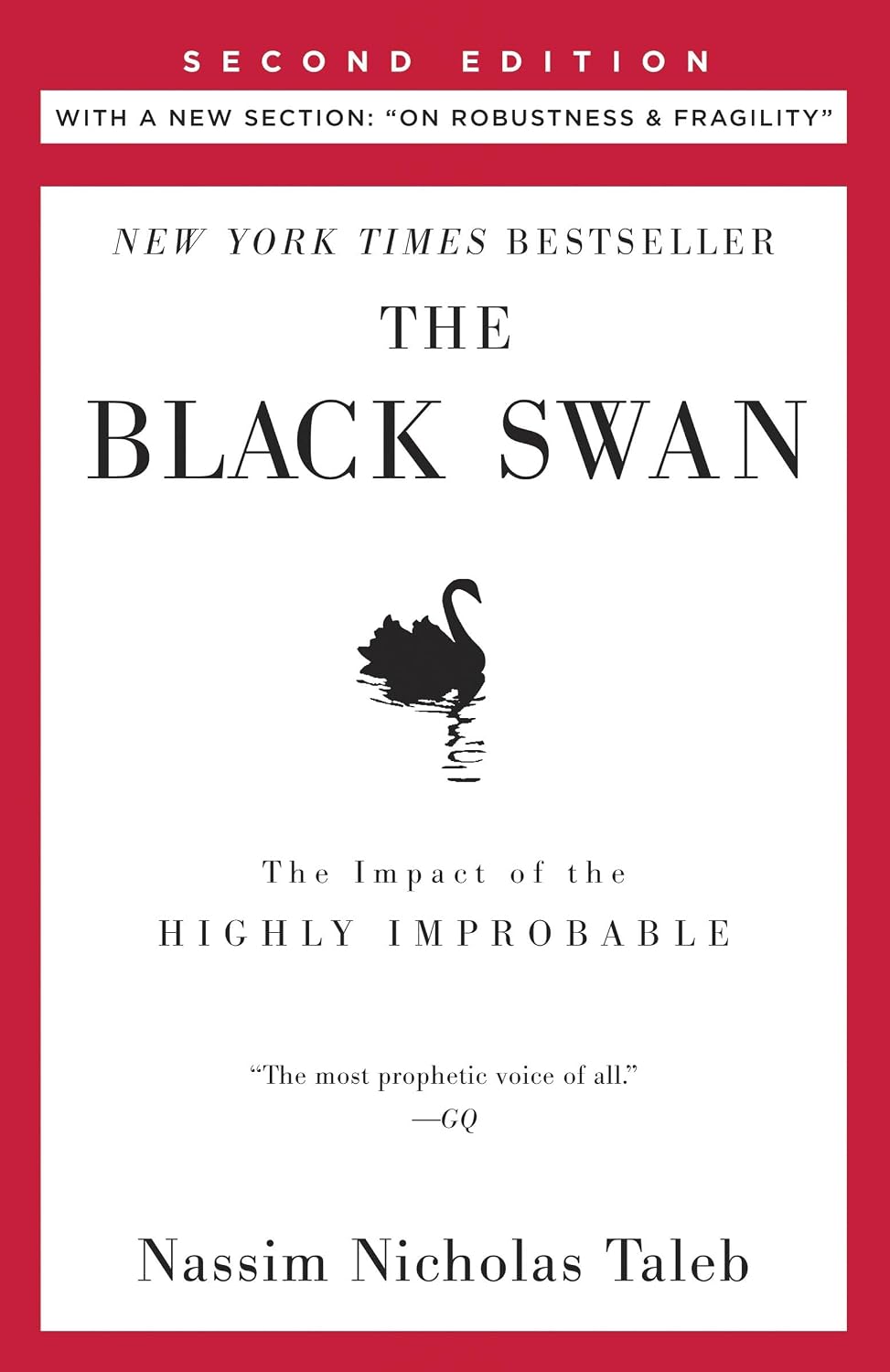
A black swan is a highly improbable event with three principal characteristics: It is unpredictable; it carries a massive impact; and, after the fact, we concoct an explanation that makes it appear less random, and more predictable, than it was. The astonishing success of Google was a black swan; so was 9/11. For Nassim Nicholas Taleb, black swans underlie almost everything about our world, from the rise of religions to events in our own personal lives.
Why do we not acknowledge the phenomenon of black swans until after they occur? Part of the answer, according to Taleb, is that humans are hardwired to learn specifics when they should be focused on generalities. We concentrate on things we already know and time and time again fail to take into consideration what we don’t know. We are, therefore, unable to truly estimate opportunities, too vulnerable to the impulse to simplify, narrate, and categorize, and not open enough to rewarding those who can imagine the “impossible.”
For years, Taleb has studied how we fool ourselves into thinking we know more than we actually do. We restrict our thinking to the irrelevant and inconsequential, while large events continue to surprise us and shape our world. In this revelatory book, Taleb explains everything we know about what we don’t know, and this second edition features a new philosophical and empirical essay, “On Robustness and Fragility,” which offers tools to navigate and exploit a Black Swan world.
Elegant, startling, and universal in its applications, The Black Swan will change the way you look at the world. Taleb is a vastly entertaining writer, with wit, irreverence, and unusual stories to tell. He has a polymathic command of subjects ranging from cognitive science to business to probability theory. The Black Swan is a landmark book—itself a black swan.
Praise for Nassim Nicholas Taleb
“The most prophetic voice of all.”—GQ
Praise for The Black Swan
“[A book] that altered modern thinking.”—The Times (London)
“A masterpiece.”—Chris Anderson, editor in chief of Wired, author of The Long Tail
“Idiosyncratically brilliant.”—Niall Ferguson, Los Angeles Times
“The Black Swan changed my view of how the world works.”—Daniel Kahneman, Nobel laureate
“[Taleb writes] in a style that owes as much to Stephen Colbert as it does to Michel de Montaigne. . . . We eagerly romp with him through the follies of confirmation bias [and] narrative fallacy.”—The Wall Street Journal
“Hugely enjoyable—compelling . . . easy to dip into.”—Financial Times
“Engaging . . . The Black Swan has appealing cheek and admirable ambition.”—The New York Times Book Review
Review
“Hugely enjoyable—compelling . . . easy to dip into.”—Financial Times
“A masterpiece.”—Chris Anderson, author of The Long Tail
“Idiosyncratically brilliant.”—Niall Ferguson, Los Angeles Times
About the Author
Excerpt. © Reprinted by permission. All rights reserved.
ON THE PLUMAGE OF BIRDS
Before the discovery of Australia, people in the old world were convinced that all swans were white, an unassailable belief as it seemed completely confirmed by empirical evidence. The sighting of the first black swan might have been an interesting surprise for a few ornithologists (and others extremely concerned with the coloring of birds), but that is not where the significance of the story lies. It illustrates a severe limitation to our learning from observations or experience and the fragility of our knowledge. One single observation can invalidate a general statement derived from millennia of confirmatory sightings of millions of white swans. All you need is one single (and, I am told, quite ugly) black bird.*
I push one step beyond this philosophical-logical question into an empirical reality, and one that has obsessed me since childhood. What we call here a Black Swan (and capitalize it) is an event with the following three attributes.
First, it is an outlier, as it lies outside the realm of regular expectations, because nothing in the past can convincingly point to its possibility. Second, it carries an extreme impact. Third, in spite of its outlier status, human nature makes us concoct explanations for its occurrence after the fact, making it explainable and predictable.
I stop and summarize the triplet: rarity, extreme impact, and retrospective (though not prospective) predictability.* A small number of Black Swans explain almost everything in our world, from the success of ideas and religions, to the dynamics of historical events, to elements of our own personal lives. Ever since we left the Pleistocene, some ten millennia ago, the effect of these Black Swans has been increasing. It started accelerating during the industrial revolution, as the world started getting more complicated, while ordinary events, the ones we study and discuss and try to predict from reading the newspapers, have become increasingly inconsequential.
Just imagine how little your understanding of the world on the eve of the events of 1914 would have helped you guess what was to happen next. (Don’t cheat by using the explanations drilled into your cranium by your dull high school teacher). How about the rise of Hitler and the subsequent war? How about the precipitous demise of the Soviet bloc? How about the rise of Islamic fundamentalism? How about the spread of the Internet? How about the market crash of 1987 (and the more unexpected recovery)? Fads, epidemics, fashion, ideas, the emergence of art genres and schools. All follow these Black Swan dynamics. Literally, just about everything of significance around you might qualify.
This combination of low predictability and large impact makes the Black Swan a great puzzle; but that is not yet the core concern of this book. Add to this phenomenon the fact that we tend to act as if it does not exist! I don’t mean just you, your cousin Joey, and me, but almost all “social scientists” who, for over a century, have operated under the false belief that their tools could measure uncertainty. For the applications of the sciences of uncertainty to real-world problems has had ridiculous effects; I have been privileged to see it in finance and economics. Go ask your portfolio manager for his definition of “risk,” and odds are that he will supply you with a measure that excludes the possibility of the Black Swan–hence one that has no better predictive value for assessing the total risks than astrology (we will see how they dress up the intellectual fraud with mathematics). This problem is endemic in social matters.
The central idea of this book concerns our blindness with respect to randomness, particularly the large deviations: Why do we, scientists or nonscientists, hotshots or regular Joes, tend to see the pennies instead of the dollars? Why do we keep focusing on the minutiae, not the possible significant large events, in spite of the obvious evidence of their huge influence? And, if you follow my argument, why does reading the newspaper actually decrease your knowledge of the world?
It is easy to see that life is the cumulative effect of a handful of significant shocks. It is not so hard to identify the role of Black Swans, from your armchair (or bar stool). Go through the following exercise. Look into your own existence. Count the significant events, the technological changes, and the inventions that have taken place in our environment since you were born and compare them to what was expected before their advent. How many of them came on a schedule? Look into your own personal life, to your choice of profession, say, or meeting your mate, your exile from your country of origin, the betrayals you faced, your sudden enrichment or impoverishment. How often did these things occur according to plan?
* The spread of camera cell phones has afforded me a large collection of pictures of black swans sent by traveling readers. Last Christmas I also got a case of Black Swan Wine (not my favorite), a videotape (I don’t watch videos), and two books. I prefer the pictures.
* The highly expected not happening is also a Black Swan. Note that, by symmetry the occurrence of a highly improbable event is the equivalent of the nonoccurrence of a highly probable one.
What You Do Not Know
Black Swan logic makes what you don’t know far more relevant than what you do know. Consider that many Black Swans can be caused and exacerbated by their being unexpected.
Think of the terrorist attack of September 11, 2001: had the risk been reasonably conceivable on September 10, it would not have happened. If such a possibility were deemed worthy of attention, fighter planes would have circled the sky above the twin towers, airplanes would have had locked bulletproof doors, and the attack would not have taken place, period. Something else might have taken place. What? I don’t know. Isn’t it strange to see an event happening precisely because it was not supposed to happen? What kind of defense do we have against that? Whatever you come to know (that New York is an easy terrorist target, for instance) may become inconsequential if your enemy knows that you know it. It may be odd to realize that, in such a strategic game, what you know can be truly inconsequential.
This extends to all businesses. Think about the “secret recipe” to making a killing in the restaurant business. If it were known and obvious then someone next door would have already come up with the idea and it would have become generic. The next killing in the restaurant industry needs to be an idea that is not easily conceived of by the current population of restaurateurs. It has to be at some distance from expectations. The more unexpected the success of such a venture, the smaller the number of competitors, and the more successful the entrepreneur who implements the idea. The same applies to the shoe and the book businesses–or any kind of entrepreneurship. The same applies to scientific theories–nobody has interest in listening to trivialities. The payoff of a human venture is, in general, inversely proportional to what it is expected to be.
Consider the Pacific tsunami of December 2004. Had it been expected, it would not have caused the damage it did–the areas affected would have been less populated, an early warning system would have been put in place. What you know cannot really hurt you.
Experts and “Empty Suits”
The inability to predict outliers implies the inability to predict the course of history, given the share of these events in the dynamics of events.
But we act as though we are able to predict historical events, or, even wore, as if we are able to change the course of history. We produce thirty year projections of social security deficits and oil prices without realizing that we cannot even predict these for next summer–our cumulative prediction errors for political and economic events are so monstrous that every time I look at the empirical record I have to pinch myself to verify that I am not dreaming. What is surprising is not the magnitude of our forecast errors, but our absence of awareness of it. This is all the more worrisome when we engage in deadly conflicts: wars are fundamentally unpredictable (and we do not know it). Owing to this misunderstanding of the casual chains between policy and actions, we can easily trigger Black Swans thanks to aggressive ignorance–like a child playing with a chemistry kit.
Our inability to predict in environments subjected to the Black Swan, coupled with a general lack of the awareness of this state of affairs, means that certain professionals, while believing they are experts, are in fact not. based on their empirical record, they do not know more about their subject matter than the general population, but they are much better at narrating–or, worse, at smoking you with complicated mathematical models. They are also more likely to wear a tie.
Black Swans being unpredictable, we need to adjust to their existence (rather than naïvely try to predict them). There are so many things we can do if we focus on anti knowledge, or what we do not know. Among many other benefits, you can set yourself up to collect serendipitous Black Swans by maximizing your exposure to them.
Learning to Learn
Another related human impediment comes from excessive focus on what we do know: we tend to learn the precise, not the general.
What did people learn from the 9/11 episode? Did they learn that some events, owing to their dynamics, stand largely outside the realm of the predictable? No. Did they learn the built-in defect of conventional wisdom? No. What did they figure out? They learned precise rules for avoiding Islamic prototerrorists and tall buildings. Many keep reminding me that it is important...
Details:
Visit the Random House Trade Paperbacks Store
The Black Swan: Second Edition: The Impact of the Highly Improbable: With a new section: "On Robustness and Fragility"
QAR13186
Quantity:
Order today to get by 7-14 business days
Delivery fee of QAR 20. Free for orders above QAR 200.
 Imported From: United States
At BOLO, we work hard to ensure the products you receive are new, genuine, and sourced from reputable suppliers.
Every product in the BOLO catalogue is sourced through our Verified Global Supply Network of verified sellers, authorized distributors or directly from the manufacturer.
Each product undergoes thorough inspection and verification at our consolidation and fulfilment centers to ensure it meets our strict authenticity and quality standards before being shipped and delivered to you.
If you ever have concerns regarding the authenticity of a product purchased from us, please contact Bolo Support. We will review your inquiry promptly and, if necessary, provide documentation verifying authenticity or offer a suitable resolution.
Your trust is our top priority, and we are committed to maintaining transparency and integrity in every transaction.
While we strive to display accurate information, variations in packaging, labeling, instructions, or formulation may occasionally occur due to regional differences or supplier updates. For detailed or manufacturer-specific information, please contact the brand directly or reach out to BOLO Support for assistance.
Unless otherwise stated, all prices displayed on the product page include applicable taxes and import duties.
BOLO operates in accordance with the laws and regulations of Qatar. Any items found to be restricted or prohibited for sale within the Qatar will be cancelled prior to shipment. We take proactive measures to ensure that only products permitted for sale in Qatar are listed on our website.
All items are shipped by air, and any products classified as “Dangerous Goods (DG)” under IATA regulations will be removed from the order and cancelled.
All orders are processed manually, and we make every effort to process them promptly once confirmed. Products cancelled due to the above reasons will be permanently removed from listings across the website.


More from this brand
Similar items from “Developmental Biology”
Share with
Or share with link
https://www.bolo.qa/products/U081297381K
Visit the Random House Trade Paperbacks Store
The Black Swan: Second Edition: The Impact of the Highly Improbable: With a new section: "On Robustness and Fragility"
QAR13186
Quantity:
Order today to get by 7-14 business days
Delivery fee of QAR 20. Free for orders above QAR 200.
Imported From: United States
At BOLO, we work hard to ensure the products you receive are new, genuine, and sourced from reputable suppliers.
Every product in the BOLO catalogue is sourced through our Verified Global Supply Network of verified sellers, authorized distributors or directly from the manufacturer.
Each product undergoes thorough inspection and verification at our consolidation and fulfilment centers to ensure it meets our strict authenticity and quality standards before being shipped and delivered to you.
If you ever have concerns regarding the authenticity of a product purchased from us, please contact Bolo Support. We will review your inquiry promptly and, if necessary, provide documentation verifying authenticity or offer a suitable resolution.
Your trust is our top priority, and we are committed to maintaining transparency and integrity in every transaction.
While we strive to display accurate information, variations in packaging, labeling, instructions, or formulation may occasionally occur due to regional differences or supplier updates. For detailed or manufacturer-specific information, please contact the brand directly or reach out to BOLO Support for assistance.
Unless otherwise stated, all prices displayed on the product page include applicable taxes and import duties.
BOLO operates in accordance with the laws and regulations of Qatar. Any items found to be restricted or prohibited for sale within the Qatar will be cancelled prior to shipment. We take proactive measures to ensure that only products permitted for sale in Qatar are listed on our website.
All items are shipped by air, and any products classified as “Dangerous Goods (DG)” under IATA regulations will be removed from the order and cancelled.
All orders are processed manually, and we make every effort to process them promptly once confirmed. Products cancelled due to the above reasons will be permanently removed from listings across the website.
Description:
A black swan is a highly improbable event with three principal characteristics: It is unpredictable; it carries a massive impact; and, after the fact, we concoct an explanation that makes it appear less random, and more predictable, than it was. The astonishing success of Google was a black swan; so was 9/11. For Nassim Nicholas Taleb, black swans underlie almost everything about our world, from the rise of religions to events in our own personal lives.
Why do we not acknowledge the phenomenon of black swans until after they occur? Part of the answer, according to Taleb, is that humans are hardwired to learn specifics when they should be focused on generalities. We concentrate on things we already know and time and time again fail to take into consideration what we don’t know. We are, therefore, unable to truly estimate opportunities, too vulnerable to the impulse to simplify, narrate, and categorize, and not open enough to rewarding those who can imagine the “impossible.”
For years, Taleb has studied how we fool ourselves into thinking we know more than we actually do. We restrict our thinking to the irrelevant and inconsequential, while large events continue to surprise us and shape our world. In this revelatory book, Taleb explains everything we know about what we don’t know, and this second edition features a new philosophical and empirical essay, “On Robustness and Fragility,” which offers tools to navigate and exploit a Black Swan world.
Elegant, startling, and universal in its applications, The Black Swan will change the way you look at the world. Taleb is a vastly entertaining writer, with wit, irreverence, and unusual stories to tell. He has a polymathic command of subjects ranging from cognitive science to business to probability theory. The Black Swan is a landmark book—itself a black swan.
Praise for Nassim Nicholas Taleb
“The most prophetic voice of all.”—GQ
Praise for The Black Swan
“[A book] that altered modern thinking.”—The Times (London)
“A masterpiece.”—Chris Anderson, editor in chief of Wired, author of The Long Tail
“Idiosyncratically brilliant.”—Niall Ferguson, Los Angeles Times
“The Black Swan changed my view of how the world works.”—Daniel Kahneman, Nobel laureate
“[Taleb writes] in a style that owes as much to Stephen Colbert as it does to Michel de Montaigne. . . . We eagerly romp with him through the follies of confirmation bias [and] narrative fallacy.”—The Wall Street Journal
“Hugely enjoyable—compelling . . . easy to dip into.”—Financial Times
“Engaging . . . The Black Swan has appealing cheek and admirable ambition.”—The New York Times Book Review
Review
“Hugely enjoyable—compelling . . . easy to dip into.”—Financial Times
“A masterpiece.”—Chris Anderson, author of The Long Tail
“Idiosyncratically brilliant.”—Niall Ferguson, Los Angeles Times
About the Author
Excerpt. © Reprinted by permission. All rights reserved.
ON THE PLUMAGE OF BIRDS
Before the discovery of Australia, people in the old world were convinced that all swans were white, an unassailable belief as it seemed completely confirmed by empirical evidence. The sighting of the first black swan might have been an interesting surprise for a few ornithologists (and others extremely concerned with the coloring of birds), but that is not where the significance of the story lies. It illustrates a severe limitation to our learning from observations or experience and the fragility of our knowledge. One single observation can invalidate a general statement derived from millennia of confirmatory sightings of millions of white swans. All you need is one single (and, I am told, quite ugly) black bird.*
I push one step beyond this philosophical-logical question into an empirical reality, and one that has obsessed me since childhood. What we call here a Black Swan (and capitalize it) is an event with the following three attributes.
First, it is an outlier, as it lies outside the realm of regular expectations, because nothing in the past can convincingly point to its possibility. Second, it carries an extreme impact. Third, in spite of its outlier status, human nature makes us concoct explanations for its occurrence after the fact, making it explainable and predictable.
I stop and summarize the triplet: rarity, extreme impact, and retrospective (though not prospective) predictability.* A small number of Black Swans explain almost everything in our world, from the success of ideas and religions, to the dynamics of historical events, to elements of our own personal lives. Ever since we left the Pleistocene, some ten millennia ago, the effect of these Black Swans has been increasing. It started accelerating during the industrial revolution, as the world started getting more complicated, while ordinary events, the ones we study and discuss and try to predict from reading the newspapers, have become increasingly inconsequential.
Just imagine how little your understanding of the world on the eve of the events of 1914 would have helped you guess what was to happen next. (Don’t cheat by using the explanations drilled into your cranium by your dull high school teacher). How about the rise of Hitler and the subsequent war? How about the precipitous demise of the Soviet bloc? How about the rise of Islamic fundamentalism? How about the spread of the Internet? How about the market crash of 1987 (and the more unexpected recovery)? Fads, epidemics, fashion, ideas, the emergence of art genres and schools. All follow these Black Swan dynamics. Literally, just about everything of significance around you might qualify.
This combination of low predictability and large impact makes the Black Swan a great puzzle; but that is not yet the core concern of this book. Add to this phenomenon the fact that we tend to act as if it does not exist! I don’t mean just you, your cousin Joey, and me, but almost all “social scientists” who, for over a century, have operated under the false belief that their tools could measure uncertainty. For the applications of the sciences of uncertainty to real-world problems has had ridiculous effects; I have been privileged to see it in finance and economics. Go ask your portfolio manager for his definition of “risk,” and odds are that he will supply you with a measure that excludes the possibility of the Black Swan–hence one that has no better predictive value for assessing the total risks than astrology (we will see how they dress up the intellectual fraud with mathematics). This problem is endemic in social matters.
The central idea of this book concerns our blindness with respect to randomness, particularly the large deviations: Why do we, scientists or nonscientists, hotshots or regular Joes, tend to see the pennies instead of the dollars? Why do we keep focusing on the minutiae, not the possible significant large events, in spite of the obvious evidence of their huge influence? And, if you follow my argument, why does reading the newspaper actually decrease your knowledge of the world?
It is easy to see that life is the cumulative effect of a handful of significant shocks. It is not so hard to identify the role of Black Swans, from your armchair (or bar stool). Go through the following exercise. Look into your own existence. Count the significant events, the technological changes, and the inventions that have taken place in our environment since you were born and compare them to what was expected before their advent. How many of them came on a schedule? Look into your own personal life, to your choice of profession, say, or meeting your mate, your exile from your country of origin, the betrayals you faced, your sudden enrichment or impoverishment. How often did these things occur according to plan?
* The spread of camera cell phones has afforded me a large collection of pictures of black swans sent by traveling readers. Last Christmas I also got a case of Black Swan Wine (not my favorite), a videotape (I don’t watch videos), and two books. I prefer the pictures.
* The highly expected not happening is also a Black Swan. Note that, by symmetry the occurrence of a highly improbable event is the equivalent of the nonoccurrence of a highly probable one.
What You Do Not Know
Black Swan logic makes what you don’t know far more relevant than what you do know. Consider that many Black Swans can be caused and exacerbated by their being unexpected.
Think of the terrorist attack of September 11, 2001: had the risk been reasonably conceivable on September 10, it would not have happened. If such a possibility were deemed worthy of attention, fighter planes would have circled the sky above the twin towers, airplanes would have had locked bulletproof doors, and the attack would not have taken place, period. Something else might have taken place. What? I don’t know. Isn’t it strange to see an event happening precisely because it was not supposed to happen? What kind of defense do we have against that? Whatever you come to know (that New York is an easy terrorist target, for instance) may become inconsequential if your enemy knows that you know it. It may be odd to realize that, in such a strategic game, what you know can be truly inconsequential.
This extends to all businesses. Think about the “secret recipe” to making a killing in the restaurant business. If it were known and obvious then someone next door would have already come up with the idea and it would have become generic. The next killing in the restaurant industry needs to be an idea that is not easily conceived of by the current population of restaurateurs. It has to be at some distance from expectations. The more unexpected the success of such a venture, the smaller the number of competitors, and the more successful the entrepreneur who implements the idea. The same applies to the shoe and the book businesses–or any kind of entrepreneurship. The same applies to scientific theories–nobody has interest in listening to trivialities. The payoff of a human venture is, in general, inversely proportional to what it is expected to be.
Consider the Pacific tsunami of December 2004. Had it been expected, it would not have caused the damage it did–the areas affected would have been less populated, an early warning system would have been put in place. What you know cannot really hurt you.
Experts and “Empty Suits”
The inability to predict outliers implies the inability to predict the course of history, given the share of these events in the dynamics of events.
But we act as though we are able to predict historical events, or, even wore, as if we are able to change the course of history. We produce thirty year projections of social security deficits and oil prices without realizing that we cannot even predict these for next summer–our cumulative prediction errors for political and economic events are so monstrous that every time I look at the empirical record I have to pinch myself to verify that I am not dreaming. What is surprising is not the magnitude of our forecast errors, but our absence of awareness of it. This is all the more worrisome when we engage in deadly conflicts: wars are fundamentally unpredictable (and we do not know it). Owing to this misunderstanding of the casual chains between policy and actions, we can easily trigger Black Swans thanks to aggressive ignorance–like a child playing with a chemistry kit.
Our inability to predict in environments subjected to the Black Swan, coupled with a general lack of the awareness of this state of affairs, means that certain professionals, while believing they are experts, are in fact not. based on their empirical record, they do not know more about their subject matter than the general population, but they are much better at narrating–or, worse, at smoking you with complicated mathematical models. They are also more likely to wear a tie.
Black Swans being unpredictable, we need to adjust to their existence (rather than naïvely try to predict them). There are so many things we can do if we focus on anti knowledge, or what we do not know. Among many other benefits, you can set yourself up to collect serendipitous Black Swans by maximizing your exposure to them.
Learning to Learn
Another related human impediment comes from excessive focus on what we do know: we tend to learn the precise, not the general.
What did people learn from the 9/11 episode? Did they learn that some events, owing to their dynamics, stand largely outside the realm of the predictable? No. Did they learn the built-in defect of conventional wisdom? No. What did they figure out? They learned precise rules for avoiding Islamic prototerrorists and tall buildings. Many keep reminding me that it is important...
Details:
More from this brand
Similar items from “Developmental Biology”
Share with
Or share with link
https://www.bolo.qa/products/U081297381K