Description:
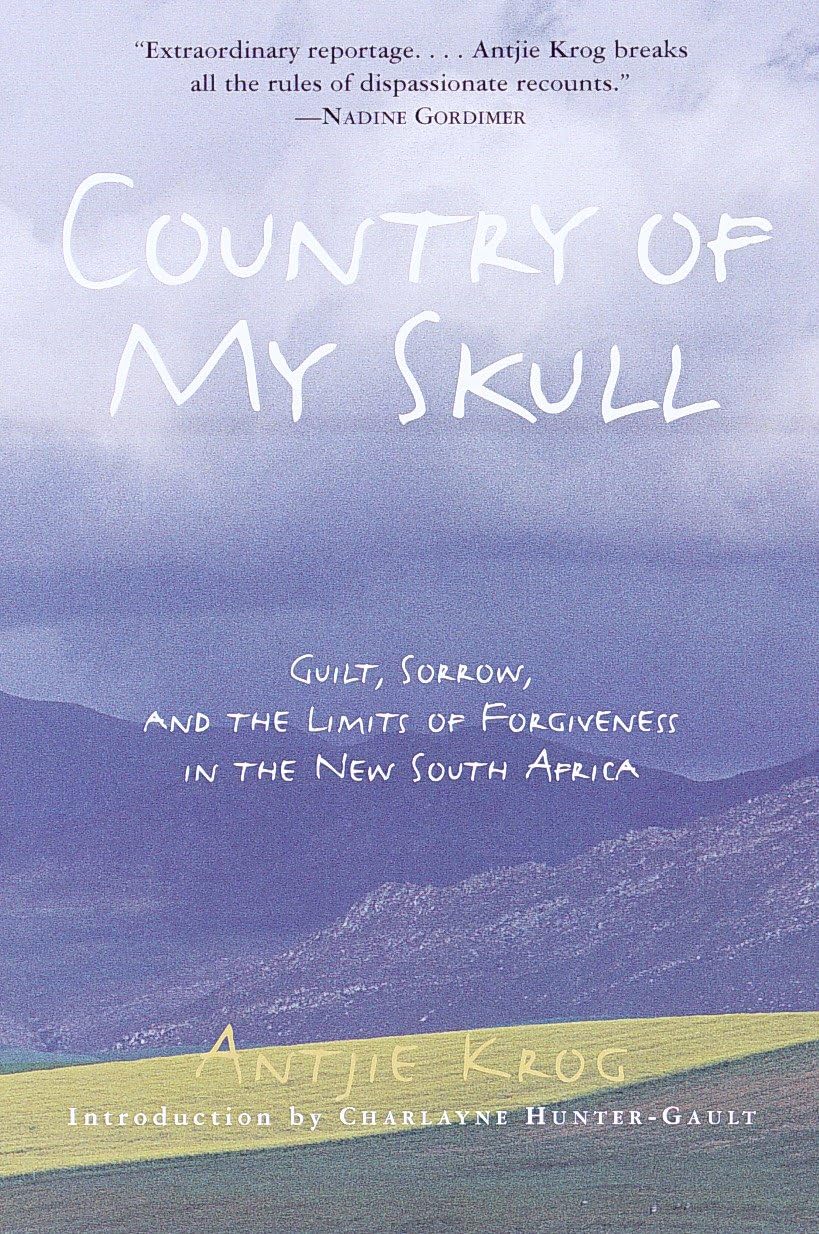
To begin the healing process, Nelson Mandela created the Truth and Reconciliation Commission, headed by the renowned cleric Archbishop Desmond Tutu. Established in 1995, the commission faced the awesome task of hearing the testimony of the victims of apartheid as well as the oppressors. Amnesty was granted to those who offered a full confession of any crimes associated with apartheid. Since the commission began its work, it has been the central player in a drama that has riveted the country. In this book, Antjie Krog, a South African journalist and poet who has covered the work of the commission, recounts the drama, the horrors, the wrenching personal stories of the victims and their families. Through the testimonies of victims of abuse and violence, from the appearance of Winnie Mandela to former South African president P. W. Botha's extraordinary courthouse press conference, this award-winning poet leads us on an amazing journey.
Country of My Skull captures the complexity of the Truth Commission's work. The narrative is often traumatic, vivid, and provocative. Krog's powerful prose lures the reader actively and inventively through a mosaic of insights, impressions, and secret themes. This compelling tale is Antjie Krog's profound literary account of the mending of a country that was in colossal need of change.
Editorial Reviews
Review
--The Economist
"This is a deeply moving account of the South African Truth and Reconciliation Commission--South Africa's attempt to come to terms with her often horrendous past. Antjie Krog writes with the sensitivity of a poet and the clarity of a journalist. Country of My Skull is a must-read for all who are fascinated by this unique attempt to deal with a post-conflict context. It is a beautiful and powerful book."
-- Archbishop Desmond Tutu
"Trying to understand the new South Africa without the Truth and Reconciliation Commission would be futile; trying to understand the commission without this book would be irresponsible."
-- André Brink, author of A Dry White Season
Antjie Krog has rendered the world a great service. This elegant manifesto for justice will haunt the soul long after the reading is done."
-- Douglas Brinkley, professor of history and director of the Eisenhower Center at the University of New Orleans
"Here is the extraordinary reportage of one who, eyes staring into the filthiest places of atrocity, poet's searing tongue speaking of them, is not afraid to go too far. Antjie Krog breaks all the rules of dispassionate recounts, the restraints of 'decent' prose, because this is where the truth might be reached and reconciliation with it is posited like a bewildered angel thrust down into hell."
-- Nadine Gordimer, winner of the Nobel Prize for Literature
From the Inside Flap
To begin the healing process, Nelson Mandela created the Truth and Reconciliation Commission, headed by t
From the Back Cover
To begin the healing process, Nelson Mandela created the Truth and Reconciliation Commission, headed by t
About the Author
Excerpt. © Reprinted by permission. All rights reserved.
Country of My Skull
Guilt, Sorrow, and the Limits of Forgiveness in the New South AfricaBy Antjie KrogThree Rivers Press (CA)
Copyright ©2000 Antjie KrogAll right reserved.
ISBN: 9780812931297
Chapter One
They Never Wept,
the Men of My Race
Sunk low on their springs, three weathered white Sierras roar pastthe wrought-iron gates of Parliament. Heavy, hamlike forearmsbulge through the open windows?honking, waving old Free State andTransvaal flags. Hairy fists in the air. I run across the cobblestonestreet?clutching notepad and recorder?to the old parliamentaryvenue where the Justice Portfolio Committee is hearing public submissionson what to include in the draft legislation establishing a TruthCommission.
The faces are grim in the hall with its dark paneling, old-fashionedmicrophones hanging from the ceiling, hard wooden gallery, and green-leatherseats. "Bellington Mampe ... Looksmart Ngudle ... SulimanSalojee ... Solomon Modipane ... James Lenkoe ..." A slow litany ofnames is read out into the quiet hall. The names of 120 people whodied in police custody. "Imam Abdullah Haroon ... Alpheus Maliba ...Ahmed Timol ... Steve Bantu Biko ... Neil Aggett ... NicodemusKgoathe ..." The chairperson of the Black Sash, Mary Burton, concludesher submission in the same way the Sash's meetings have beenconcluded for years: name upon name upon name. They fall like chimesinto the silence. Journalists stop taking notes, committee members putdown their pens?stunned by this magnitude of death that is but a barebeginning.
The double doors snap open. The marching crunch of the black-cladYstergarde?even on the carpet their boots make a noise. The IronGuard, elite corps of the far-right Afrikaner Weerstandsbeweging(AWB). Black balaclavas worn like caps, ready to be rolled down overthe faces. Three-armed swastikas on the sleeves. Then, dressed in ordinarykhaki clothes, in walks Eugene Terre'Blanche as if taking a strollon his farm. Suddenly another kind of noise fills the hall. Members ofParliament, secretaries, messengers, even a minister or two, shuffleinto the already crowded gallery.
"We've asked for all the committee meetings to be adjourned," whispersa black senator. "We have to see this man with our own eyes?howreal he is."
Expectation fills the air. Does Terre'Blanche's adjutant want to sayanything? He jumps up. Salutes. "No, I say what my leader say!"
The chair of the Justice Portfolio Committee, Johnny de Lange,shows Terre'Blanche to his seat. "Mr. Terre'Blanche, what would youlike to see in the Truth Commission legislation?"
It is so quiet you can hear an alliteration drop. Terre'Blanche staysseated. Barely audibly, he asks: "Is hier waar ek vandag sit, hierdiesitplek, is dit die plek waar Sy Edele Dr. Verwoerd dertig jaar gelede vermooris met 'n mes in sy hart?" ("This seat I am sitting in, is it the same onewhere Dr. Verwoerd was murdered with a knife in his heart thirty years ago?")
We look at one another. "Indeed," says the chairperson. Terre'Blanche stares at his hat until the changed context of blood and betrayalis dominating the silence.
He gets up. He moves out of the bench. Away from the microphones,the guards. He stands alone on the carpet. And the first word that entersthe mind, despite the neatly trimmed gray beard, is "poor." Theman is a poor Afrikaner. His khaki shirt is bleached, its collar thread-bare.But poor as he is, he is a master of acoustics. He drenches us withsound?every tremor, boom, reverberating corner of that space, underhis command.
"Laat. Die soldate ... Huis toe gaan!" he shouts. Let the soldiers gohome. Then in a normal voice: "Agbare Meneer die Voorsitler, Agbare Ledevan die Parlement ... Laat AL ... die soldate ... HUIS toe gaan ... [whispering]Laat. MY ... soldate ... huis toe gaan ... [in a crescendo] sodat dieweeklag van wagtende vroue en die wringende hande van kinders kan einde kry ...my klere is nat van hulle trane ..."
Members of Parliament ransack desks for translation equipment.They don't want to miss a word.
"Amnesty is a gift! But for the political prisoner who has neverknown the coldness and the bleakness [die koud-heid en die kil-heid] ofjail cells, whose life has always been woven into the wide waving veld offreedom, for him, Honorable Chair, for him amnesty is ... a fire of joy."
Terre'Blanche asks for the cutoff date, now set at December 6, 1993,to be shifted forward, so that AWB members who committed violenceright up to the first democratic election in April 1994 will qualify foramnesty. Then the AWB will cooperate with the government.
When Terre'Blanche is finished, committee member Jan van Eckpraises his Afrikaans. Carl Niehaus, the Afrikaans-speaking memberof Parliament for the African National Congress (ANC), is less enthusiastic.What does Terre'Blanche mean by the term "cooperation"?
"It seems Mr. Niehaus himself has mastered only Standard TwoAfrikaans," Terre'Blanche sneers.
Someone starts to hiss. Dramatically Terre'Blanche throws two fingersin the air. "Two bomb-planters! The one drives a Mercedes-Benz,and the other one, like me, drives a Nissan bakkie [pickup truck]. TheNissan. Comes late. Five minutes after twelve his bomb goes off. Butthe Mercedes. Arrives on time. And that bomb explodes. Five minutesto twelve. Now because he drives a Mercedes, and not a Nissan,he ... gets amnesty!"
Dene Smuts, another Afrikaner MP and a member of the DemocraticParty, calls for a point of order. "No, Mr. Terre'Blanche, your Nissandid not come late. It burst with deafening noise through the glasswindows of the World Trade Centre in Kempton Park. I was there. Andyour deeds were not aimed at the Big Stealer?as you insist on callingF. W. de Klerk?but at the negotiations for a democratic dispensation.Your people are in jail not because they drove Nissan bakkies, but becausethey refused to accept democracy."
Incensed, Terre'Blanche gasps for air. "That a woman?and mymother was also a woman," he shouts, "that a woman does not understandwhat I say!"
He ends his submission. "If the shifting of a date can bring peace,then you must shift the date ... If justice rules ... I will talk peace...because that is all that I am ... a simple farmer from Westransvaal whohas come to you to put my case."
The contrast between client and advocate is striking. General Johan vander Merwe, former commissioner of police, sits collapsed in the frontrow. Whether it is part of a calculated strategy or simply an effect ofseeing him out of uniform for the first time, I cannot say. His color isyellowish, he blinks constantly, his mouth nibbles at times like a geriatric,and when he touch-touches the bandage on his finger, his handtrembles. But his case is taken up with a flourish by a rosy, confident,English-speaking lawyer from Natal. He is not taking up the general'scase because he agrees with what happened in the past, the advocateassures the Justice Portfolio Committee, but because he believes thegeneral has a point. And the point is politics. The mere fact that a deedmust have a political motive to qualify the perpetrator for amnesty isproof enough that the politicians should be the essence of the TruthCommission's inquest. It is not the police who came up with apartheid,he says, but the politicians.
With an instinct for the dramatic, the advocate gestures in the directionof Van der Merwe. "Yesterday afternoon when we were flying toCape Town, the general was staring out of the window of the plane. Thesun was setting and he said to me ... he said in this choked-up voice:`The politicians have prostituted the police. Once I was a proud policeman,but here I am today?humiliated and despised. My career, towhich I dedicated my entire life with such pride, is ending in this horribleshame and dishonor.'"
"We all know that the ultimate reconciliation should be betweenAfrikaner and African," Freedom Front leader General ConstandViljoen tells the committee, "and this could happen if the Truth Commissiondoes not vilify the Afrikaner into being worse than we are ..."
All of us have failed, Viljoen goes on. "We all used violence to getwhat we wanted. The terror of the tyrant invited the terror of therevolutionary."
Submissions from across the board. Orgies of alliteration. In thepress, Afrikaner intellectuals point out that thanks to apartheid the newgovernment inherited the most sophisticated infrastructure in Africa.Thanks to apartheid political prisoners all obtained quality degreeswhile on Robben Island?with the result that the ANC's senior leadershipis better qualified than any other political party on the continent.Fewer people died under apartheid than were killed in Rwanda. So howbad could apartheid have been?
The oppressors are weary; the oppressed, foam-in-the-mouth angry.
This is the theme for a kind of overture?but at the time we couldnot hear it.
From the beginning of March 1995, the Justice Portfolio Committee,under the chairmanship of Johnny de Lange, meets daily to debate thesubmissions and draft the legislation. The civil servants, who physicallywrite the law, sit somewhat apart. They work late into the night to havealternative formulations ready for the next day. "If I personally had todraft this legislation," one of them complains, "it would have been alean, simple law?completed weeks ago. But because this has to be aprocess, it is developing into a hell of a unique but impossiblycomplex law."
As if back into a womb, I crawl?the heavy-light eiderdown, the hot-waterbottle. Through the window, I see the sleeping farmyard washedaway in moonlight. A plover calls far off. Overcome with the carefreenessof my youth, I doze?safe in this stinkwood bed, safe in this sandstonehouse, this part of the Free State. Everything so quiet.
Stars roar past the yard.
A sudden sound. Harsh. "Hendrik, kom in! ... Hendrik, kom in!"
It must be around midnight.
My brother Andries, who lives on another part of the farm, is callingHendrik, our younger brother, on the radio. The line crackles. "Kom gou![Come quickly!] People are stealing cattle ... don't switch on yourlights?and bring your rifle."
The screen door of the rondavel slams as Hendrik leaves and drivesaway in the dark.
The radio crackles again: "How many?"
Andries: "Two and a dog. They have taken five cows and have justpassed the windpomp. Do you have bullets?"
I put on my gown. In the dining room next to the radio, my parentsare already sitting?in sheepskin slippers, each covered with a blanket?nervousand as if pinned down. I sit next to them. We do not talk.My mother brings a blanket for me. The night is suddenly filled withmenace.
"What's going on?" I ask.
My mother explains. Andries's wife, Bettie, would now be standingon the roof of their house, from where she has a large part of the farmunder surveillance with a night-vision scope. Bettie shouts the informationdown to nine-year-old Sumien at the radio, and she has to passit on to her father in the bakkie.
It's nearly one o'clock. We wait.
Sumien: "Pa ...? Pa, come in ... Ma says they have turned towardthe road, but she can't see you ... Where are you?"
Silence. My parents sit humped up?in the gray moonlight theirfaces seem carved to pieces.
Sumien: "Pa, where are you? Can you hear me?" Anxiety in hervoice.
Only the silence zooms down the line ... We wait in the dark.
After a quarter of an hour, the radio comes to life. It's Andries.Breathless: "We've found one, but the other got away. Tell Ma to getdown from the roof and lock the doors."
We wait. Then we think we hear shots. The dogs bark. We wait. Whodid the shooting? Who has been shot? And which is worse? What fiercescenes are being played out in the veld?
The family photo catches my eye. I look at my smiling, borselkopbrothers. I remember how Hendrik clutched my mother's arm whenshe was paging to the bookmark in the children's Bible. "Please, pleasedon't read the bit about that guy who wants to cut his child's throat inthe veld."
What are my brothers experiencing tonight that I cannot even imagine?
We wait an eternity. At last, the line finds its voice: "Call an ambulanceand tell them to come to the dam."
It is one of my brothers. But the voice sounds so tense that we cannottell who's speaking. We three are sitting there?the moon has lostits abundance. We sit?each with our own disproportionate thoughts.My mother gets up with a tired heaviness. In the kitchen, she makestea. My father and I sit without speaking. I take my tea to my icy bed.My eyes dry in the dark.
"The idea of a Truth Commission goes back to ANC decisions," Ministerof Justice Dullah Omar says in an interview. "When the NationalExecutive Committee of the ANC discussed what had happened in thecountry, and in particular what happened in ANC training camps likeQuatro, there was a strong feeling that some mechanism must be foundto deal with all violations in a way which would ensure that we put ourcountry on a sound moral basis. And so a view developed that whatSouth Africa needs is a mechanism which would open up the truth forpublic scrutiny. But to humanize our society we had to put across theidea of moral responsibility?that is why I suggested a combination ofthe amnesty process with the process of victims' stories."
Victims, and not perpetrators, should be the beginning, the focus, andthe central point of the legislation, the ANC argues. Victims shouldhave several points of entry into the process. Should losses be categorized?So many rand for an arm, so many for a leg, and so many for alife? Should compensation be available immediately or should the governmentwait for a coherent assessment?
Every discussion opens up new problem areas. Amnesty takes awaythe victim's right to a civil claim. Does compensation make amnestyconstitutional? What about the state? Should the state ask for amnesty?Because victims who receive compensation could still decide tosue the state.
The Democratic Party also wants to shift a date: the starting date ofthe period the commission is mandated to consider. The workload isimpossible, says Dene Smuts. This is the first Truth Commission requiredto investigate nearly four decades, and to look not only at disappearances,as in Chile, but at other gross violations such as murder,kidnapping, torture, and severe ill-treatment. Not only would a startingdate of June 16, 1976, shorten the commission's area of research by sixteenyears, but it would have symbolic resonance, because it ushered inthe famous cycle of resistance and oppression.
But as possible scenarios are spelled out and the pressure mounts tofinish the legislation, the parties start to work on one another's nerves.National Party member Sheila Camerer has the energetic chairpersoncollapsing onto his forearms, muttering next to the microphone: "Ag,God help my, the woman is driving me out of my mind!"
Between Johnny de Lange and the National Party's Jacko Maree thereis nothing but total war. The solidly built chairperson with his working-classAfrikaner background and the skinny-looking Maree with his bowtie and delicate spectacles cannot stand each other. The moment Mareeopens his mouth, the chair's facial color intensifies a shade.
One morning a note is sent to the media: "Don't leave toosoon?promise to provide you with a row and an underhand ANC deal."
That someone has already shouted "Fire!" is clear the moment theroom suddenly fills up with ANC faces never seen on the committee before.An unexpected extra National Party member also appears. Thetwo parties are gearing up for a fight.
And it happens. Mr. De Lange says members should vote on theshifting of two other motions to the top of the agenda. Mr. Maree interruptshim. He would like three minutes to explain his request thatthe indemnity given to ANC members by the Currin Commission bediscussed first. De Lange refuses. He is interrupted again. By NP memberDanie Schutte, also asking for time to motivate Maree's request.
De Lange refuses again. Red in the face by now. He is the chair, hesays, and this is his ruling. If Mr. Maree is not satisfied, he can go andcomplain to the highest authorities. As chairperson, he is not going toallow Mr. Maree to turn the Justice Portfolio Committee into a mediaspectacle. "You can make clowns of other people, but not of me, thechairperson."
"Please, Mr. Chairman," pleads Inkatha Freedom Party member Koosvan der Merwe, "do not let the poison between you and Mr. Maree destroythe good relations the rest of us have built up over the year. Can'tyou resolve this in any other way?"
Maree thrashes around in his chair, his hand raised. In his otherhand, he is waving a thick pile of documents, representing 100 ANCmembers who, he says, were stealthily granted indemnity just beforeChristmas by the Currin Commission.
De Lange is adamant. "We still have eight draft bills to discuss. Weargued this agenda last week for more than an hour. We have acceptedit. I will allow no discussion. I am putting it to the vote. Read my lips:I am putting it to the vote."
Whereupon the ANC outvotes the other parties by fifteen to seven.
As Maree storms out, Koos van der Merwe mutters: "The heavyhammer of democracy ..."
But the rush to finish the bill has to take a backseat for a day or two.
"A blink and a wink?and it was all over," I report on that afternoon'scurrent affairs program. "After weeks of publicity?peaking this morningin a hysteria of upper-class British accents in the corridors of Parliament?thequeen came, and saw, and left."
As always, the Cape knows when to behave herself. The southeastermeekly calms down, the sweepers sweep up the last bits of paper, thepupils line the streets, and the red carpet bleeds down the steps. Insidethe Assembly Hall, the atmosphere is predominantly that of ... howshall one put it? ... dressing up for the queen. An opportunity to showoff your traditional dress, your designer contacts, and your gravy-trainmenu.
Either shiny African-print dresses with puffed-up angel wings forsleeves, or shimmering Indian robes streaming over the shoulders, or atraditional beaded apron rounded off by the most massive flesh-coloredMaidenform bra ever seen in the houses of Parliament. One of the visitorsfrom the Free State seems to be hiding in some purple and goldshrubbery; another one from Stellenbosch wears a potjie like our ownJohanna van Arkel. Two Hare Krishnas chant Queen Elizabeth II intothe foyer with stained muslin pockets on their bare breasts.
The men, of course, are wearing traditional male dress: the expensivewoolen suit, the loud tie, the gold-framed glasses, and the indispensablethick neck.
Then they enter.
In front walks the colored sergeant at arms carrying Parliament'sgolden traditional weapon in his white gloves. Then follows the blackBlack Rod?yes, for all these years, Parliament had a white Black Rod... but the times they are a-changin' ...
The media have been fighting for weeks for the best seats in thepress gallery. I stretch my neck. Blink my eyes.
Can it be true? She looks like anybody's auntie, complete with aclasp handbag and thick little shoes from an upmarket departmentstore. Under any other circumstances, the brooch on her left shouldercould only be a fake, but we know, oh yes, we know, it is realer thanreal. She clips open her handbag, takes out her glasses, and puts herspeech on the speaker's desk.
She speeches.
Can it be true? It sounds like something one would find at any small-townwomen's society meeting. Typed out on ordinary notepaper, oneparagraph per page. With her gloves, she battles like other mortals tofold the pages into dog-ears to turn them more easily.
But don't be mistaken, the content may be ordinary, but it is deliveredin the Accent that has intimidated half the earth for centuries.When last did Parliament hear the phrase "doughty champion"?
Then she folds up her speech, puts it in her handbag, and off shegoes.
With bags flying, we ambush a taxi passing the gates of Parliament?"we"means the editor and myself.
"Go!" shouts the editor. "To the waterfront, to the Britannia!" Weturn our bags inside out, pull down zips, rip open blouses?the taxidriver looks panicky.
"Go!" I yell. "We meet the queen in seven minutes."
"Watter queen?" He sounds skeptical.
"Princess Di's skoonma, but you must fly."
He turns right round in his seat: "We are talking about the queen,the one with"?he touches his head?"our diamond in her crown? Theone who wears lead in her seams?"
"Yes, yes, yes," I yell in a strangled voice.
But nothing escapes my op-en-wakker editor: "Why lead?"
"So that the wind cannot blow her dress above her knees," says thetaxi driver smartly.
He grabs the steering wheel as if possessed. He has a mission. Hehas a skill. He wants us to be on time. We scour bends; we cut corners.The man drives like a demon.
He asks sternly, "Why are you late?"
"Because," the editor shouts while dialing on her cell phone with onehand and fastening an earring with the other, "we had to report on thequeen's speech in Parliament, to two hundred news bulletins and ineleven languages, and now she has invited some journalists for cocktailson her yacht ..."
"And what did she say in Parliament?" he asks.
"Nothing ..."
Our legs shoot past him in new charcoal pantyhose.
"So what did you report?"
In the heap of rubble on the backseat, we dig up prehistoric lipsticks,rouge that needs quarrying with fingernails, mascara brushes cloggedwith gravel, empty perfume bottles, buckled bangles?and apply themall, to the tune of howling tires and a racing engine.
"We asked how such mediocrity could stay so luxuriously swaddled.We said to live like her you need to plunder your own people for centuriesand thereafter suck half the world dry."
The taxi driver races down the jetty and skids to an impressive stopjust behind a group of Solemn Male Political Analysts in Deep Conversation,fondling their old school ties.
We tumble out. We have made it.
On the deck of the Britannia, our names are called out with theproverbial imaginary roll of a drum; our ordinary names are treatedwith the Accent: "Rrrina Smithhh: Afrrikaans Stereo!" And one walksup and puts one's hand in the white glove. ("And how did it feel?" myfriends ask afterward. I can't remember; my eyes were nailed to theseam of the queen's chirpy yellow dress.)
A man walks up to us. He is the spokesperson for the palace. He saysthe queen will move from group to group. He says we will speak onlywhen addressed. He says no one will ask her any questions. He says wewill not report on this friendly royal gesture.
The gin and tonic is deadly accurate. Next to the railings, I becomedrunker and drunker. A sailor with a lot of golden rope on his shoulderstells me the problems of sailing the Britannia so that the Queen couldarrive in South Africa twice. Unofficially by plane, the first time;then helicoptered to the Britannia for the official arrival?the secondcoming?sailing under a rousing twenty-one-gun salute into the harbor.During all this, his mustache never moves. Not once.
General Constand Viljoen of the Freedom Front asks the queen to visitthe Women's Memorial in Bloemfontein and to apologize to Afrikanersfor what was done to them in the name of the British. But her scheduleis already full.
The Justice Portfolio Committee spent 61/2 hours on the Truth CommissionBill before any public submission was made. It listened formore than 20 hours to submissions, and it discussed, compiled, anddrafted the various clauses of the bill in 100 hours and 53 minutes.Many a time, the civil servants turned up at the meeting with red eyesand wrinkled clothes, having worked through the night to prepare anew discussion document. All told, the committee spent 127 hours and30 minutes on the Truth Commission Bill.
Eventually the legislation to establish the Truth Commission is introducedin the National Assembly. Over time it has earned different descriptions.It is regarded as the most sensitive, technically complex,controversial, and important legislation ever to be passed by Parliament.It is also called the Mother of All Laws. For the occasion, the visitors'gallery is packed with schoolchildren and?so the speculationgoes?possible candidates for the commission.
Just as it did in the committee, the discussion of the bill quicklyturns into an emotional spectacle. After a sedate plea by President NelsonMandela not to use the Truth Commission to score political points,the theme of injustice incites speakers to oratorical heights.
Everybody has a story to tell?from members of Parliament whosehouses were firebombed, to friends' children whose fingers were put ina coffee grinder, to criminals already walking the streets while right-wingerslanguish in jail. Most of the speeches are in Afrikaans. It is withthis group, in this language, that they want to wrestle it out.
A journalist from one of the Afrikaans newspapers, Beeld, remindsme: "Do you remember that the finalizing of the legislation by the corecommittee was done in Afrikaans?" I frown. "It was Johnny de Lange aschair, Willie Hofmeyr from the ANC, Dene Smuts of the DP, Koos vander Merwe of the IFP, Danie Schutte for the NP, and Corné Mulder forthe Freedom Front. I like it," he says, "those responsible for the pastworking to rectify it."
It is late afternoon when Johnny de Lange concludes the debate.What makes this piece of legislation so unique, he says, is that it reallyis a patchwork of all the viewpoints of the country. "I can point out aDene Smuts clause, a Danie Schutte clause, a Lawyers for HumanRights clause, a victim clause, a police clause?and for this all of usshould proudly take credit." All but Jacko Maree, says De Lange, whoused the committee discussions only to get cheap publicity.
Then it is time to vote. All those for the legislation should puttheir cards in the slots in front of them and push the buttons.
Everybody does it.
"Something is wrong," says the Speaker. All cards to be taken out.Put back in.
It seems the electric current that has to register the cards isn't working.The Speaker asks members to wait a few minutes.
Finally, the Speaker asks those members in favor of the legislation toput up their hands in the old-fashioned way to be counted?those whosay yea (African National Congress, National Party, and Pan-AfricanistCongress) and those who say nay (Freedom Front). The Inkatha FreedomParty abstains.
Then the legislation flails around for some time in the Senate. To provethat they are not mere rubber stamps of the Assembly, the senators insiston some changes. They want two non-South Africans on the commission;they want blanket amnesty to be discussed.
Through clenched jaws, the civil service law-writer hisses: "It's a webof a law?a moerse web. If you change anything, you have to changeevery single clause."
It is Dullah Omar's task to get the legislation passed by the Senate.When a colored National Party member tells how he was tortured andhung upside down by the security police, ANC members shout himdown. Crying, he relates how he was repeatedly thrown on the cementfloor. Amid raucous laughter, an ANC member shouts, "That's whereyou got your brain damage from."
Omar stands up. "We can make a distinction among perpetrators,but I hope this law will teach us all that we cannot make any distinctionamong victims."
At last the legislation finds its way to the Department of Justice in abuilding previously known as the Verwoerd Building. A building wheremost of the civil servants are white and speak Afrikaans. And thoseblonde ones with the orange-peel nails?you can't find better secretaries,a deputy minister confides?it is they who process the legislation.And it is the middle-aged Afrikaner men with their slumpingshoulders, making bitter jokes in the elevators ... "See you later?""Ja, God?and the Constitution?willing" ... who get it to the minister,the president, and the printers.
The Truth Commission Bill was signed into law by President NelsonMandela on July 19, 1995.
They come for breakfast?my two brothers. Laugh, talk, eat, and dismissthe night before as just another normal night. Their politics, I notice,are still moderate National Party.
"Who fired the shots?" I ask. But I know Andries is one of the bestshots in the district.
They explain. Every week before full moon and every week afterward,they patrol the farm. Since the 1994 election, they have caughtmore thieves than the whole stock-theft unit of the Kroonstad police.Andries usually drives the bakkie. Hendrik stands at the back withthe spotlight. The moment they see the thieves, they switch on thelight.
"Then we shout: `Staan of ons skiet!' ['Stop or we'll shoot!'] Orsomething in Sesotho," says Andries. "But at this point, you are full ofsickening fears. The greatest fear is that the thief is armed, that he willshoot unexpectedly; then you also fear the moment they decide to splitand one runs for the farmhouse and the other to loot. Most of the time,they don't stop when you warn them."
It is quiet in the dining room. "But the moment they run away ... itis then that I am overcome by an indescribable cold fury ... He who istrespassing and breaking the law?by running away, forcing me toshoot him?he is forcing me to point a gun at another human being andto pull the trigger ... and I hate him for that.
"First I try to shoot into the ground next to him. If he's close to amealie patch where I won't be able to find him, I try to wound him inthe legs ... all the time petrified that I might kill him and then have tolive with it, deal with it for the rest of my bloody life ..."
Hendrik adds: "But the worst is that they don't think Andries is deliberatelytrying to miss them; several of them told us that Andriescouldn't hit them because their muti was too strong!"
"What do the police say?"
"Man, the moment the police come, all is well for them?they go tothe police station, tomorrow they get bail ... Most of the time, they geta suspended sentence. You leave the court together. Or on your wayhome, you pass them on the road. I told the magistrate it is not thevalue of the things they steal, it is the value of my life they steal, thevalue of my farm, the value of my future plans, the value of my peaceof mind ..."
In one of the first Afrikaans novels written by a black man, two blackvagabonds murder a Jewish shop-owner. When someone squeals on themurderers, the main character condemns the stool pigeon. I drive up tointerview the author.
"Why does your main character condemn the splitter and not themurderers?"
"Because black people must always stick together."
"But the woman who saw a white man running away from ChrisHani's dead body didn't say, `He was white, so I'll shut up.' She said,`The deed is wrong, so I'll speak out.'"
He looks at me. "No one can destroy whites?they have survival intheir bones. But for us, if we don't stand together no matter what, we'llbe wiped out."
Hendrik touches the knuckles of his right hand lightly. They areswollen. "Do you hit them?" I ask, numb.
Hendrik nods. "At some stage, we realized we were catching thesame thieves over and over again and we thought we had to do something,so that if they want to steal, they'll decide to steal on any otherfarm except this one."
My brothers tell me that stock theft on the farm has increased five-foldsince the election.
"How long will you be able to take this?" I ask Andries.
My brother shakes his head. "I don't know. I become aware of thingsin myself that I never knew were in me ..."
"Like what?"
"Like feeling daily how my family and I become brutalized ... likeknowing that I am able to kill someone with my bare hands ... I amlearning to fight, to kill, to hate. And we have nowhere to turn. Someyears ago, we could pick up the phone and talk to the highest power inthe country. Now my home town is run by a guy whose name I can'teven pronounce."
"Ja, but it was always like that for millions of black people."
"Exactly ... I thought what was coming was a new dispensation for all... what I see now is that the brutalization of ordinary people that waspreviously confined to the townships is not disappearing, but insteadspilling over the rest of the country." He stops, but then flings it out:"When Mandela was talking about white and black morality, how whitesonly care when whites die, he should have added: blacks don't care ifwhites die ... but what is worse, they also don't care if blacks die."
My last free weekend before the Truth Commission starts its hearingsin the eastern Cape. Mondli Shabalala picks me up on the farm on hisway to Johannesburg. Mondli is a colleague of mine at the SouthAfrican Broadcasting Corporation.
"Mondli, Moshoeshoe's name means `He who can steal as swiftlyand silently as cutting someone's beard.' How can the deftness of stealingbe a mark of honor? Why did Dingane ask Retief to steal back thecattle stolen by Sekonyela? Why would Mandela write in his biographyabout the cattle he and his cousin stole from his uncle? Do we understandthe same thing when we talk about stealing?"
Mondli is silent for a long time. Then he says, "I don't know. Butwhat I do know is that I grew up with the notion that stealing fromwhites is actually not stealing. Way back, Africans had no concept ofstealing other than taking cattle as a means of contesting power. Butyou whiteys came and accused us of stealing?while at that very sameminute you were stealing everything from us!"
I remember how my parents and I sat the whole Sunday behindclosed doors. How we stopped talking when the dogs barked. "Theyprefer to come on Sundays ... when they think you are in church," mymother said. Later, when I left for Johannesburg, I looked back to waveand I saw them standing in front of the sandstone house of my youth.And as we drove out, my father locked the gate and turned the dogsloose.
Continues...
Excerpted from Country of My Skullby Antjie Krog Copyright ©2000 by Antjie Krog. Excerpted by permission.
All rights reserved. No part of this excerpt may be reproduced or reprinted without permission in writing from the publisher.
Excerpts are provided by Dial-A-Book Inc. solely for the personal use of visitors to this web site.
Details:
Visit the Crown Store
Country of My Skull: Guilt, Sorrow, and the Limits of Forgiveness in the New South Africa
QAR9123
Quantity:
Order today to get by 7-14 business days
Delivery fee of QAR 20. Free for orders above QAR 200.
 Imported From: United States
At BOLO, we work hard to ensure the products you receive are new, genuine, and sourced from reputable suppliers.
Every product in the BOLO catalogue is sourced through our Verified Global Supply Network of verified sellers, authorized distributors or directly from the manufacturer.
Each product undergoes thorough inspection and verification at our consolidation and fulfilment centers to ensure it meets our strict authenticity and quality standards before being shipped and delivered to you.
If you ever have concerns regarding the authenticity of a product purchased from us, please contact Bolo Support. We will review your inquiry promptly and, if necessary, provide documentation verifying authenticity or offer a suitable resolution.
Your trust is our top priority, and we are committed to maintaining transparency and integrity in every transaction.
While we strive to display accurate information, variations in packaging, labeling, instructions, or formulation may occasionally occur due to regional differences or supplier updates. For detailed or manufacturer-specific information, please contact the brand directly or reach out to BOLO Support for assistance.
Unless otherwise stated, all prices displayed on the product page include applicable taxes and import duties.
BOLO operates in accordance with the laws and regulations of Qatar. Any items found to be restricted or prohibited for sale within the Qatar will be cancelled prior to shipment. We take proactive measures to ensure that only products permitted for sale in Qatar are listed on our website.
All items are shipped by air, and any products classified as “Dangerous Goods (DG)” under IATA regulations will be removed from the order and cancelled.
All orders are processed manually, and we make every effort to process them promptly once confirmed. Products cancelled due to the above reasons will be permanently removed from listings across the website.
More from this brand
Similar items from “African”
Share with
Or share with link
https://www.bolo.qa/products/U0812931297
Visit the Crown Store
Country of My Skull: Guilt, Sorrow, and the Limits of Forgiveness in the New South Africa
QAR9123
Quantity:
Order today to get by 7-14 business days
Delivery fee of QAR 20. Free for orders above QAR 200.
Imported From: United States
At BOLO, we work hard to ensure the products you receive are new, genuine, and sourced from reputable suppliers.
Every product in the BOLO catalogue is sourced through our Verified Global Supply Network of verified sellers, authorized distributors or directly from the manufacturer.
Each product undergoes thorough inspection and verification at our consolidation and fulfilment centers to ensure it meets our strict authenticity and quality standards before being shipped and delivered to you.
If you ever have concerns regarding the authenticity of a product purchased from us, please contact Bolo Support. We will review your inquiry promptly and, if necessary, provide documentation verifying authenticity or offer a suitable resolution.
Your trust is our top priority, and we are committed to maintaining transparency and integrity in every transaction.
While we strive to display accurate information, variations in packaging, labeling, instructions, or formulation may occasionally occur due to regional differences or supplier updates. For detailed or manufacturer-specific information, please contact the brand directly or reach out to BOLO Support for assistance.
Unless otherwise stated, all prices displayed on the product page include applicable taxes and import duties.
BOLO operates in accordance with the laws and regulations of Qatar. Any items found to be restricted or prohibited for sale within the Qatar will be cancelled prior to shipment. We take proactive measures to ensure that only products permitted for sale in Qatar are listed on our website.
All items are shipped by air, and any products classified as “Dangerous Goods (DG)” under IATA regulations will be removed from the order and cancelled.
All orders are processed manually, and we make every effort to process them promptly once confirmed. Products cancelled due to the above reasons will be permanently removed from listings across the website.
Description:
To begin the healing process, Nelson Mandela created the Truth and Reconciliation Commission, headed by the renowned cleric Archbishop Desmond Tutu. Established in 1995, the commission faced the awesome task of hearing the testimony of the victims of apartheid as well as the oppressors. Amnesty was granted to those who offered a full confession of any crimes associated with apartheid. Since the commission began its work, it has been the central player in a drama that has riveted the country. In this book, Antjie Krog, a South African journalist and poet who has covered the work of the commission, recounts the drama, the horrors, the wrenching personal stories of the victims and their families. Through the testimonies of victims of abuse and violence, from the appearance of Winnie Mandela to former South African president P. W. Botha's extraordinary courthouse press conference, this award-winning poet leads us on an amazing journey.
Country of My Skull captures the complexity of the Truth Commission's work. The narrative is often traumatic, vivid, and provocative. Krog's powerful prose lures the reader actively and inventively through a mosaic of insights, impressions, and secret themes. This compelling tale is Antjie Krog's profound literary account of the mending of a country that was in colossal need of change.
Editorial Reviews
Review
--The Economist
"This is a deeply moving account of the South African Truth and Reconciliation Commission--South Africa's attempt to come to terms with her often horrendous past. Antjie Krog writes with the sensitivity of a poet and the clarity of a journalist. Country of My Skull is a must-read for all who are fascinated by this unique attempt to deal with a post-conflict context. It is a beautiful and powerful book."
-- Archbishop Desmond Tutu
"Trying to understand the new South Africa without the Truth and Reconciliation Commission would be futile; trying to understand the commission without this book would be irresponsible."
-- André Brink, author of A Dry White Season
Antjie Krog has rendered the world a great service. This elegant manifesto for justice will haunt the soul long after the reading is done."
-- Douglas Brinkley, professor of history and director of the Eisenhower Center at the University of New Orleans
"Here is the extraordinary reportage of one who, eyes staring into the filthiest places of atrocity, poet's searing tongue speaking of them, is not afraid to go too far. Antjie Krog breaks all the rules of dispassionate recounts, the restraints of 'decent' prose, because this is where the truth might be reached and reconciliation with it is posited like a bewildered angel thrust down into hell."
-- Nadine Gordimer, winner of the Nobel Prize for Literature
From the Inside Flap
To begin the healing process, Nelson Mandela created the Truth and Reconciliation Commission, headed by t
From the Back Cover
To begin the healing process, Nelson Mandela created the Truth and Reconciliation Commission, headed by t
About the Author
Excerpt. © Reprinted by permission. All rights reserved.
Country of My Skull
Guilt, Sorrow, and the Limits of Forgiveness in the New South AfricaBy Antjie KrogThree Rivers Press (CA)
Copyright ©2000 Antjie KrogAll right reserved.
ISBN: 9780812931297
Chapter One
They Never Wept,
the Men of My Race
Sunk low on their springs, three weathered white Sierras roar pastthe wrought-iron gates of Parliament. Heavy, hamlike forearmsbulge through the open windows?honking, waving old Free State andTransvaal flags. Hairy fists in the air. I run across the cobblestonestreet?clutching notepad and recorder?to the old parliamentaryvenue where the Justice Portfolio Committee is hearing public submissionson what to include in the draft legislation establishing a TruthCommission.
The faces are grim in the hall with its dark paneling, old-fashionedmicrophones hanging from the ceiling, hard wooden gallery, and green-leatherseats. "Bellington Mampe ... Looksmart Ngudle ... SulimanSalojee ... Solomon Modipane ... James Lenkoe ..." A slow litany ofnames is read out into the quiet hall. The names of 120 people whodied in police custody. "Imam Abdullah Haroon ... Alpheus Maliba ...Ahmed Timol ... Steve Bantu Biko ... Neil Aggett ... NicodemusKgoathe ..." The chairperson of the Black Sash, Mary Burton, concludesher submission in the same way the Sash's meetings have beenconcluded for years: name upon name upon name. They fall like chimesinto the silence. Journalists stop taking notes, committee members putdown their pens?stunned by this magnitude of death that is but a barebeginning.
The double doors snap open. The marching crunch of the black-cladYstergarde?even on the carpet their boots make a noise. The IronGuard, elite corps of the far-right Afrikaner Weerstandsbeweging(AWB). Black balaclavas worn like caps, ready to be rolled down overthe faces. Three-armed swastikas on the sleeves. Then, dressed in ordinarykhaki clothes, in walks Eugene Terre'Blanche as if taking a strollon his farm. Suddenly another kind of noise fills the hall. Members ofParliament, secretaries, messengers, even a minister or two, shuffleinto the already crowded gallery.
"We've asked for all the committee meetings to be adjourned," whispersa black senator. "We have to see this man with our own eyes?howreal he is."
Expectation fills the air. Does Terre'Blanche's adjutant want to sayanything? He jumps up. Salutes. "No, I say what my leader say!"
The chair of the Justice Portfolio Committee, Johnny de Lange,shows Terre'Blanche to his seat. "Mr. Terre'Blanche, what would youlike to see in the Truth Commission legislation?"
It is so quiet you can hear an alliteration drop. Terre'Blanche staysseated. Barely audibly, he asks: "Is hier waar ek vandag sit, hierdiesitplek, is dit die plek waar Sy Edele Dr. Verwoerd dertig jaar gelede vermooris met 'n mes in sy hart?" ("This seat I am sitting in, is it the same onewhere Dr. Verwoerd was murdered with a knife in his heart thirty years ago?")
We look at one another. "Indeed," says the chairperson. Terre'Blanche stares at his hat until the changed context of blood and betrayalis dominating the silence.
He gets up. He moves out of the bench. Away from the microphones,the guards. He stands alone on the carpet. And the first word that entersthe mind, despite the neatly trimmed gray beard, is "poor." Theman is a poor Afrikaner. His khaki shirt is bleached, its collar thread-bare.But poor as he is, he is a master of acoustics. He drenches us withsound?every tremor, boom, reverberating corner of that space, underhis command.
"Laat. Die soldate ... Huis toe gaan!" he shouts. Let the soldiers gohome. Then in a normal voice: "Agbare Meneer die Voorsitler, Agbare Ledevan die Parlement ... Laat AL ... die soldate ... HUIS toe gaan ... [whispering]Laat. MY ... soldate ... huis toe gaan ... [in a crescendo] sodat dieweeklag van wagtende vroue en die wringende hande van kinders kan einde kry ...my klere is nat van hulle trane ..."
Members of Parliament ransack desks for translation equipment.They don't want to miss a word.
"Amnesty is a gift! But for the political prisoner who has neverknown the coldness and the bleakness [die koud-heid en die kil-heid] ofjail cells, whose life has always been woven into the wide waving veld offreedom, for him, Honorable Chair, for him amnesty is ... a fire of joy."
Terre'Blanche asks for the cutoff date, now set at December 6, 1993,to be shifted forward, so that AWB members who committed violenceright up to the first democratic election in April 1994 will qualify foramnesty. Then the AWB will cooperate with the government.
When Terre'Blanche is finished, committee member Jan van Eckpraises his Afrikaans. Carl Niehaus, the Afrikaans-speaking memberof Parliament for the African National Congress (ANC), is less enthusiastic.What does Terre'Blanche mean by the term "cooperation"?
"It seems Mr. Niehaus himself has mastered only Standard TwoAfrikaans," Terre'Blanche sneers.
Someone starts to hiss. Dramatically Terre'Blanche throws two fingersin the air. "Two bomb-planters! The one drives a Mercedes-Benz,and the other one, like me, drives a Nissan bakkie [pickup truck]. TheNissan. Comes late. Five minutes after twelve his bomb goes off. Butthe Mercedes. Arrives on time. And that bomb explodes. Five minutesto twelve. Now because he drives a Mercedes, and not a Nissan,he ... gets amnesty!"
Dene Smuts, another Afrikaner MP and a member of the DemocraticParty, calls for a point of order. "No, Mr. Terre'Blanche, your Nissandid not come late. It burst with deafening noise through the glasswindows of the World Trade Centre in Kempton Park. I was there. Andyour deeds were not aimed at the Big Stealer?as you insist on callingF. W. de Klerk?but at the negotiations for a democratic dispensation.Your people are in jail not because they drove Nissan bakkies, but becausethey refused to accept democracy."
Incensed, Terre'Blanche gasps for air. "That a woman?and mymother was also a woman," he shouts, "that a woman does not understandwhat I say!"
He ends his submission. "If the shifting of a date can bring peace,then you must shift the date ... If justice rules ... I will talk peace...because that is all that I am ... a simple farmer from Westransvaal whohas come to you to put my case."
The contrast between client and advocate is striking. General Johan vander Merwe, former commissioner of police, sits collapsed in the frontrow. Whether it is part of a calculated strategy or simply an effect ofseeing him out of uniform for the first time, I cannot say. His color isyellowish, he blinks constantly, his mouth nibbles at times like a geriatric,and when he touch-touches the bandage on his finger, his handtrembles. But his case is taken up with a flourish by a rosy, confident,English-speaking lawyer from Natal. He is not taking up the general'scase because he agrees with what happened in the past, the advocateassures the Justice Portfolio Committee, but because he believes thegeneral has a point. And the point is politics. The mere fact that a deedmust have a political motive to qualify the perpetrator for amnesty isproof enough that the politicians should be the essence of the TruthCommission's inquest. It is not the police who came up with apartheid,he says, but the politicians.
With an instinct for the dramatic, the advocate gestures in the directionof Van der Merwe. "Yesterday afternoon when we were flying toCape Town, the general was staring out of the window of the plane. Thesun was setting and he said to me ... he said in this choked-up voice:`The politicians have prostituted the police. Once I was a proud policeman,but here I am today?humiliated and despised. My career, towhich I dedicated my entire life with such pride, is ending in this horribleshame and dishonor.'"
"We all know that the ultimate reconciliation should be betweenAfrikaner and African," Freedom Front leader General ConstandViljoen tells the committee, "and this could happen if the Truth Commissiondoes not vilify the Afrikaner into being worse than we are ..."
All of us have failed, Viljoen goes on. "We all used violence to getwhat we wanted. The terror of the tyrant invited the terror of therevolutionary."
Submissions from across the board. Orgies of alliteration. In thepress, Afrikaner intellectuals point out that thanks to apartheid the newgovernment inherited the most sophisticated infrastructure in Africa.Thanks to apartheid political prisoners all obtained quality degreeswhile on Robben Island?with the result that the ANC's senior leadershipis better qualified than any other political party on the continent.Fewer people died under apartheid than were killed in Rwanda. So howbad could apartheid have been?
The oppressors are weary; the oppressed, foam-in-the-mouth angry.
This is the theme for a kind of overture?but at the time we couldnot hear it.
From the beginning of March 1995, the Justice Portfolio Committee,under the chairmanship of Johnny de Lange, meets daily to debate thesubmissions and draft the legislation. The civil servants, who physicallywrite the law, sit somewhat apart. They work late into the night to havealternative formulations ready for the next day. "If I personally had todraft this legislation," one of them complains, "it would have been alean, simple law?completed weeks ago. But because this has to be aprocess, it is developing into a hell of a unique but impossiblycomplex law."
As if back into a womb, I crawl?the heavy-light eiderdown, the hot-waterbottle. Through the window, I see the sleeping farmyard washedaway in moonlight. A plover calls far off. Overcome with the carefreenessof my youth, I doze?safe in this stinkwood bed, safe in this sandstonehouse, this part of the Free State. Everything so quiet.
Stars roar past the yard.
A sudden sound. Harsh. "Hendrik, kom in! ... Hendrik, kom in!"
It must be around midnight.
My brother Andries, who lives on another part of the farm, is callingHendrik, our younger brother, on the radio. The line crackles. "Kom gou![Come quickly!] People are stealing cattle ... don't switch on yourlights?and bring your rifle."
The screen door of the rondavel slams as Hendrik leaves and drivesaway in the dark.
The radio crackles again: "How many?"
Andries: "Two and a dog. They have taken five cows and have justpassed the windpomp. Do you have bullets?"
I put on my gown. In the dining room next to the radio, my parentsare already sitting?in sheepskin slippers, each covered with a blanket?nervousand as if pinned down. I sit next to them. We do not talk.My mother brings a blanket for me. The night is suddenly filled withmenace.
"What's going on?" I ask.
My mother explains. Andries's wife, Bettie, would now be standingon the roof of their house, from where she has a large part of the farmunder surveillance with a night-vision scope. Bettie shouts the informationdown to nine-year-old Sumien at the radio, and she has to passit on to her father in the bakkie.
It's nearly one o'clock. We wait.
Sumien: "Pa ...? Pa, come in ... Ma says they have turned towardthe road, but she can't see you ... Where are you?"
Silence. My parents sit humped up?in the gray moonlight theirfaces seem carved to pieces.
Sumien: "Pa, where are you? Can you hear me?" Anxiety in hervoice.
Only the silence zooms down the line ... We wait in the dark.
After a quarter of an hour, the radio comes to life. It's Andries.Breathless: "We've found one, but the other got away. Tell Ma to getdown from the roof and lock the doors."
We wait. Then we think we hear shots. The dogs bark. We wait. Whodid the shooting? Who has been shot? And which is worse? What fiercescenes are being played out in the veld?
The family photo catches my eye. I look at my smiling, borselkopbrothers. I remember how Hendrik clutched my mother's arm whenshe was paging to the bookmark in the children's Bible. "Please, pleasedon't read the bit about that guy who wants to cut his child's throat inthe veld."
What are my brothers experiencing tonight that I cannot even imagine?
We wait an eternity. At last, the line finds its voice: "Call an ambulanceand tell them to come to the dam."
It is one of my brothers. But the voice sounds so tense that we cannottell who's speaking. We three are sitting there?the moon has lostits abundance. We sit?each with our own disproportionate thoughts.My mother gets up with a tired heaviness. In the kitchen, she makestea. My father and I sit without speaking. I take my tea to my icy bed.My eyes dry in the dark.
"The idea of a Truth Commission goes back to ANC decisions," Ministerof Justice Dullah Omar says in an interview. "When the NationalExecutive Committee of the ANC discussed what had happened in thecountry, and in particular what happened in ANC training camps likeQuatro, there was a strong feeling that some mechanism must be foundto deal with all violations in a way which would ensure that we put ourcountry on a sound moral basis. And so a view developed that whatSouth Africa needs is a mechanism which would open up the truth forpublic scrutiny. But to humanize our society we had to put across theidea of moral responsibility?that is why I suggested a combination ofthe amnesty process with the process of victims' stories."
Victims, and not perpetrators, should be the beginning, the focus, andthe central point of the legislation, the ANC argues. Victims shouldhave several points of entry into the process. Should losses be categorized?So many rand for an arm, so many for a leg, and so many for alife? Should compensation be available immediately or should the governmentwait for a coherent assessment?
Every discussion opens up new problem areas. Amnesty takes awaythe victim's right to a civil claim. Does compensation make amnestyconstitutional? What about the state? Should the state ask for amnesty?Because victims who receive compensation could still decide tosue the state.
The Democratic Party also wants to shift a date: the starting date ofthe period the commission is mandated to consider. The workload isimpossible, says Dene Smuts. This is the first Truth Commission requiredto investigate nearly four decades, and to look not only at disappearances,as in Chile, but at other gross violations such as murder,kidnapping, torture, and severe ill-treatment. Not only would a startingdate of June 16, 1976, shorten the commission's area of research by sixteenyears, but it would have symbolic resonance, because it ushered inthe famous cycle of resistance and oppression.
But as possible scenarios are spelled out and the pressure mounts tofinish the legislation, the parties start to work on one another's nerves.National Party member Sheila Camerer has the energetic chairpersoncollapsing onto his forearms, muttering next to the microphone: "Ag,God help my, the woman is driving me out of my mind!"
Between Johnny de Lange and the National Party's Jacko Maree thereis nothing but total war. The solidly built chairperson with his working-classAfrikaner background and the skinny-looking Maree with his bowtie and delicate spectacles cannot stand each other. The moment Mareeopens his mouth, the chair's facial color intensifies a shade.
One morning a note is sent to the media: "Don't leave toosoon?promise to provide you with a row and an underhand ANC deal."
That someone has already shouted "Fire!" is clear the moment theroom suddenly fills up with ANC faces never seen on the committee before.An unexpected extra National Party member also appears. Thetwo parties are gearing up for a fight.
And it happens. Mr. De Lange says members should vote on theshifting of two other motions to the top of the agenda. Mr. Maree interruptshim. He would like three minutes to explain his request thatthe indemnity given to ANC members by the Currin Commission bediscussed first. De Lange refuses. He is interrupted again. By NP memberDanie Schutte, also asking for time to motivate Maree's request.
De Lange refuses again. Red in the face by now. He is the chair, hesays, and this is his ruling. If Mr. Maree is not satisfied, he can go andcomplain to the highest authorities. As chairperson, he is not going toallow Mr. Maree to turn the Justice Portfolio Committee into a mediaspectacle. "You can make clowns of other people, but not of me, thechairperson."
"Please, Mr. Chairman," pleads Inkatha Freedom Party member Koosvan der Merwe, "do not let the poison between you and Mr. Maree destroythe good relations the rest of us have built up over the year. Can'tyou resolve this in any other way?"
Maree thrashes around in his chair, his hand raised. In his otherhand, he is waving a thick pile of documents, representing 100 ANCmembers who, he says, were stealthily granted indemnity just beforeChristmas by the Currin Commission.
De Lange is adamant. "We still have eight draft bills to discuss. Weargued this agenda last week for more than an hour. We have acceptedit. I will allow no discussion. I am putting it to the vote. Read my lips:I am putting it to the vote."
Whereupon the ANC outvotes the other parties by fifteen to seven.
As Maree storms out, Koos van der Merwe mutters: "The heavyhammer of democracy ..."
But the rush to finish the bill has to take a backseat for a day or two.
"A blink and a wink?and it was all over," I report on that afternoon'scurrent affairs program. "After weeks of publicity?peaking this morningin a hysteria of upper-class British accents in the corridors of Parliament?thequeen came, and saw, and left."
As always, the Cape knows when to behave herself. The southeastermeekly calms down, the sweepers sweep up the last bits of paper, thepupils line the streets, and the red carpet bleeds down the steps. Insidethe Assembly Hall, the atmosphere is predominantly that of ... howshall one put it? ... dressing up for the queen. An opportunity to showoff your traditional dress, your designer contacts, and your gravy-trainmenu.
Either shiny African-print dresses with puffed-up angel wings forsleeves, or shimmering Indian robes streaming over the shoulders, or atraditional beaded apron rounded off by the most massive flesh-coloredMaidenform bra ever seen in the houses of Parliament. One of the visitorsfrom the Free State seems to be hiding in some purple and goldshrubbery; another one from Stellenbosch wears a potjie like our ownJohanna van Arkel. Two Hare Krishnas chant Queen Elizabeth II intothe foyer with stained muslin pockets on their bare breasts.
The men, of course, are wearing traditional male dress: the expensivewoolen suit, the loud tie, the gold-framed glasses, and the indispensablethick neck.
Then they enter.
In front walks the colored sergeant at arms carrying Parliament'sgolden traditional weapon in his white gloves. Then follows the blackBlack Rod?yes, for all these years, Parliament had a white Black Rod... but the times they are a-changin' ...
The media have been fighting for weeks for the best seats in thepress gallery. I stretch my neck. Blink my eyes.
Can it be true? She looks like anybody's auntie, complete with aclasp handbag and thick little shoes from an upmarket departmentstore. Under any other circumstances, the brooch on her left shouldercould only be a fake, but we know, oh yes, we know, it is realer thanreal. She clips open her handbag, takes out her glasses, and puts herspeech on the speaker's desk.
She speeches.
Can it be true? It sounds like something one would find at any small-townwomen's society meeting. Typed out on ordinary notepaper, oneparagraph per page. With her gloves, she battles like other mortals tofold the pages into dog-ears to turn them more easily.
But don't be mistaken, the content may be ordinary, but it is deliveredin the Accent that has intimidated half the earth for centuries.When last did Parliament hear the phrase "doughty champion"?
Then she folds up her speech, puts it in her handbag, and off shegoes.
With bags flying, we ambush a taxi passing the gates of Parliament?"we"means the editor and myself.
"Go!" shouts the editor. "To the waterfront, to the Britannia!" Weturn our bags inside out, pull down zips, rip open blouses?the taxidriver looks panicky.
"Go!" I yell. "We meet the queen in seven minutes."
"Watter queen?" He sounds skeptical.
"Princess Di's skoonma, but you must fly."
He turns right round in his seat: "We are talking about the queen,the one with"?he touches his head?"our diamond in her crown? Theone who wears lead in her seams?"
"Yes, yes, yes," I yell in a strangled voice.
But nothing escapes my op-en-wakker editor: "Why lead?"
"So that the wind cannot blow her dress above her knees," says thetaxi driver smartly.
He grabs the steering wheel as if possessed. He has a mission. Hehas a skill. He wants us to be on time. We scour bends; we cut corners.The man drives like a demon.
He asks sternly, "Why are you late?"
"Because," the editor shouts while dialing on her cell phone with onehand and fastening an earring with the other, "we had to report on thequeen's speech in Parliament, to two hundred news bulletins and ineleven languages, and now she has invited some journalists for cocktailson her yacht ..."
"And what did she say in Parliament?" he asks.
"Nothing ..."
Our legs shoot past him in new charcoal pantyhose.
"So what did you report?"
In the heap of rubble on the backseat, we dig up prehistoric lipsticks,rouge that needs quarrying with fingernails, mascara brushes cloggedwith gravel, empty perfume bottles, buckled bangles?and apply themall, to the tune of howling tires and a racing engine.
"We asked how such mediocrity could stay so luxuriously swaddled.We said to live like her you need to plunder your own people for centuriesand thereafter suck half the world dry."
The taxi driver races down the jetty and skids to an impressive stopjust behind a group of Solemn Male Political Analysts in Deep Conversation,fondling their old school ties.
We tumble out. We have made it.
On the deck of the Britannia, our names are called out with theproverbial imaginary roll of a drum; our ordinary names are treatedwith the Accent: "Rrrina Smithhh: Afrrikaans Stereo!" And one walksup and puts one's hand in the white glove. ("And how did it feel?" myfriends ask afterward. I can't remember; my eyes were nailed to theseam of the queen's chirpy yellow dress.)
A man walks up to us. He is the spokesperson for the palace. He saysthe queen will move from group to group. He says we will speak onlywhen addressed. He says no one will ask her any questions. He says wewill not report on this friendly royal gesture.
The gin and tonic is deadly accurate. Next to the railings, I becomedrunker and drunker. A sailor with a lot of golden rope on his shoulderstells me the problems of sailing the Britannia so that the Queen couldarrive in South Africa twice. Unofficially by plane, the first time;then helicoptered to the Britannia for the official arrival?the secondcoming?sailing under a rousing twenty-one-gun salute into the harbor.During all this, his mustache never moves. Not once.
General Constand Viljoen of the Freedom Front asks the queen to visitthe Women's Memorial in Bloemfontein and to apologize to Afrikanersfor what was done to them in the name of the British. But her scheduleis already full.
The Justice Portfolio Committee spent 61/2 hours on the Truth CommissionBill before any public submission was made. It listened formore than 20 hours to submissions, and it discussed, compiled, anddrafted the various clauses of the bill in 100 hours and 53 minutes.Many a time, the civil servants turned up at the meeting with red eyesand wrinkled clothes, having worked through the night to prepare anew discussion document. All told, the committee spent 127 hours and30 minutes on the Truth Commission Bill.
Eventually the legislation to establish the Truth Commission is introducedin the National Assembly. Over time it has earned different descriptions.It is regarded as the most sensitive, technically complex,controversial, and important legislation ever to be passed by Parliament.It is also called the Mother of All Laws. For the occasion, the visitors'gallery is packed with schoolchildren and?so the speculationgoes?possible candidates for the commission.
Just as it did in the committee, the discussion of the bill quicklyturns into an emotional spectacle. After a sedate plea by President NelsonMandela not to use the Truth Commission to score political points,the theme of injustice incites speakers to oratorical heights.
Everybody has a story to tell?from members of Parliament whosehouses were firebombed, to friends' children whose fingers were put ina coffee grinder, to criminals already walking the streets while right-wingerslanguish in jail. Most of the speeches are in Afrikaans. It is withthis group, in this language, that they want to wrestle it out.
A journalist from one of the Afrikaans newspapers, Beeld, remindsme: "Do you remember that the finalizing of the legislation by the corecommittee was done in Afrikaans?" I frown. "It was Johnny de Lange aschair, Willie Hofmeyr from the ANC, Dene Smuts of the DP, Koos vander Merwe of the IFP, Danie Schutte for the NP, and Corné Mulder forthe Freedom Front. I like it," he says, "those responsible for the pastworking to rectify it."
It is late afternoon when Johnny de Lange concludes the debate.What makes this piece of legislation so unique, he says, is that it reallyis a patchwork of all the viewpoints of the country. "I can point out aDene Smuts clause, a Danie Schutte clause, a Lawyers for HumanRights clause, a victim clause, a police clause?and for this all of usshould proudly take credit." All but Jacko Maree, says De Lange, whoused the committee discussions only to get cheap publicity.
Then it is time to vote. All those for the legislation should puttheir cards in the slots in front of them and push the buttons.
Everybody does it.
"Something is wrong," says the Speaker. All cards to be taken out.Put back in.
It seems the electric current that has to register the cards isn't working.The Speaker asks members to wait a few minutes.
Finally, the Speaker asks those members in favor of the legislation toput up their hands in the old-fashioned way to be counted?those whosay yea (African National Congress, National Party, and Pan-AfricanistCongress) and those who say nay (Freedom Front). The Inkatha FreedomParty abstains.
Then the legislation flails around for some time in the Senate. To provethat they are not mere rubber stamps of the Assembly, the senators insiston some changes. They want two non-South Africans on the commission;they want blanket amnesty to be discussed.
Through clenched jaws, the civil service law-writer hisses: "It's a webof a law?a moerse web. If you change anything, you have to changeevery single clause."
It is Dullah Omar's task to get the legislation passed by the Senate.When a colored National Party member tells how he was tortured andhung upside down by the security police, ANC members shout himdown. Crying, he relates how he was repeatedly thrown on the cementfloor. Amid raucous laughter, an ANC member shouts, "That's whereyou got your brain damage from."
Omar stands up. "We can make a distinction among perpetrators,but I hope this law will teach us all that we cannot make any distinctionamong victims."
At last the legislation finds its way to the Department of Justice in abuilding previously known as the Verwoerd Building. A building wheremost of the civil servants are white and speak Afrikaans. And thoseblonde ones with the orange-peel nails?you can't find better secretaries,a deputy minister confides?it is they who process the legislation.And it is the middle-aged Afrikaner men with their slumpingshoulders, making bitter jokes in the elevators ... "See you later?""Ja, God?and the Constitution?willing" ... who get it to the minister,the president, and the printers.
The Truth Commission Bill was signed into law by President NelsonMandela on July 19, 1995.
They come for breakfast?my two brothers. Laugh, talk, eat, and dismissthe night before as just another normal night. Their politics, I notice,are still moderate National Party.
"Who fired the shots?" I ask. But I know Andries is one of the bestshots in the district.
They explain. Every week before full moon and every week afterward,they patrol the farm. Since the 1994 election, they have caughtmore thieves than the whole stock-theft unit of the Kroonstad police.Andries usually drives the bakkie. Hendrik stands at the back withthe spotlight. The moment they see the thieves, they switch on thelight.
"Then we shout: `Staan of ons skiet!' ['Stop or we'll shoot!'] Orsomething in Sesotho," says Andries. "But at this point, you are full ofsickening fears. The greatest fear is that the thief is armed, that he willshoot unexpectedly; then you also fear the moment they decide to splitand one runs for the farmhouse and the other to loot. Most of the time,they don't stop when you warn them."
It is quiet in the dining room. "But the moment they run away ... itis then that I am overcome by an indescribable cold fury ... He who istrespassing and breaking the law?by running away, forcing me toshoot him?he is forcing me to point a gun at another human being andto pull the trigger ... and I hate him for that.
"First I try to shoot into the ground next to him. If he's close to amealie patch where I won't be able to find him, I try to wound him inthe legs ... all the time petrified that I might kill him and then have tolive with it, deal with it for the rest of my bloody life ..."
Hendrik adds: "But the worst is that they don't think Andries is deliberatelytrying to miss them; several of them told us that Andriescouldn't hit them because their muti was too strong!"
"What do the police say?"
"Man, the moment the police come, all is well for them?they go tothe police station, tomorrow they get bail ... Most of the time, they geta suspended sentence. You leave the court together. Or on your wayhome, you pass them on the road. I told the magistrate it is not thevalue of the things they steal, it is the value of my life they steal, thevalue of my farm, the value of my future plans, the value of my peaceof mind ..."
In one of the first Afrikaans novels written by a black man, two blackvagabonds murder a Jewish shop-owner. When someone squeals on themurderers, the main character condemns the stool pigeon. I drive up tointerview the author.
"Why does your main character condemn the splitter and not themurderers?"
"Because black people must always stick together."
"But the woman who saw a white man running away from ChrisHani's dead body didn't say, `He was white, so I'll shut up.' She said,`The deed is wrong, so I'll speak out.'"
He looks at me. "No one can destroy whites?they have survival intheir bones. But for us, if we don't stand together no matter what, we'llbe wiped out."
Hendrik touches the knuckles of his right hand lightly. They areswollen. "Do you hit them?" I ask, numb.
Hendrik nods. "At some stage, we realized we were catching thesame thieves over and over again and we thought we had to do something,so that if they want to steal, they'll decide to steal on any otherfarm except this one."
My brothers tell me that stock theft on the farm has increased five-foldsince the election.
"How long will you be able to take this?" I ask Andries.
My brother shakes his head. "I don't know. I become aware of thingsin myself that I never knew were in me ..."
"Like what?"
"Like feeling daily how my family and I become brutalized ... likeknowing that I am able to kill someone with my bare hands ... I amlearning to fight, to kill, to hate. And we have nowhere to turn. Someyears ago, we could pick up the phone and talk to the highest power inthe country. Now my home town is run by a guy whose name I can'teven pronounce."
"Ja, but it was always like that for millions of black people."
"Exactly ... I thought what was coming was a new dispensation for all... what I see now is that the brutalization of ordinary people that waspreviously confined to the townships is not disappearing, but insteadspilling over the rest of the country." He stops, but then flings it out:"When Mandela was talking about white and black morality, how whitesonly care when whites die, he should have added: blacks don't care ifwhites die ... but what is worse, they also don't care if blacks die."
My last free weekend before the Truth Commission starts its hearingsin the eastern Cape. Mondli Shabalala picks me up on the farm on hisway to Johannesburg. Mondli is a colleague of mine at the SouthAfrican Broadcasting Corporation.
"Mondli, Moshoeshoe's name means `He who can steal as swiftlyand silently as cutting someone's beard.' How can the deftness of stealingbe a mark of honor? Why did Dingane ask Retief to steal back thecattle stolen by Sekonyela? Why would Mandela write in his biographyabout the cattle he and his cousin stole from his uncle? Do we understandthe same thing when we talk about stealing?"
Mondli is silent for a long time. Then he says, "I don't know. Butwhat I do know is that I grew up with the notion that stealing fromwhites is actually not stealing. Way back, Africans had no concept ofstealing other than taking cattle as a means of contesting power. Butyou whiteys came and accused us of stealing?while at that very sameminute you were stealing everything from us!"
I remember how my parents and I sat the whole Sunday behindclosed doors. How we stopped talking when the dogs barked. "Theyprefer to come on Sundays ... when they think you are in church," mymother said. Later, when I left for Johannesburg, I looked back to waveand I saw them standing in front of the sandstone house of my youth.And as we drove out, my father locked the gate and turned the dogsloose.
Continues...
Excerpted from Country of My Skullby Antjie Krog Copyright ©2000 by Antjie Krog. Excerpted by permission.
All rights reserved. No part of this excerpt may be reproduced or reprinted without permission in writing from the publisher.
Excerpts are provided by Dial-A-Book Inc. solely for the personal use of visitors to this web site.
Details:
More from this brand
Similar items from “African”
Share with
Or share with link
https://www.bolo.qa/products/U0812931297