Description:
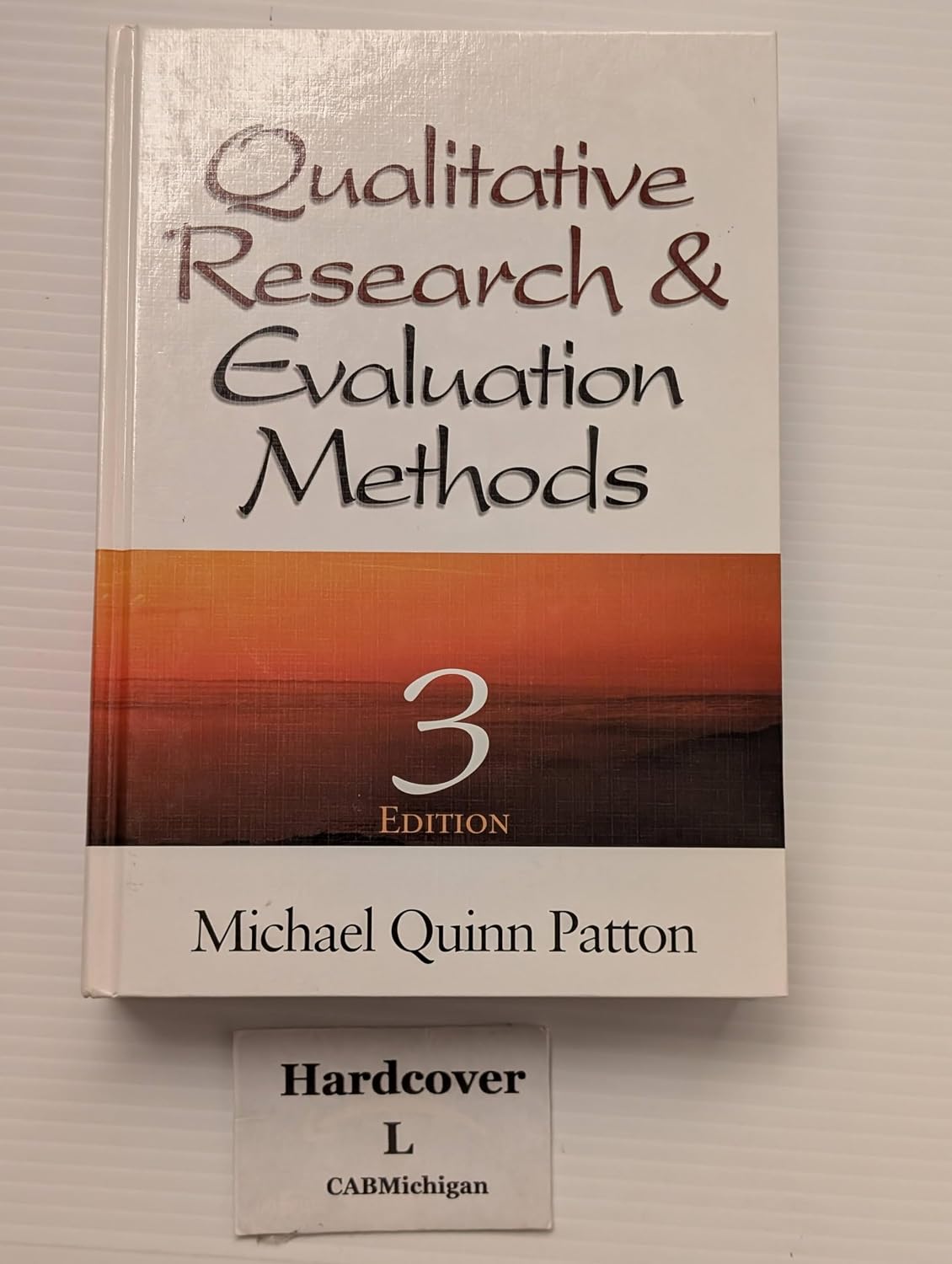
This book contains hundreds of examples and stories illuminating all aspects of qualitative inquiry. Patton has created the most comprehensive, systematic review of qualitative methods available.
Key Features- Explores, compares and contrasts 16 different theoretical and philosophical approaches to qualitative inquiry
- Offers strategies for enhancing quality and credibility of qualitative findings Unravels the complexities of mixed methods and triangulation
- Explains the issues and approaches to fieldwork as well as providing detailed analytical guidelines
Praise for the Edition
"On dissertation proposals on which I have served, Patton is by far the most cited qualitative research text."
―Ian Baptiste, Penn State University
"I am dazzled by the extent of the material that this book describes and clarifies. Patton has shifted the focus of the text to qualitative inquiry in general, which includes qualitative evaluation. New examples from his own work and that of others serve to clarify and deepen understanding of qualitative research topics and processes. New discussion of many current issues and debates in qualitative scholarship (autoethnography, ethical issues of informed consent and confidentiality, focus group/group interviews, computer-assisted analysis, the complexity of creating criteria for judging the quality of qualitative research, etc.) will bring readers up-to-date with the variety in perspectives about (and the variety within) qualitative inquiry. Most of the chapters in the book have been substantially reorganized in ways that augment the reader′s understanding. When anyone asks me about conducting qualitative inquiry, I will say: ′Get Patton′s book′."
―Corrine Glesne, author of Becoming Qualitative Researchers
"Clearly, this is a vastly improved, much more comprehensive, cogently systematic, and timely review-a tour de force, one might say-of the field of qualitative research, in terms of the theoretical, conceptual, methodological, and normative dimensions/foundations of qualitative research. This is one of the strengths of the volume. It seeks to bring together theory and practice/methods without overburdening one or the other--this is as rare as it is commendable, not to mention extremely useful, not only for the professional researcher, but for the "non-professional" as well."
―Lester Edwin J. Ruiz, New York Theological Seminar
Review
"Paton has a distinguished career as an evaluation researcher and his experience in applying the tools of qualitative research to address the questions and concerns of those in the world of practice come through clearly… a gem of a discussion of sampling strategies in qualitative research that is useful not only to prospective researchers but also to more seasoned ones. It is the most complete and carefully reasoned consideration of sampling in qualitative research that I have encountered
"
-- Organizational Research MethodsThe book is too long, wordy, and expensive. Although I really like Patton′s way of explaining many things, this book needs some major editing. It is way more information than needed. If it were cut by a couple of hundred pages (and price reduced), I would likely adopt it. -- Alisa Belzer ― drupal Published On: 2010-04-06
I looked through half dozen texts and found this to e the best, general guide to qualitative research. -- Dr Barry Grant ― drupal Published On: 2010-12-20
I recommend this book to all students who write their master thesis with a qualitative design, and I use the book frequently even in the undergraduate thesis writing process when students do their first own studies with qualitative methods.
Note: I do not teach this class anymore, but examine and supervise a lot of undergraduate students who have taken this class. Thus, in sum, I recommend the book to at least 40 students each academic year... -- Dr Claudia Bernhard-Oettel ― drupal Published On: 2012-12-18
I′ve been using this text for the past three years - I do wish Patton would update it. I use it in Masters level Applied Research courses, the students find it easy to comprehend and the examples are practical. I use it amongst a very diverse group of students in our international MA in Leadership & MA in International Development programs, and every time, they rave about it. Its a thick book but it is easy to get through it because Patton is an excellent communicator. The illustrations and humor work well to demystify research. -- Dr Faith Ngunjiri ― drupal Published On: 2011-08-25
This book covers the essential principles of qualitative research with more depth and accessibility than many other newer texts I have read. I like the fact that it does not advocate a single line of inquiry, but allows the reader to consider all the options and make an informed selection of the most appropriate qualitative methodology and research design. Isn′t it time for a new edition? -- Dr Gabrielle Thorpe ― drupal Published On: 2014-06-17
Part on purposeful sampling was adopted in our self-compiled book from Pearson Education -- Dr Karin Hannes ― drupal Published On: 2011-09-23
Class is postponed for development. Still may use -- Dr Keith Bell ― drupal Published On: 2010-02-07
I use this book with my advisees -- Dr Kimberly Truong ― drupal Published On: 2012-10-23
A very solid coverage of qualitative research not to mention evaluation issues. I miss aspects of psychoanalytic research methods. -- Dr Klaus Stagis ― drupal Published On: 2012-05-15
A must book for all research methods graduates and professionals′
-- Dr Krishna Regmi ― drupal Published On: 2011-09-19
Easy to read for students. Helpful and will continue to be a valuable resource for students as they pursue dissertation and research interests. -- Dr Marlene Valter ― drupal Published On: 2010-11-03
An excellent book. It provides a comprehensive overview of qualitative research, which will provide a great starting place for undergraduate and postgradaute students. -- Dr Ross Wadey ― drupal Published On: 2010-05-24
It arrived late. The chapter on interviewing and interview techniques is VERY much recommended for students wanting to learn to interview. These 100 pages definitely contain very good tips. -- Dr Roy Gigengack ― drupal Published On: 2010-05-06
Weel written book which appeals to students who wrestle with some of the underlying theories of qualitative research -- Dr Ruth Jepson ― drupal Published On: 2011-03-08
The comprehensive approach of presenting qualitative research is a big plus for my students. Particularly for second year students a number of general but easy to understand examples would help to make a link between theory and application. Patton has done a very good job, and students close to preparing or writing their dissertation in Year 4 have been appreciating contents and presentation style. -- Dr Stefan Koehn ― drupal Published On: 2012-09-21
I appreciate the style of the author in explaining qualitative methods without engaging in epistemological debates, which students generally find confusing. The author addresses all issues related to setting up qualitative studies and he does so in an accessible way. This makes this handbook exceptional. Nevertheless, this handbook is too extensive to be used only for two classes on qualitative research as part of a general course in research methodology. Therefore I attach the status of ′recommended reading′ to this handbook and students are free to decide whether or not to consult it. For courses dedicated to qualitative research methodology, this handbook is an ideal companion. -- Dr Stefan Hardonk ― drupal Published On: 2013-10-31
A very useful book for postgraduate students undertaking qualitative research for the first time. It is readable and comprehensive -- Dr Susan Clamp ― drupal Published On: 2011-01-12
This is the only text in public policy evaluation that uses qualitative method examples. -- Dr Victor Ferreros ― drupal Published On: 2011-06-24
Not enough focus on health care research. -- Dr Virginia Seno ― drupal Published On: 2010-09-07
Good ancillary resource for doctoral students -- Elsie Szecsy ― drupal Published On: 2013-06-13
Very good and user friendly text -- Miss Ann Marie Rice ― drupal Published On: 2011-08-01
This text provides students with essential knowledge to conduct qualitative research and the content covers all areas in an accessible manner for the reader. -- Miss Arabella Ashfield ― drupal Published On: 2011-06-29
This is the complete set of rules and procedures to be followed by students right from the start of research till the end covering selction of research tools, techniques for data collection, and write up. -- Miss Asma Rauf ― drupal Published On: 2010-04-17
Not as useful for the course as I had hoped. Students consulted found it hard to approach. Will recommend for supplemental for higher achieving and highly-motivated learners. -- Miss Christine Hatcher ― drupal Published On: 2013-05-08
This is a wonderful text, but too extensive for my course. My course includes quantitative and single subject research methodology, but the Patton book seemed ideal for a stand alone qualitative class. -- Mr Bryan Ness ― drupal Published On: 2013-10-28
This is an excellent book that goes into great detail and covers all the issues that anyone considering this approach would need -- Mr David Atkinson ― drupal Published On: 2013-01-10
Qualitative research and evaluation methods explain the purposes and usefulness of different approaches used to gather and analyse, or evaluate qualitative data. The text contains helpful between chapters interlude which presents additional useful information for the reader. An appendix section with an example of a case study from a documenter’s perspective is also provided for the reader to examine. The book provides useful diagrams, matrix, conceptual guides, and guiding questions for decisions about methods selection. The book is structured into three parts which contain nine chapters.
Part one is divided into four chapters with the first chapter introducing the reader to different kinds of qualitative data and issues which can arise when selecting a research design for undertaking a qualitative inquiry. The second chapter discusses strategies for qualitative design, data collection and analysis, as well as, purposeful sampling and different inquiry paradigms. The third chapter covers diverse theoretical orientations in detail with regards to ethnography and the kinds of questions it can answer, in addition to positivist, realist and analytical approaches and other types of theory such as grounded theory, and chaos and complexity theory. The fourth chapter is concerned with pragmatism, specifically with respect to quality assurance and programme evaluation and their applications for auditing, monitoring and policy analysis.
Part two is divided into three chapters with the fifth chapter being focused upon different qualitative research designs in relation to the types of research questions which different disciplines attempt to answer and sampling strategies which they can employ. This chapter also covers mixing different kinds of data, design and approaches to analysis, and presents a table of design issues associated with mixing methods, as well as a useful set of design options. The sixth chapter covers what to expect and how to prepare for undertaking fieldwork and what is involved in the process of observation and data gathering processes, as well as the importance of evaluation feedback in terms of increasing validity. The seventh chapter presents various approaches and techniques to qualitative interviewing and the different kinds of questions and their formats which an interviewer can ask and the importance of question ethics as well as informed participant consent.
Part three is divided into two chapters with chapter eight examining qualitative analysis and interpretation in relation to analytical description, organising data and reporting the results of qualitative data, their findings and implications for the study and future search, as well as the importance of protecting the data gathered. The ninth and final chapter is concerned with enhancing the quality and credibility of qualitative analysis with respect to making judgements based upon criteria relevant to the purpose of the study. This chapter concludes by presenting sets of criteria for making judgements about the quality and credibility of qualitative studies and the importance of methods of triangulation for cross checking the consistency of data.
The style of the book is written in an assessable and humorous style and is accessible for undergraduate, postgraduate and doctoral students, as well as anyone who is interested in qualitative research approaches and techniques and evaluative methods. This text is essential reading for students and researchers employing qualitative strategies for research projects.
-- Mr Gary McKenna ― drupal Published On: 2013-02-26
provides a good introductory text to give students insight into the emerging variety of qualitative approaches. Patton provides plenty of examples and does not over complicate methods. A useful resource to guide the qualitative researcher. -- Mr Hassan Khalil ― drupal Published On: 2011-07-17
still a classic -- Mr Mark Hardy ― drupal Published On: 2013-01-18
This is one of milestone-books in qualitative research approach. The examples make it easy to understand. It′s design is good and cartoons are interesting. -- Mr Murat BAGLIBEL ― drupal Published On: 2013-05-15
Excellent text. Thorough overview of key themes and concepts, yet text is manageable for Degree students to read. -- Mr Peter Tiernan ― drupal Published On: 2014-03-19
This is a fabulous book. Very easy to understand and apply. It has been helpful to me personally, but I will use it for my modules and for my dissertation students. -- Mrs Angela Beggan ― drupal Published On: 2010-09-15
We choose this book because it seems the most detailed and rich book on qualitative research we could find. For Dutch students it was well readable. We prescribe it for a course ′qualitative research and ethics of care theories′ that starts two times a year. -- Mrs Anne Goossensen ― drupal Published On: 2010-11-19
An excellent text book with a variety of very interesting and relevant examples and stories. -- Mrs Lisa Millar ― drupal Published On: 2014-09-26
This book is a good reference source, but is written by the best textbook author. The book is difficult to understand, has not been significantly modified since its first edition in 1980, wanders off on topics seldom related to the main content, is somewhat groundless in its relation to adequate theoretical applications, and so on. -- Mrs Maartje De Graaf ― drupal Published On: 2013-11-19
Too expensive. Adopted 2 other sources. -- Mrs Shannon Leinen ― drupal Published On: 2013-04-17
Awaiting to receive the book. -- Mrs Tania De Villiers ― drupal Published On: 2013-10-15
the course did not meet enrollment -- Ms Heidi Samuels ― drupal Published On: 2013-02-28
Easy to follow text with detailed examples. -- Ms Karina Dancza ― drupal Published On: 2009-11-23
Excellent text which is both rich in examples, issues and debates. -- Ms Louise O'Boyle ― drupal Published On: 2014-08-12
This book is clear, concise and informative. Ideal for those starting out in research and those with more advanced skills. -- Ms Michelle Evans ― drupal Published On: 2013-05-02
Strong coverage of qualitaive research data collection and analysis -- Nick Cutforth ― drupal Published On: 2011-07-12
Committee did not deem necessary for course. -- Professor Barb LaRue ― drupal Published On: 2013-04-02
in depth descriptions of numerous analytic strategies -- Professor Holona Ochs ― drupal Published On: 2013-03-06
This is an important text for students beginning their research at doctoral level. It guides researchers in a number of research designs using qualitative methods and suggests strategies for conducting their own research. The third edition is better than ever. I particularly like the discussion at the start of the text to situate qualitative research in a conceptual framework to help new and established researchers address some of the key issues on how knowledge can be developed from qualitative data in chapter 1. Chapter 2 thengoes on to discuss strategic themes providing researchers with plenty of ideas from which to develop their own inquiry. Chapter 3 is particulary useful in outlining the variety of approaches in qualitative research. There is an excellent discussion of constructionist and constructivist approaches finely pointing to differences in the social and the psychologist stance towards doing research in this vain. It is something that few other books do and Paton is to be commended for doing so. Part 2 offers practical advice to students in doing their work offering many good ideas with ways to think about and do high quality qualitative research. Many good tips here! Finally, section 3 offers a very good guide to analysis, interpretation and reporting research using qualitative methods. Overall this book offers good advice on how to do qualitative research, why you would want to do qualitative research and what it involves. -- Professor Tony Hines ― drupal Published On: 2009-10-19
About the Author
Michael Quinn Patton is author of more than a dozen books on evaluation including Qualitative Research & Evaluation Methods, 4th ed (2015), Blue Marble Evaluation (2020), Principles-Focused Evaluation (2018), Facilitating Evaluation (2018) and Developmental Evaluation (2011). Based in Minnesota, he was on the faculty of the University of Minnesota for 18 years and is a former president of the American Evaluation Association (AEA). Michael is a recipient of the Alva and Gunnar Myrdal Evaluation Practice Award, the Paul F. Lazarsfeld Evaluation Theory Award, and the Research on Evaluation Award, all from AEA He has also received the Lester F. Ward Distinguished Contribution to Applied and Clinical Sociology Award from the Association for Applied and Clinical Sociology. In 2021 he received the first Transformative Evaluator Award from EvalYouth. He is an active speaker, trainer, and workshop presenter who has conducted applied research and evaluation on a broad range of issues and has worked with organizations and programs at the international, national, state, provincial, and local levels. Michael has three children―a musician, an engineer, and an evaluator―and four grandchildren. When not evaluating, he enjoys exploring the woods and rivers of Minnesota, where he lives.
Details:
Visit the SAGE Publications, Inc Store
Qualitative Research & Evaluation Methods
QAR33240
Quantity:
Order today to get by 7-14 business days
This item qualifies for free delivery
 Imported From: United States
At BOLO, we work hard to ensure the products you receive are new, genuine, and sourced from reputable suppliers.
Every product in the BOLO catalogue is sourced through our Verified Global Supply Network of verified sellers, authorized distributors or directly from the manufacturer.
Each product undergoes thorough inspection and verification at our consolidation and fulfilment centers to ensure it meets our strict authenticity and quality standards before being shipped and delivered to you.
If you ever have concerns regarding the authenticity of a product purchased from us, please contact Bolo Support. We will review your inquiry promptly and, if necessary, provide documentation verifying authenticity or offer a suitable resolution.
Your trust is our top priority, and we are committed to maintaining transparency and integrity in every transaction.
While we strive to display accurate information, variations in packaging, labeling, instructions, or formulation may occasionally occur due to regional differences or supplier updates. For detailed or manufacturer-specific information, please contact the brand directly or reach out to BOLO Support for assistance.
Unless otherwise stated, all prices displayed on the product page include applicable taxes and import duties.
BOLO operates in accordance with the laws and regulations of Qatar. Any items found to be restricted or prohibited for sale within the Qatar will be cancelled prior to shipment. We take proactive measures to ensure that only products permitted for sale in Qatar are listed on our website.
All items are shipped by air, and any products classified as “Dangerous Goods (DG)” under IATA regulations will be removed from the order and cancelled.
All orders are processed manually, and we make every effort to process them promptly once confirmed. Products cancelled due to the above reasons will be permanently removed from listings across the website.
More from this brand
Similar items from “Research”
Share with
Or share with link
https://www.bolo.qa/products/U0761919716
Visit the SAGE Publications, Inc Store
Qualitative Research & Evaluation Methods
QAR33240
Quantity:
Order today to get by 7-14 business days
This item qualifies for free delivery
Imported From: United States
At BOLO, we work hard to ensure the products you receive are new, genuine, and sourced from reputable suppliers.
Every product in the BOLO catalogue is sourced through our Verified Global Supply Network of verified sellers, authorized distributors or directly from the manufacturer.
Each product undergoes thorough inspection and verification at our consolidation and fulfilment centers to ensure it meets our strict authenticity and quality standards before being shipped and delivered to you.
If you ever have concerns regarding the authenticity of a product purchased from us, please contact Bolo Support. We will review your inquiry promptly and, if necessary, provide documentation verifying authenticity or offer a suitable resolution.
Your trust is our top priority, and we are committed to maintaining transparency and integrity in every transaction.
While we strive to display accurate information, variations in packaging, labeling, instructions, or formulation may occasionally occur due to regional differences or supplier updates. For detailed or manufacturer-specific information, please contact the brand directly or reach out to BOLO Support for assistance.
Unless otherwise stated, all prices displayed on the product page include applicable taxes and import duties.
BOLO operates in accordance with the laws and regulations of Qatar. Any items found to be restricted or prohibited for sale within the Qatar will be cancelled prior to shipment. We take proactive measures to ensure that only products permitted for sale in Qatar are listed on our website.
All items are shipped by air, and any products classified as “Dangerous Goods (DG)” under IATA regulations will be removed from the order and cancelled.
All orders are processed manually, and we make every effort to process them promptly once confirmed. Products cancelled due to the above reasons will be permanently removed from listings across the website.
Description:
This book contains hundreds of examples and stories illuminating all aspects of qualitative inquiry. Patton has created the most comprehensive, systematic review of qualitative methods available.
Key Features- Explores, compares and contrasts 16 different theoretical and philosophical approaches to qualitative inquiry
- Offers strategies for enhancing quality and credibility of qualitative findings Unravels the complexities of mixed methods and triangulation
- Explains the issues and approaches to fieldwork as well as providing detailed analytical guidelines
Praise for the Edition
"On dissertation proposals on which I have served, Patton is by far the most cited qualitative research text."
―Ian Baptiste, Penn State University
"I am dazzled by the extent of the material that this book describes and clarifies. Patton has shifted the focus of the text to qualitative inquiry in general, which includes qualitative evaluation. New examples from his own work and that of others serve to clarify and deepen understanding of qualitative research topics and processes. New discussion of many current issues and debates in qualitative scholarship (autoethnography, ethical issues of informed consent and confidentiality, focus group/group interviews, computer-assisted analysis, the complexity of creating criteria for judging the quality of qualitative research, etc.) will bring readers up-to-date with the variety in perspectives about (and the variety within) qualitative inquiry. Most of the chapters in the book have been substantially reorganized in ways that augment the reader′s understanding. When anyone asks me about conducting qualitative inquiry, I will say: ′Get Patton′s book′."
―Corrine Glesne, author of Becoming Qualitative Researchers
"Clearly, this is a vastly improved, much more comprehensive, cogently systematic, and timely review-a tour de force, one might say-of the field of qualitative research, in terms of the theoretical, conceptual, methodological, and normative dimensions/foundations of qualitative research. This is one of the strengths of the volume. It seeks to bring together theory and practice/methods without overburdening one or the other--this is as rare as it is commendable, not to mention extremely useful, not only for the professional researcher, but for the "non-professional" as well."
―Lester Edwin J. Ruiz, New York Theological Seminar
Review
"Paton has a distinguished career as an evaluation researcher and his experience in applying the tools of qualitative research to address the questions and concerns of those in the world of practice come through clearly… a gem of a discussion of sampling strategies in qualitative research that is useful not only to prospective researchers but also to more seasoned ones. It is the most complete and carefully reasoned consideration of sampling in qualitative research that I have encountered
"
-- Organizational Research MethodsThe book is too long, wordy, and expensive. Although I really like Patton′s way of explaining many things, this book needs some major editing. It is way more information than needed. If it were cut by a couple of hundred pages (and price reduced), I would likely adopt it. -- Alisa Belzer ― drupal Published On: 2010-04-06
I looked through half dozen texts and found this to e the best, general guide to qualitative research. -- Dr Barry Grant ― drupal Published On: 2010-12-20
I recommend this book to all students who write their master thesis with a qualitative design, and I use the book frequently even in the undergraduate thesis writing process when students do their first own studies with qualitative methods.
Note: I do not teach this class anymore, but examine and supervise a lot of undergraduate students who have taken this class. Thus, in sum, I recommend the book to at least 40 students each academic year... -- Dr Claudia Bernhard-Oettel ― drupal Published On: 2012-12-18
I′ve been using this text for the past three years - I do wish Patton would update it. I use it in Masters level Applied Research courses, the students find it easy to comprehend and the examples are practical. I use it amongst a very diverse group of students in our international MA in Leadership & MA in International Development programs, and every time, they rave about it. Its a thick book but it is easy to get through it because Patton is an excellent communicator. The illustrations and humor work well to demystify research. -- Dr Faith Ngunjiri ― drupal Published On: 2011-08-25
This book covers the essential principles of qualitative research with more depth and accessibility than many other newer texts I have read. I like the fact that it does not advocate a single line of inquiry, but allows the reader to consider all the options and make an informed selection of the most appropriate qualitative methodology and research design. Isn′t it time for a new edition? -- Dr Gabrielle Thorpe ― drupal Published On: 2014-06-17
Part on purposeful sampling was adopted in our self-compiled book from Pearson Education -- Dr Karin Hannes ― drupal Published On: 2011-09-23
Class is postponed for development. Still may use -- Dr Keith Bell ― drupal Published On: 2010-02-07
I use this book with my advisees -- Dr Kimberly Truong ― drupal Published On: 2012-10-23
A very solid coverage of qualitative research not to mention evaluation issues. I miss aspects of psychoanalytic research methods. -- Dr Klaus Stagis ― drupal Published On: 2012-05-15
A must book for all research methods graduates and professionals′
-- Dr Krishna Regmi ― drupal Published On: 2011-09-19
Easy to read for students. Helpful and will continue to be a valuable resource for students as they pursue dissertation and research interests. -- Dr Marlene Valter ― drupal Published On: 2010-11-03
An excellent book. It provides a comprehensive overview of qualitative research, which will provide a great starting place for undergraduate and postgradaute students. -- Dr Ross Wadey ― drupal Published On: 2010-05-24
It arrived late. The chapter on interviewing and interview techniques is VERY much recommended for students wanting to learn to interview. These 100 pages definitely contain very good tips. -- Dr Roy Gigengack ― drupal Published On: 2010-05-06
Weel written book which appeals to students who wrestle with some of the underlying theories of qualitative research -- Dr Ruth Jepson ― drupal Published On: 2011-03-08
The comprehensive approach of presenting qualitative research is a big plus for my students. Particularly for second year students a number of general but easy to understand examples would help to make a link between theory and application. Patton has done a very good job, and students close to preparing or writing their dissertation in Year 4 have been appreciating contents and presentation style. -- Dr Stefan Koehn ― drupal Published On: 2012-09-21
I appreciate the style of the author in explaining qualitative methods without engaging in epistemological debates, which students generally find confusing. The author addresses all issues related to setting up qualitative studies and he does so in an accessible way. This makes this handbook exceptional. Nevertheless, this handbook is too extensive to be used only for two classes on qualitative research as part of a general course in research methodology. Therefore I attach the status of ′recommended reading′ to this handbook and students are free to decide whether or not to consult it. For courses dedicated to qualitative research methodology, this handbook is an ideal companion. -- Dr Stefan Hardonk ― drupal Published On: 2013-10-31
A very useful book for postgraduate students undertaking qualitative research for the first time. It is readable and comprehensive -- Dr Susan Clamp ― drupal Published On: 2011-01-12
This is the only text in public policy evaluation that uses qualitative method examples. -- Dr Victor Ferreros ― drupal Published On: 2011-06-24
Not enough focus on health care research. -- Dr Virginia Seno ― drupal Published On: 2010-09-07
Good ancillary resource for doctoral students -- Elsie Szecsy ― drupal Published On: 2013-06-13
Very good and user friendly text -- Miss Ann Marie Rice ― drupal Published On: 2011-08-01
This text provides students with essential knowledge to conduct qualitative research and the content covers all areas in an accessible manner for the reader. -- Miss Arabella Ashfield ― drupal Published On: 2011-06-29
This is the complete set of rules and procedures to be followed by students right from the start of research till the end covering selction of research tools, techniques for data collection, and write up. -- Miss Asma Rauf ― drupal Published On: 2010-04-17
Not as useful for the course as I had hoped. Students consulted found it hard to approach. Will recommend for supplemental for higher achieving and highly-motivated learners. -- Miss Christine Hatcher ― drupal Published On: 2013-05-08
This is a wonderful text, but too extensive for my course. My course includes quantitative and single subject research methodology, but the Patton book seemed ideal for a stand alone qualitative class. -- Mr Bryan Ness ― drupal Published On: 2013-10-28
This is an excellent book that goes into great detail and covers all the issues that anyone considering this approach would need -- Mr David Atkinson ― drupal Published On: 2013-01-10
Qualitative research and evaluation methods explain the purposes and usefulness of different approaches used to gather and analyse, or evaluate qualitative data. The text contains helpful between chapters interlude which presents additional useful information for the reader. An appendix section with an example of a case study from a documenter’s perspective is also provided for the reader to examine. The book provides useful diagrams, matrix, conceptual guides, and guiding questions for decisions about methods selection. The book is structured into three parts which contain nine chapters.
Part one is divided into four chapters with the first chapter introducing the reader to different kinds of qualitative data and issues which can arise when selecting a research design for undertaking a qualitative inquiry. The second chapter discusses strategies for qualitative design, data collection and analysis, as well as, purposeful sampling and different inquiry paradigms. The third chapter covers diverse theoretical orientations in detail with regards to ethnography and the kinds of questions it can answer, in addition to positivist, realist and analytical approaches and other types of theory such as grounded theory, and chaos and complexity theory. The fourth chapter is concerned with pragmatism, specifically with respect to quality assurance and programme evaluation and their applications for auditing, monitoring and policy analysis.
Part two is divided into three chapters with the fifth chapter being focused upon different qualitative research designs in relation to the types of research questions which different disciplines attempt to answer and sampling strategies which they can employ. This chapter also covers mixing different kinds of data, design and approaches to analysis, and presents a table of design issues associated with mixing methods, as well as a useful set of design options. The sixth chapter covers what to expect and how to prepare for undertaking fieldwork and what is involved in the process of observation and data gathering processes, as well as the importance of evaluation feedback in terms of increasing validity. The seventh chapter presents various approaches and techniques to qualitative interviewing and the different kinds of questions and their formats which an interviewer can ask and the importance of question ethics as well as informed participant consent.
Part three is divided into two chapters with chapter eight examining qualitative analysis and interpretation in relation to analytical description, organising data and reporting the results of qualitative data, their findings and implications for the study and future search, as well as the importance of protecting the data gathered. The ninth and final chapter is concerned with enhancing the quality and credibility of qualitative analysis with respect to making judgements based upon criteria relevant to the purpose of the study. This chapter concludes by presenting sets of criteria for making judgements about the quality and credibility of qualitative studies and the importance of methods of triangulation for cross checking the consistency of data.
The style of the book is written in an assessable and humorous style and is accessible for undergraduate, postgraduate and doctoral students, as well as anyone who is interested in qualitative research approaches and techniques and evaluative methods. This text is essential reading for students and researchers employing qualitative strategies for research projects.
-- Mr Gary McKenna ― drupal Published On: 2013-02-26
provides a good introductory text to give students insight into the emerging variety of qualitative approaches. Patton provides plenty of examples and does not over complicate methods. A useful resource to guide the qualitative researcher. -- Mr Hassan Khalil ― drupal Published On: 2011-07-17
still a classic -- Mr Mark Hardy ― drupal Published On: 2013-01-18
This is one of milestone-books in qualitative research approach. The examples make it easy to understand. It′s design is good and cartoons are interesting. -- Mr Murat BAGLIBEL ― drupal Published On: 2013-05-15
Excellent text. Thorough overview of key themes and concepts, yet text is manageable for Degree students to read. -- Mr Peter Tiernan ― drupal Published On: 2014-03-19
This is a fabulous book. Very easy to understand and apply. It has been helpful to me personally, but I will use it for my modules and for my dissertation students. -- Mrs Angela Beggan ― drupal Published On: 2010-09-15
We choose this book because it seems the most detailed and rich book on qualitative research we could find. For Dutch students it was well readable. We prescribe it for a course ′qualitative research and ethics of care theories′ that starts two times a year. -- Mrs Anne Goossensen ― drupal Published On: 2010-11-19
An excellent text book with a variety of very interesting and relevant examples and stories. -- Mrs Lisa Millar ― drupal Published On: 2014-09-26
This book is a good reference source, but is written by the best textbook author. The book is difficult to understand, has not been significantly modified since its first edition in 1980, wanders off on topics seldom related to the main content, is somewhat groundless in its relation to adequate theoretical applications, and so on. -- Mrs Maartje De Graaf ― drupal Published On: 2013-11-19
Too expensive. Adopted 2 other sources. -- Mrs Shannon Leinen ― drupal Published On: 2013-04-17
Awaiting to receive the book. -- Mrs Tania De Villiers ― drupal Published On: 2013-10-15
the course did not meet enrollment -- Ms Heidi Samuels ― drupal Published On: 2013-02-28
Easy to follow text with detailed examples. -- Ms Karina Dancza ― drupal Published On: 2009-11-23
Excellent text which is both rich in examples, issues and debates. -- Ms Louise O'Boyle ― drupal Published On: 2014-08-12
This book is clear, concise and informative. Ideal for those starting out in research and those with more advanced skills. -- Ms Michelle Evans ― drupal Published On: 2013-05-02
Strong coverage of qualitaive research data collection and analysis -- Nick Cutforth ― drupal Published On: 2011-07-12
Committee did not deem necessary for course. -- Professor Barb LaRue ― drupal Published On: 2013-04-02
in depth descriptions of numerous analytic strategies -- Professor Holona Ochs ― drupal Published On: 2013-03-06
This is an important text for students beginning their research at doctoral level. It guides researchers in a number of research designs using qualitative methods and suggests strategies for conducting their own research. The third edition is better than ever. I particularly like the discussion at the start of the text to situate qualitative research in a conceptual framework to help new and established researchers address some of the key issues on how knowledge can be developed from qualitative data in chapter 1. Chapter 2 thengoes on to discuss strategic themes providing researchers with plenty of ideas from which to develop their own inquiry. Chapter 3 is particulary useful in outlining the variety of approaches in qualitative research. There is an excellent discussion of constructionist and constructivist approaches finely pointing to differences in the social and the psychologist stance towards doing research in this vain. It is something that few other books do and Paton is to be commended for doing so. Part 2 offers practical advice to students in doing their work offering many good ideas with ways to think about and do high quality qualitative research. Many good tips here! Finally, section 3 offers a very good guide to analysis, interpretation and reporting research using qualitative methods. Overall this book offers good advice on how to do qualitative research, why you would want to do qualitative research and what it involves. -- Professor Tony Hines ― drupal Published On: 2009-10-19
About the Author
Michael Quinn Patton is author of more than a dozen books on evaluation including Qualitative Research & Evaluation Methods, 4th ed (2015), Blue Marble Evaluation (2020), Principles-Focused Evaluation (2018), Facilitating Evaluation (2018) and Developmental Evaluation (2011). Based in Minnesota, he was on the faculty of the University of Minnesota for 18 years and is a former president of the American Evaluation Association (AEA). Michael is a recipient of the Alva and Gunnar Myrdal Evaluation Practice Award, the Paul F. Lazarsfeld Evaluation Theory Award, and the Research on Evaluation Award, all from AEA He has also received the Lester F. Ward Distinguished Contribution to Applied and Clinical Sociology Award from the Association for Applied and Clinical Sociology. In 2021 he received the first Transformative Evaluator Award from EvalYouth. He is an active speaker, trainer, and workshop presenter who has conducted applied research and evaluation on a broad range of issues and has worked with organizations and programs at the international, national, state, provincial, and local levels. Michael has three children―a musician, an engineer, and an evaluator―and four grandchildren. When not evaluating, he enjoys exploring the woods and rivers of Minnesota, where he lives.
Details:
More from this brand
Similar items from “Research”
Share with
Or share with link
https://www.bolo.qa/products/U0761919716