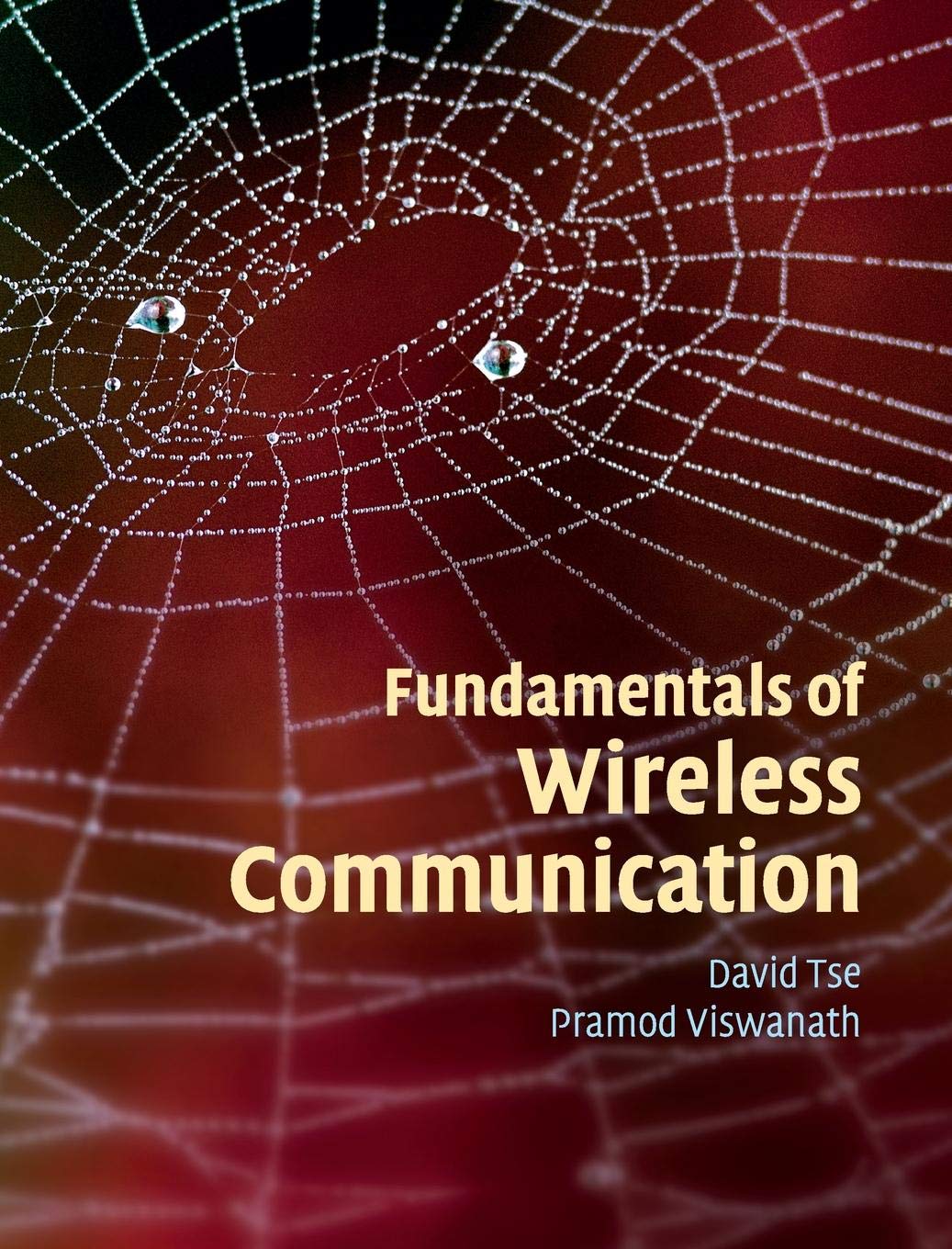
Description:
Review
Professor Robert G. Gallager, MIT
"Fundamentals of Wireless Communication is a terrific introduction to principles of physical-layer design for state-of-the-art wireless systems. It is a wonderful and much-needed resource for new graduate students and practicing professionals alike. Tse and Viswanath have written a text of enduring value."
Professor Gregory W. Wornell, MIT
"Fundamentals of Wireless Communication is a unique combination of engineering insight, theoretical vision and systems experience. This is the text I use to explain to graduate students how they should think about fading channels."
Professor Robert Calderbank, Princeton University
"David Tse and Pramod Viswanath have succeeded in developing a superb textbook covering the field of modern wireless communications. The book, Fundamentals of Wireless Communication, truly covers the fundamentals of a wireless system design and incorporates a lucid exposition of the most recent advances such as MIMO and opportunistic communication. The results are derived with exceeding clarity and often linked to an information theoretical framework, thus providing the reader with a clear understanding of optimal design choices for both point-to-point and multiple access wireless communication... this textbook will be extremely valuable not only to graduate students pursuing research in wireless systems but also to engineering professionals who have the task of designing and developing future wireless technologies."
Dr. Roberto Padovani, Qualcomm Inc.
This is a book written by academics, primarily for graduate courses. The style fits that role perfectly. It is predominantly mathematical, often using the maths as part of the way to describe a concept. However, it is an improvement over many graduate texts. The style of writing is open and relaxed. There are many real world examples explaining how concepts are related in 2G and 3G systems. The use of illustrations is excellent and there are copious exercises at the end of each chapter…I think that as a graduate text this would be truly excellent.
William Webb, IEE Communications Engineer
"The book Fundamentals of Wireless Communication, written by David Tse and Pramod Viswanath, presents a very good summary of the concepts and techniques used for the physical layer of radio networks that have emerged mainly during the last 10 years. The first chapters introduce wireless fading channels, diversity, multiple access, and interference management. The second part of the book covers the topic of multiple antennas, especially MIMO systems, with the authors concentrating on spectral efficiency and bit error probability...I strongly recommend this book for graduate students taking a course in wireless systems. The first four chapters can be recommended for use in an undergraduate course in wireless communications as well."
IEEE Communications Magazine
Book Description
About the Author
PRAMOD VISWANATH is Assistant Professor at the Department of Electrical and Computer Engineering, University of Illinois at Urbana-Champaign.
Details:
Visit the Cambridge University Press Store
Fundamentals of Wireless Communication
QAR51897
Quantity:
Order today to get by 7-14 business days
This item qualifies for free delivery
 Imported From: United States
At BOLO, we work hard to ensure the products you receive are new, genuine, and sourced from reputable suppliers.
Every product in the BOLO catalogue is sourced through our Verified Global Supply Network of verified sellers, authorized distributors or directly from the manufacturer.
Each product undergoes thorough inspection and verification at our consolidation and fulfilment centers to ensure it meets our strict authenticity and quality standards before being shipped and delivered to you.
If you ever have concerns regarding the authenticity of a product purchased from us, please contact Bolo Support. We will review your inquiry promptly and, if necessary, provide documentation verifying authenticity or offer a suitable resolution.
Your trust is our top priority, and we are committed to maintaining transparency and integrity in every transaction.
While we strive to display accurate information, variations in packaging, labeling, instructions, or formulation may occasionally occur due to regional differences or supplier updates. For detailed or manufacturer-specific information, please contact the brand directly or reach out to BOLO Support for assistance.
Unless otherwise stated, all prices displayed on the product page include applicable taxes and import duties.
BOLO operates in accordance with the laws and regulations of Qatar. Any items found to be restricted or prohibited for sale within the Qatar will be cancelled prior to shipment. We take proactive measures to ensure that only products permitted for sale in Qatar are listed on our website.
All items are shipped by air, and any products classified as “Dangerous Goods (DG)” under IATA regulations will be removed from the order and cancelled.
All orders are processed manually, and we make every effort to process them promptly once confirmed. Products cancelled due to the above reasons will be permanently removed from listings across the website.
More from this brand
Similar items from “Mobile & Wireless”
Share with
Or share with link
https://www.bolo.qa/products/U0521845270
Visit the Cambridge University Press Store
Fundamentals of Wireless Communication
QAR51897
Quantity:
Order today to get by 7-14 business days
This item qualifies for free delivery
Imported From: United States
At BOLO, we work hard to ensure the products you receive are new, genuine, and sourced from reputable suppliers.
Every product in the BOLO catalogue is sourced through our Verified Global Supply Network of verified sellers, authorized distributors or directly from the manufacturer.
Each product undergoes thorough inspection and verification at our consolidation and fulfilment centers to ensure it meets our strict authenticity and quality standards before being shipped and delivered to you.
If you ever have concerns regarding the authenticity of a product purchased from us, please contact Bolo Support. We will review your inquiry promptly and, if necessary, provide documentation verifying authenticity or offer a suitable resolution.
Your trust is our top priority, and we are committed to maintaining transparency and integrity in every transaction.
While we strive to display accurate information, variations in packaging, labeling, instructions, or formulation may occasionally occur due to regional differences or supplier updates. For detailed or manufacturer-specific information, please contact the brand directly or reach out to BOLO Support for assistance.
Unless otherwise stated, all prices displayed on the product page include applicable taxes and import duties.
BOLO operates in accordance with the laws and regulations of Qatar. Any items found to be restricted or prohibited for sale within the Qatar will be cancelled prior to shipment. We take proactive measures to ensure that only products permitted for sale in Qatar are listed on our website.
All items are shipped by air, and any products classified as “Dangerous Goods (DG)” under IATA regulations will be removed from the order and cancelled.
All orders are processed manually, and we make every effort to process them promptly once confirmed. Products cancelled due to the above reasons will be permanently removed from listings across the website.
Description:
Review
Professor Robert G. Gallager, MIT
"Fundamentals of Wireless Communication is a terrific introduction to principles of physical-layer design for state-of-the-art wireless systems. It is a wonderful and much-needed resource for new graduate students and practicing professionals alike. Tse and Viswanath have written a text of enduring value."
Professor Gregory W. Wornell, MIT
"Fundamentals of Wireless Communication is a unique combination of engineering insight, theoretical vision and systems experience. This is the text I use to explain to graduate students how they should think about fading channels."
Professor Robert Calderbank, Princeton University
"David Tse and Pramod Viswanath have succeeded in developing a superb textbook covering the field of modern wireless communications. The book, Fundamentals of Wireless Communication, truly covers the fundamentals of a wireless system design and incorporates a lucid exposition of the most recent advances such as MIMO and opportunistic communication. The results are derived with exceeding clarity and often linked to an information theoretical framework, thus providing the reader with a clear understanding of optimal design choices for both point-to-point and multiple access wireless communication... this textbook will be extremely valuable not only to graduate students pursuing research in wireless systems but also to engineering professionals who have the task of designing and developing future wireless technologies."
Dr. Roberto Padovani, Qualcomm Inc.
This is a book written by academics, primarily for graduate courses. The style fits that role perfectly. It is predominantly mathematical, often using the maths as part of the way to describe a concept. However, it is an improvement over many graduate texts. The style of writing is open and relaxed. There are many real world examples explaining how concepts are related in 2G and 3G systems. The use of illustrations is excellent and there are copious exercises at the end of each chapter…I think that as a graduate text this would be truly excellent.
William Webb, IEE Communications Engineer
"The book Fundamentals of Wireless Communication, written by David Tse and Pramod Viswanath, presents a very good summary of the concepts and techniques used for the physical layer of radio networks that have emerged mainly during the last 10 years. The first chapters introduce wireless fading channels, diversity, multiple access, and interference management. The second part of the book covers the topic of multiple antennas, especially MIMO systems, with the authors concentrating on spectral efficiency and bit error probability...I strongly recommend this book for graduate students taking a course in wireless systems. The first four chapters can be recommended for use in an undergraduate course in wireless communications as well."
IEEE Communications Magazine
Book Description
About the Author
PRAMOD VISWANATH is Assistant Professor at the Department of Electrical and Computer Engineering, University of Illinois at Urbana-Champaign.
Details:
More from this brand
Similar items from “Mobile & Wireless”
Share with
Or share with link
https://www.bolo.qa/products/U0521845270