Deliver toQatar
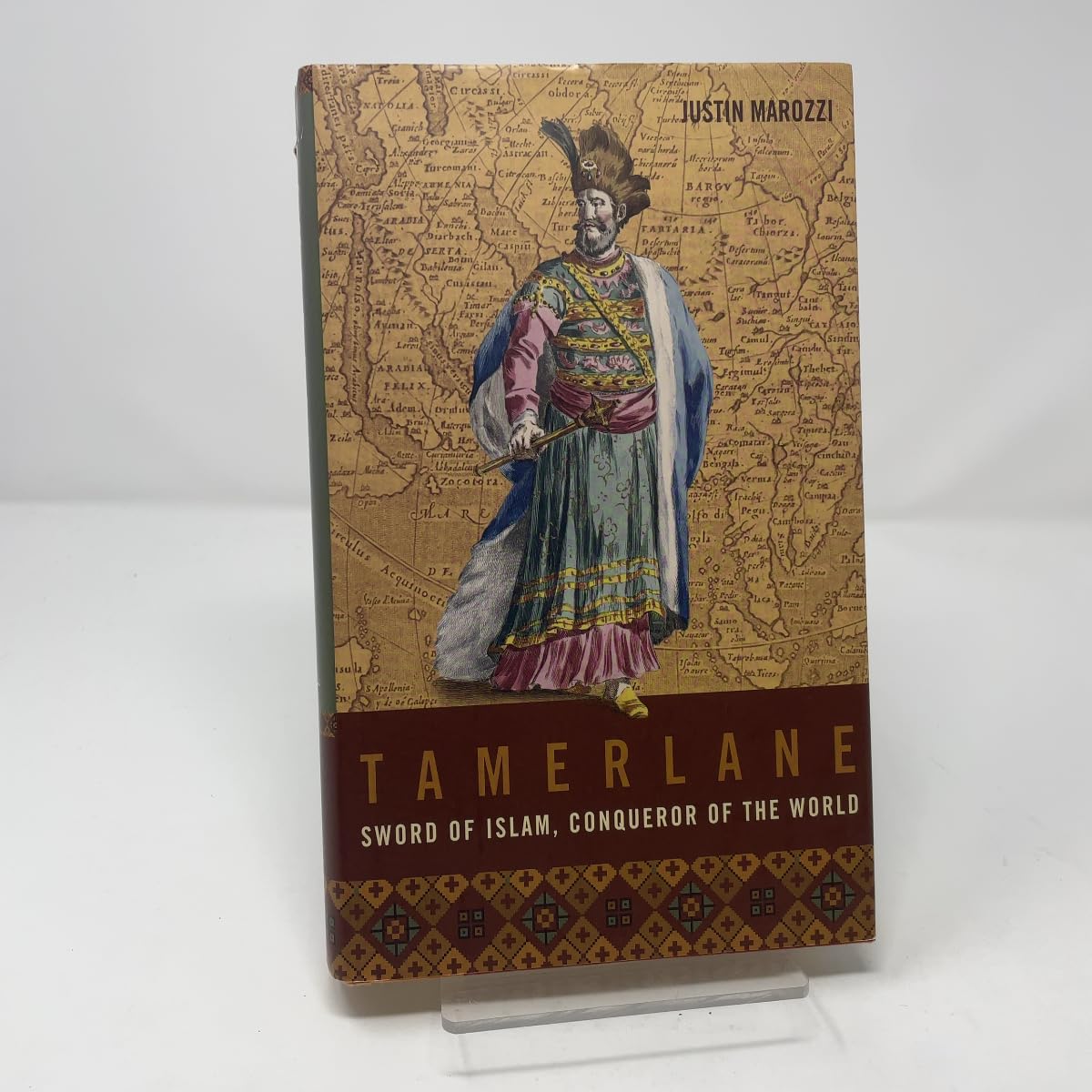
Tamerlane: Sword of Islam, Conqueror of the World

Description:

Tamerlane, aka Temur-the Mongol successor to Genghis Khan-ranks with Alexander the Great as one of the world's great conquerors, yet the details of his life are scarcely known in the West. Born in obscurity and poverty, he rose to become a fierce tribal leader, and with that his dominion and power grew with astonishing speed. He blazed through Asia, razing cities to the ground. He tortured conquered inhabitants without mercy, sometimes ordering them buried alive, at other times decapitating them. Over the ruins of conquered Baghdad, Tamerlane had his soldiers erect a pyramid of 90,000 enemy heads. As he and his armies swept through Central Asia, sacking, and then rebuilding cities, Tamerlane gradually imposed an iron rule and a refined culture over a vast territory-from the steppes of Asia to the Syrian coastline. Justin Marozzi traveled in the footsteps of this fearsome emperor of Samarkand (modern-day Uzbekistan) to write this book, which is part history, part travelogue. He carefully follows the path of this infamous and enigmatic conqueror, recounting the history and the story of this cruel, cultivated, and indomitable warrior.


Editorial Reviews

From The New Yorker

This revisionist history traces the rise of the fourteenth-century warlord Temur -- known in the West as Tamerlane -- from a crippled peasant boy wandering the steppe to ruler of half the known world. Marozzi asserts that while Temur, like Genghis Kahn, specialized in razing cities and slaughtering their inhabitants, he also had the wisdom to rebuild, and Islamic art and architecture flourished on his watch. Marozzi quotes widely from contemporaneous accounts, relishing the fantastical detail. In India, for example, Temur countered the armored elephants of Delhi with "roaring camels on fire," then had the defeated beasts brought before him and forced to kneel. Along the way, Marozzi makes a pilgrimage through Temur's former empire, and argues that the Soviets outdid the warlord in destruction by turning the once fertile basin of Central Asia into a dust bowl.
Copyright © 2006
The New Yorker

From Booklist

A nomadic mass of destruction, Tamerlane (1336-1405) was just sedentary enough to leave behind, in addition to his signature monuments of piled skulls, the great Islamic architecture of Samarkand. Marozzi is an up-and-coming journalist-travel writer ( South from Barbary: Along the Slave Routes of Libyan Sahara, 2001) who melds the biography with visits to sites of Tamerlane's battles, atrocities, and buildings. Richly describing central Asia's steppe and desert, Marozzi recounts Tamerlane's initial claim on his due portion of Genghis Khan's empire. Following the warlord's widening conquests, Marozzi sorts through the panegyrics and condemnations of chroniclers of the time, whose dominantly opprobrious opinion of Tamerlane descends for the West via Christopher Marlowe's famous drama Tamburlaine (1587) and periodic studies. The previous popular biography (Tamburlaine the Conqueror, by Hilda Hookham, 1962) is out of print, and Uzbekistan has adopted Tamerlane as its national hero, which further recommends Marozzi's fine performance of evoking the past and present of one of history's most lurid empire builders. Gilbert Taylor
Copyright © American Library Association. All rights reserved

Details:

Tamerlane: Sword of Islam, Conqueror of the World

Product ID: U030681465K
|

Returns & Warranty policies

Imported From: United States

At BOLO, we work hard to ensure the products you receive are new, genuine, and sourced from reputable suppliers.

Every product in the BOLO catalogue is sourced through our Verified Global Supply Network of verified sellers, authorized distributors or directly from the manufacturer.

Each product undergoes thorough inspection and verification at our consolidation and fulfilment centers to ensure it meets our strict authenticity and quality standards before being shipped and delivered to you.

If you ever have concerns regarding the authenticity of a product purchased from us, please contact Bolo Support. We will review your inquiry promptly and, if necessary, provide documentation verifying authenticity or offer a suitable resolution.

Your trust is our top priority, and we are committed to maintaining transparency and integrity in every transaction.

While we strive to display accurate information, variations in packaging, labeling, instructions, or formulation may occasionally occur due to regional differences or supplier updates. For detailed or manufacturer-specific information, please contact the brand directly or reach out to BOLO Support for assistance.

Unless otherwise stated, all prices displayed on the product page include applicable taxes and import duties.

BOLO operates in accordance with the laws and regulations of Qatar. Any items found to be restricted or prohibited for sale within the Qatar will be cancelled prior to shipment. We take proactive measures to ensure that only products permitted for sale in Qatar are listed on our website.

All items are shipped by air, and any products classified as “Dangerous Goods (DG)” under IATA regulations will be removed from the order and cancelled.

All orders are processed manually, and we make every effort to process them promptly once confirmed. Products cancelled due to the above reasons will be permanently removed from listings across the website.

Tamerlane: Sword of Islam, Conqueror of the World

Product ID: U030681465K
Tamerlane: Sword of Islam, Conqueror of the World-0
|

Returns & Warranty policies

Imported From: United States

At BOLO, we work hard to ensure the products you receive are new, genuine, and sourced from reputable suppliers.

Every product in the BOLO catalogue is sourced through our Verified Global Supply Network of verified sellers, authorized distributors or directly from the manufacturer.

Each product undergoes thorough inspection and verification at our consolidation and fulfilment centers to ensure it meets our strict authenticity and quality standards before being shipped and delivered to you.

If you ever have concerns regarding the authenticity of a product purchased from us, please contact Bolo Support. We will review your inquiry promptly and, if necessary, provide documentation verifying authenticity or offer a suitable resolution.

Your trust is our top priority, and we are committed to maintaining transparency and integrity in every transaction.

While we strive to display accurate information, variations in packaging, labeling, instructions, or formulation may occasionally occur due to regional differences or supplier updates. For detailed or manufacturer-specific information, please contact the brand directly or reach out to BOLO Support for assistance.

Unless otherwise stated, all prices displayed on the product page include applicable taxes and import duties.

BOLO operates in accordance with the laws and regulations of Qatar. Any items found to be restricted or prohibited for sale within the Qatar will be cancelled prior to shipment. We take proactive measures to ensure that only products permitted for sale in Qatar are listed on our website.

All items are shipped by air, and any products classified as “Dangerous Goods (DG)” under IATA regulations will be removed from the order and cancelled.

All orders are processed manually, and we make every effort to process them promptly once confirmed. Products cancelled due to the above reasons will be permanently removed from listings across the website.

Description:

Tamerlane, aka Temur-the Mongol successor to Genghis Khan-ranks with Alexander the Great as one of the world's great conquerors, yet the details of his life are scarcely known in the West. Born in obscurity and poverty, he rose to become a fierce tribal leader, and with that his dominion and power grew with astonishing speed. He blazed through Asia, razing cities to the ground. He tortured conquered inhabitants without mercy, sometimes ordering them buried alive, at other times decapitating them. Over the ruins of conquered Baghdad, Tamerlane had his soldiers erect a pyramid of 90,000 enemy heads. As he and his armies swept through Central Asia, sacking, and then rebuilding cities, Tamerlane gradually imposed an iron rule and a refined culture over a vast territory-from the steppes of Asia to the Syrian coastline. Justin Marozzi traveled in the footsteps of this fearsome emperor of Samarkand (modern-day Uzbekistan) to write this book, which is part history, part travelogue. He carefully follows the path of this infamous and enigmatic conqueror, recounting the history and the story of this cruel, cultivated, and indomitable warrior.


Editorial Reviews

From The New Yorker

This revisionist history traces the rise of the fourteenth-century warlord Temur -- known in the West as Tamerlane -- from a crippled peasant boy wandering the steppe to ruler of half the known world. Marozzi asserts that while Temur, like Genghis Kahn, specialized in razing cities and slaughtering their inhabitants, he also had the wisdom to rebuild, and Islamic art and architecture flourished on his watch. Marozzi quotes widely from contemporaneous accounts, relishing the fantastical detail. In India, for example, Temur countered the armored elephants of Delhi with "roaring camels on fire," then had the defeated beasts brought before him and forced to kneel. Along the way, Marozzi makes a pilgrimage through Temur's former empire, and argues that the Soviets outdid the warlord in destruction by turning the once fertile basin of Central Asia into a dust bowl.
Copyright © 2006
The New Yorker

From Booklist

A nomadic mass of destruction, Tamerlane (1336-1405) was just sedentary enough to leave behind, in addition to his signature monuments of piled skulls, the great Islamic architecture of Samarkand. Marozzi is an up-and-coming journalist-travel writer ( South from Barbary: Along the Slave Routes of Libyan Sahara, 2001) who melds the biography with visits to sites of Tamerlane's battles, atrocities, and buildings. Richly describing central Asia's steppe and desert, Marozzi recounts Tamerlane's initial claim on his due portion of Genghis Khan's empire. Following the warlord's widening conquests, Marozzi sorts through the panegyrics and condemnations of chroniclers of the time, whose dominantly opprobrious opinion of Tamerlane descends for the West via Christopher Marlowe's famous drama Tamburlaine (1587) and periodic studies. The previous popular biography (Tamburlaine the Conqueror, by Hilda Hookham, 1962) is out of print, and Uzbekistan has adopted Tamerlane as its national hero, which further recommends Marozzi's fine performance of evoking the past and present of one of history's most lurid empire builders. Gilbert Taylor
Copyright © American Library Association. All rights reserved

Details: