Description:
Editorial Reviews
About the Author
Dr. Michael L. Shuler is Samuel B. Eckert Professor of Engineering at Cornell University. He directed the School of Chemical Engineering (1998-2002) and was founding James and Marsha McCormick Chair for Biomedical Engineering (2004-2014). He also directs the Center on the Microenvironment and Metastasis (CMM), funded by the National Cancer Institute as a Physical Sciences - Oncology Center. He has received numerous teaching, advising, and research related awards, and has been elected to the National Academy of Engineering and the American Academy of Arts and Sciences.
Fikret Kargi is Professor in the Department of Environmental Engineering at Dokuz Eylul University. His interests include bioprocess engineering, environmental biotechnology, wastewater treatment, biotechnology-bioengineering, and waste bioprocessing. He holds a Ph.D. in Chemical/Biochemical Engineering from Cornell.
Matthew DeLisa is William L. Lewis Professor of Engineering in Cornell's Department of Chemical and Biomolecular Engineering. His research focuses on understanding and controlling the molecular mechanisms underlying protein biogenesis in the complex environment of a living cell. He has invented numerous commercially important technologies for facilitating the discovery, design and manufacturing of human drugs, and has made seminal discoveries about cellular protein folding and protein translocation. DeLisa has received several awards including an NSF CAREER award, and was named one of the top 35 young innovators by MIT's Technology Review. He was elected as a fellow of the American Institute for Medical and Biological Engineering in 2014.
Details:
Visit the Pearson Store
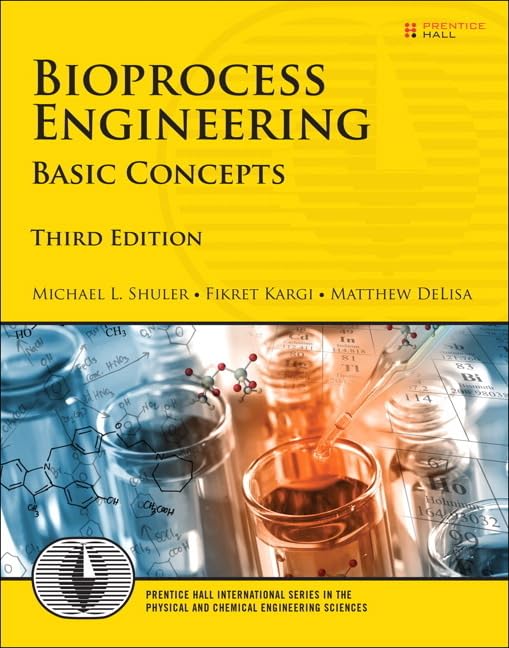
Bioprocess Engineering: Basic Concepts (Prentice Hall International Series in the Physical and Chemical Engineering Sciences)
QAR78245
Quantity:
Order today to get by 7-14 business days
This item qualifies for free delivery
 Imported From: United States
At BOLO, we work hard to ensure the products you receive are new, genuine, and sourced from reputable suppliers.
Every product in the BOLO catalogue is sourced through our Verified Global Supply Network of verified sellers, authorized distributors or directly from the manufacturer.
Each product undergoes thorough inspection and verification at our consolidation and fulfilment centers to ensure it meets our strict authenticity and quality standards before being shipped and delivered to you.
If you ever have concerns regarding the authenticity of a product purchased from us, please contact Bolo Support. We will review your inquiry promptly and, if necessary, provide documentation verifying authenticity or offer a suitable resolution.
Your trust is our top priority, and we are committed to maintaining transparency and integrity in every transaction.
While we strive to display accurate information, variations in packaging, labeling, instructions, or formulation may occasionally occur due to regional differences or supplier updates. For detailed or manufacturer-specific information, please contact the brand directly or reach out to BOLO Support for assistance.
Unless otherwise stated, all prices displayed on the product page include applicable taxes and import duties.
BOLO operates in accordance with the laws and regulations of Qatar. Any items found to be restricted or prohibited for sale within the Qatar will be cancelled prior to shipment. We take proactive measures to ensure that only products permitted for sale in Qatar are listed on our website.
All items are shipped by air, and any products classified as “Dangerous Goods (DG)” under IATA regulations will be removed from the order and cancelled.
All orders are processed manually, and we make every effort to process them promptly once confirmed. Products cancelled due to the above reasons will be permanently removed from listings across the website.
Similar suggestions by Bolo
More from this brand
Similar items from “Chemical”
Share with
Or share with link
https://www.bolo.qa/products/U0137062702
Visit the Pearson Store
Bioprocess Engineering: Basic Concepts (Prentice Hall International Series in the Physical and Chemical Engineering Sciences)
QAR78245
Quantity:
Order today to get by 7-14 business days
This item qualifies for free delivery
Imported From: United States
At BOLO, we work hard to ensure the products you receive are new, genuine, and sourced from reputable suppliers.
Every product in the BOLO catalogue is sourced through our Verified Global Supply Network of verified sellers, authorized distributors or directly from the manufacturer.
Each product undergoes thorough inspection and verification at our consolidation and fulfilment centers to ensure it meets our strict authenticity and quality standards before being shipped and delivered to you.
If you ever have concerns regarding the authenticity of a product purchased from us, please contact Bolo Support. We will review your inquiry promptly and, if necessary, provide documentation verifying authenticity or offer a suitable resolution.
Your trust is our top priority, and we are committed to maintaining transparency and integrity in every transaction.
While we strive to display accurate information, variations in packaging, labeling, instructions, or formulation may occasionally occur due to regional differences or supplier updates. For detailed or manufacturer-specific information, please contact the brand directly or reach out to BOLO Support for assistance.
Unless otherwise stated, all prices displayed on the product page include applicable taxes and import duties.
BOLO operates in accordance with the laws and regulations of Qatar. Any items found to be restricted or prohibited for sale within the Qatar will be cancelled prior to shipment. We take proactive measures to ensure that only products permitted for sale in Qatar are listed on our website.
All items are shipped by air, and any products classified as “Dangerous Goods (DG)” under IATA regulations will be removed from the order and cancelled.
All orders are processed manually, and we make every effort to process them promptly once confirmed. Products cancelled due to the above reasons will be permanently removed from listings across the website.
Description:
Editorial Reviews
About the Author
Dr. Michael L. Shuler is Samuel B. Eckert Professor of Engineering at Cornell University. He directed the School of Chemical Engineering (1998-2002) and was founding James and Marsha McCormick Chair for Biomedical Engineering (2004-2014). He also directs the Center on the Microenvironment and Metastasis (CMM), funded by the National Cancer Institute as a Physical Sciences - Oncology Center. He has received numerous teaching, advising, and research related awards, and has been elected to the National Academy of Engineering and the American Academy of Arts and Sciences.
Fikret Kargi is Professor in the Department of Environmental Engineering at Dokuz Eylul University. His interests include bioprocess engineering, environmental biotechnology, wastewater treatment, biotechnology-bioengineering, and waste bioprocessing. He holds a Ph.D. in Chemical/Biochemical Engineering from Cornell.
Matthew DeLisa is William L. Lewis Professor of Engineering in Cornell's Department of Chemical and Biomolecular Engineering. His research focuses on understanding and controlling the molecular mechanisms underlying protein biogenesis in the complex environment of a living cell. He has invented numerous commercially important technologies for facilitating the discovery, design and manufacturing of human drugs, and has made seminal discoveries about cellular protein folding and protein translocation. DeLisa has received several awards including an NSF CAREER award, and was named one of the top 35 young innovators by MIT's Technology Review. He was elected as a fellow of the American Institute for Medical and Biological Engineering in 2014.
Details:
Similar suggestions by Bolo
More from this brand
Similar items from “Chemical”
Share with
Or share with link
https://www.bolo.qa/products/U0137062702