
Description:
Review
About the Author
Excerpt. © Reprinted by permission. All rights reserved.
As I looked at the scribble and at the walls, and then back again at the drawing, an image out of a Pixar short popped into my head: the doodle shimmied to life to become the building it imagined, which now surrounded me. Gehry talks about these scribbles (his word for them—and there are many, just like this one) as his way of “thinking aloud.” And for a brief moment, I was right there with him when he had that ?rst electric thought envisioning the place. It was one of those ?eeting associations you hardly register. I moved on.
And yet I’d had a similar experience while I was still upstairs in the museum, at an exhibit of Alice Neel paintings that had been traveling around the world. Among them was a picture of a man named James Hunter, called Black Draftee (James Hunter).
As the story goes, Hunter came for a sitting, then went to Vietnam; he never returned to her studio. Neel looked at what she had applied to the canvas in that one meeting and declared the painting ?nished. I’m nuts about a lot of her work, but on that day as I was tooling around the galleries, I kept circling back to this painting. I was stuck on it. The interrupted portrait of Hunter was haunting, but what really got to me was the implied portrait—of Neel the artist, painting the picture. So there I was with her, too, experiencing the sit- ting as she experienced it.
And then it happened again. A day or so later I was in Madrid at the museum, and I saw this painting by Velázquez, one of the many court portraits of Philip IV. It’s hardly the most interesting of his works, but see where you can make out a trace of where it looks like the artist initially posed the king’s leg before ?xing it? Standing by the painting, staring down the flaw, I felt as if I’d discovered a secret. It came as a gift to view Velázquez as mortal, making a decision and then thinking better of it.
I’ve long been attracted to this sort of artifact—of artists caught in the act of making art. If you look around, you can ?nd them in corners of the internet: academic websites, auction house offerings, fanzines. They show up in the occasional exhibit, or as a sideshow in museum retrospectives. There are many types: tossed-off sketches and more-considered studies, un?nished work, meandering notes to self, scribbled lyric fragments, marked-up text, mad out- lines. I ?nd them almost inexplicably beautiful in all their genres.
Some of my interest is aesthetic. I appreciate a crude hand; I can see the artist in it. I respect the honesty of the specimens, knowing they were not meant for me to see. They’re forensically interesting, often revealing stages of thinking. But I suppose what I ?nd most satisfying about them is the way they seem to embody anticipation. They’re full of portent, more verb than noun. Also, poring over them gives me the same charge I get from reading the letters and journals of famous people. There’s a nosy pleasure in that, and I’ve often thought, in passing, that someone ought to put these kinds of documents in a book. So, to begin with, that’s what you’re holding right now.
But that’s not really what this book is about. The true value of unbaked scrawls and sketches and whatnot is as a window to an artist’s process. Process is an ugly-sounding word—pedestrian jargon for the inherently wondrous act of creation—but it describes a method by which a thing evolves, which has always had a hold on me. For over forty years I was an editor, of magazines mostly: New York most recently, The New York Times Magazine before that, and also a short-lived weekly called 7 Days. Particularly in the kinds of general-interest magazines I was editing, you could follow your curiosities any old place (that was the job description), and mine was often the how of anything. While a childlike interest perhaps—naive and open-ended, each how toppling into another—it was also opportunistic. I published a lot of what is known as process journalism, origin stories especially, which could then be fashioned into narrative.
As an editor, what I liked about these stories (beyond their answers to my questions) was the classic structure of them—each inherently dramatic, starting with nothing and ending with something. Cultural procedurals were especially good material. Years ago I assigned a story on Stephen Sondheim in which he explained, in thousands of words, how he wrote a single song. That was pretty great. I published the story on the Guggenheim Museum in Bilbao that compared the building with Marilyn Monroe. I traced the evolutions of songs and novels and soap opera arcs. As an editor and as a reader, I found the story of how creators create irresistible.
And that interest wasn’t restricted to the page. When I could get a closer look, I took advantage of opportunities that came my way. One day I was invited to visit the set of the HBO political satire Veep. There I watched David Mandel, who ran the show, tune a joke. Its punchline was a Jewish holiday. He kept barking out variations, landing the joke on different holidays—Yom Kippur or Simchat Torah, which is funnier?—improving it steadily until one turn fell flat. That’s when he knew he had gone too far. All that for a throw- away joke? I was mesmerized.
You’ll see I talk to Mandel about that later on. But I mention it here to say that I’ve always been a freak for the zealous pursuit of the better, especially where culture is concerned. I love the story of it, and also the motive. So that, too, is what this book is—a celebration of the art that happens when instinct meets rigor. But it isn’t only that either.
I’m a painter. I feel ridiculous saying that. But when I quit my magazine job sometime before that trip to Spain, I decided to try my hand as an artist. It wasn’t entirely abrupt: in my work I always found it satisfying telling stories in photographs and graphics and drawings, and in spare moments—a whim at ?rst—I picked up a paintbrush to try making images myself. I have no background in art at all, but I liked it, and I dabbled. Then I left my job, and I began to paint more seriously. That was the beginning of my torment: I just wasn’t very good.
After I learned a few skills, I could paint all right—basic stuff. My drawing got better, I knew my way around a color wheel, I could represent in a primitive way. And representation was what I was after—mainly because I didn’t have the courage to be more adventurous. If I were to try to describe what sort of painter I was, I guess you could say I was a ?gure painter with a distorting style (much like Alice Neel in my fantasies), but the distortion wasn’t always exactly deliberate. I just couldn’t do any better. Decent paintings sometimes emerged, but they seemed almost by accident. And they were accidents I couldn’t necessarily re-create. I was conservative—if one part of a painting showed promise, I would protect it and put the rest of the painting at risk. Sometimes I could get something going, and then tentatively feel emboldened to try something new (my paintings weren’t loose enough; I kept trying new ways to break the bad habits I was already picking up as a new painter), and then fall back, and that would scare me—so I would retreat to what I knew, which meant resuming the bad habits. As a result I made the same painting over and over again. I got frustrated easily and gave up easily, never knowing when to persevere or surrender. I had no faith that I could make the painting I wanted. If I stopped midway, that ideal painting could at least remain intact—in my mind. If I painted it, and painted poorly, I’d be crushed. You can see that these are all problems more of the head than of the hand (though there were plenty of technique issues as well). Basically, it all seemed impossible.
And yet though it sounds horrible, it wasn’t entirely. It was like a bad affair. I loved it even as it tortured me. And at least it consumed me. In spite of my troubles, I kept painting. Though I pretended otherwise, I really was ambitious. I wanted to be good. And when I was at my most exasperated, I found myself asking the same question I had asked as an editor: How does anybody make art?
Only now, my professional interest had become personal. The problems I am describing were ones of editorial self-scrutiny run amok, as if I had an overeager immune system that was sabotaging me. Editing is deliberating— choosing a word or a thought, dismissing or advancing; it comes up often in this book as a way to describe artistic decision-making. And in my journalism career, editing had served me well. My temperament was well suited to it. I always had trouble writing—I was too self-conscious (you can see a pattern). And I couldn’t bear working alone. But I thrived in a group and in response: I could corral ideas, and sharpen them. And I enjoyed thinking of the magazine itself as a canvas, playing with new ways to use it. In the various magazines I ran, we were forever trying to invent original story forms, and those attempts got even more interesting (we could invent whole new magazines on the fly) as the digital age kept offering up new toys to work with. But the emphasis here is on the we. There was safety in numbers. It was as part of a community that I was most successful.
But that was in the past. Now I was on my own wanting to be a painter—and I was vain enough to hope that I could even, maybe, make something interesting. Because why else do it? I didn’t dare express that hope out loud, because serious art making seemed so far out of reach.
I was staring at a canvas, in a room all by myself, and getting—not nowhere, but not far enough. I took to YouTube for tutorials, but realized it wasn’t practical help I was seeking—in fact, the inevitably contradictory guidance often confused me. And anyway, I ?gured skills would just come with more practice. I went to see a lot of art. And I read a lot about painting. In one book, a monograph about the ?gurative artist Eric Fischl (Eric Fischl:1970–2007) I came across this passage in which he described the making of one of his more famous paintings, called Bad Boy.
Here’s what Fischl had to say about it:
[Bad Boy] was an extremely meaningful painting for me to paint, not only because of what it ultimately came to mean to my career, but also because of how I got to it . . . . I was so lost in that picture that I actually had no idea what I was looking for . . . . I started out just wanting to paint a bowl of fruit. I went
from painting that bowl of fruit to constructing the room that the fruit could be in, to ?nding who might be in that room and what time of day it was. Who I ?rst thought was in the room wasn’t there. People came and went. The twelve-year- old boy stealing money from the purse started out as an infant, lying next to the woman; then became a ?ve-year-old sitting on the edge of the bed . . . He literally grew up in that room . . . I just kept following it, [trying] things that
didn’t work. I just painted things in, and painted things out.
Reading this account, I felt some of my torture starting to lift. I appreciated Fischl’s willingness to allow me into his mind as he stumbled through the work. His struggle was comforting—and illuminating. It gave me the beginnings of an idea.
Details:
Visit the Penguin Press Store
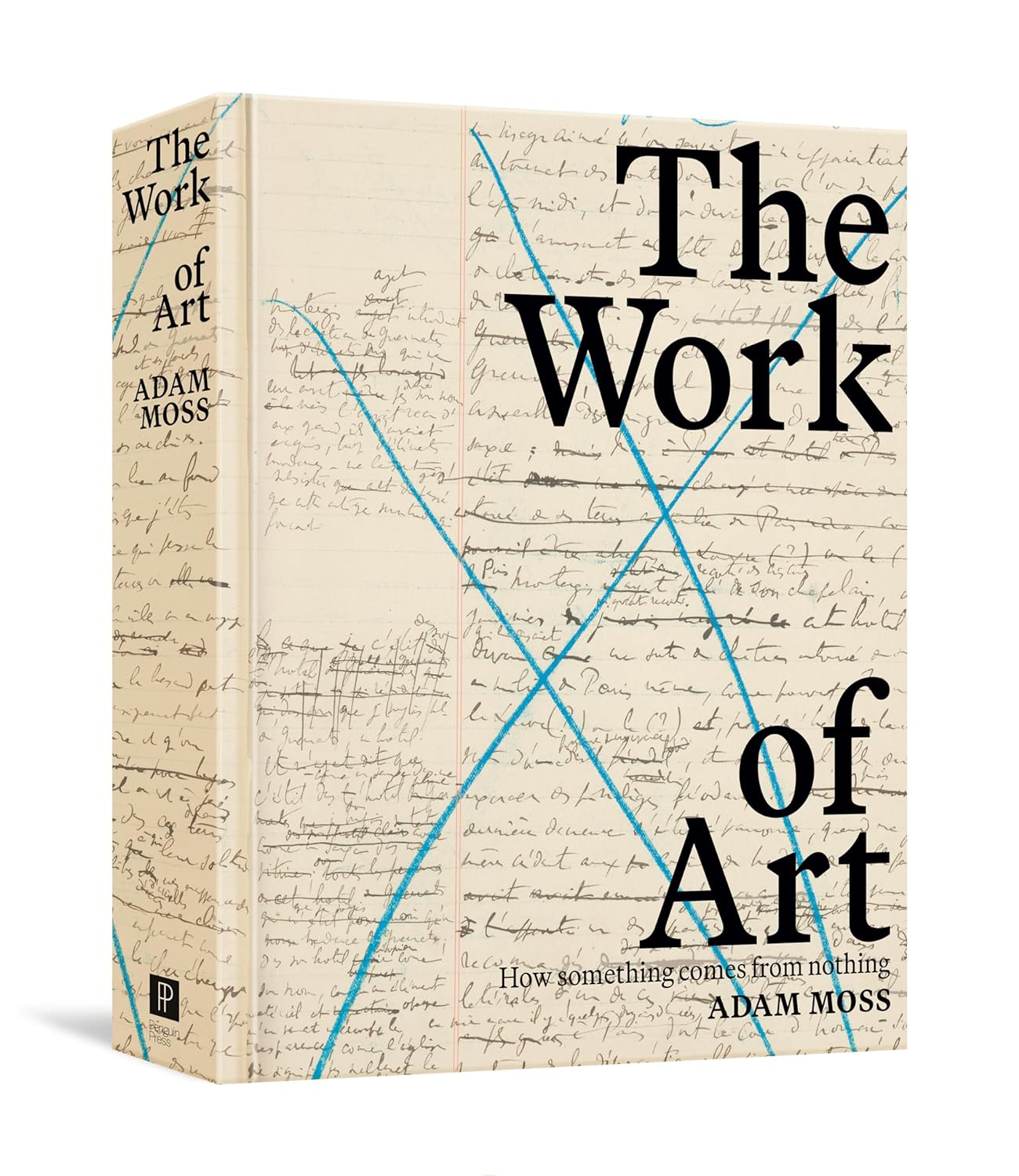
The Work of Art: How Something Comes from Nothing
Imported From: United Kingdom
At BOLO, we work hard to ensure the products you receive are new, genuine, and sourced from reputable suppliers.
Every product in the BOLO catalogue is sourced through our Verified Global Supply Network of verified sellers, authorized distributors or directly from the manufacturer.
Each product undergoes thorough inspection and verification at our consolidation and fulfilment centers to ensure it meets our strict authenticity and quality standards before being shipped and delivered to you.
If you ever have concerns regarding the authenticity of a product purchased from us, please contact Bolo Support. We will review your inquiry promptly and, if necessary, provide documentation verifying authenticity or offer a suitable resolution.
Your trust is our top priority, and we are committed to maintaining transparency and integrity in every transaction.
While we strive to display accurate information, variations in packaging, labeling, instructions, or formulation may occasionally occur due to regional differences or supplier updates. For detailed or manufacturer-specific information, please contact the brand directly or reach out to BOLO Support for assistance.
Unless otherwise stated, all prices displayed on the product page include applicable taxes and import duties.
BOLO operates in accordance with the laws and regulations of Qatar. Any items found to be restricted or prohibited for sale within the Qatar will be cancelled prior to shipment. We take proactive measures to ensure that only products permitted for sale in Qatar are listed on our website.
All items are shipped by air, and any products classified as “Dangerous Goods (DG)” under IATA regulations will be removed from the order and cancelled.
All orders are processed manually, and we make every effort to process them promptly once confirmed. Products cancelled due to the above reasons will be permanently removed from listings across the website.
Similar suggestions by Bolo
Share with
Or share with link
https://www.bolo.qa/products/K059329758K
Visit the Penguin Press Store
The Work of Art: How Something Comes from Nothing

Imported From: United Kingdom
At BOLO, we work hard to ensure the products you receive are new, genuine, and sourced from reputable suppliers.
Every product in the BOLO catalogue is sourced through our Verified Global Supply Network of verified sellers, authorized distributors or directly from the manufacturer.
Each product undergoes thorough inspection and verification at our consolidation and fulfilment centers to ensure it meets our strict authenticity and quality standards before being shipped and delivered to you.
If you ever have concerns regarding the authenticity of a product purchased from us, please contact Bolo Support. We will review your inquiry promptly and, if necessary, provide documentation verifying authenticity or offer a suitable resolution.
Your trust is our top priority, and we are committed to maintaining transparency and integrity in every transaction.
While we strive to display accurate information, variations in packaging, labeling, instructions, or formulation may occasionally occur due to regional differences or supplier updates. For detailed or manufacturer-specific information, please contact the brand directly or reach out to BOLO Support for assistance.
Unless otherwise stated, all prices displayed on the product page include applicable taxes and import duties.
BOLO operates in accordance with the laws and regulations of Qatar. Any items found to be restricted or prohibited for sale within the Qatar will be cancelled prior to shipment. We take proactive measures to ensure that only products permitted for sale in Qatar are listed on our website.
All items are shipped by air, and any products classified as “Dangerous Goods (DG)” under IATA regulations will be removed from the order and cancelled.
All orders are processed manually, and we make every effort to process them promptly once confirmed. Products cancelled due to the above reasons will be permanently removed from listings across the website.
Description:
Review
About the Author
Excerpt. © Reprinted by permission. All rights reserved.
As I looked at the scribble and at the walls, and then back again at the drawing, an image out of a Pixar short popped into my head: the doodle shimmied to life to become the building it imagined, which now surrounded me. Gehry talks about these scribbles (his word for them—and there are many, just like this one) as his way of “thinking aloud.” And for a brief moment, I was right there with him when he had that ?rst electric thought envisioning the place. It was one of those ?eeting associations you hardly register. I moved on.
And yet I’d had a similar experience while I was still upstairs in the museum, at an exhibit of Alice Neel paintings that had been traveling around the world. Among them was a picture of a man named James Hunter, called Black Draftee (James Hunter).
As the story goes, Hunter came for a sitting, then went to Vietnam; he never returned to her studio. Neel looked at what she had applied to the canvas in that one meeting and declared the painting ?nished. I’m nuts about a lot of her work, but on that day as I was tooling around the galleries, I kept circling back to this painting. I was stuck on it. The interrupted portrait of Hunter was haunting, but what really got to me was the implied portrait—of Neel the artist, painting the picture. So there I was with her, too, experiencing the sit- ting as she experienced it.
And then it happened again. A day or so later I was in Madrid at the museum, and I saw this painting by Velázquez, one of the many court portraits of Philip IV. It’s hardly the most interesting of his works, but see where you can make out a trace of where it looks like the artist initially posed the king’s leg before ?xing it? Standing by the painting, staring down the flaw, I felt as if I’d discovered a secret. It came as a gift to view Velázquez as mortal, making a decision and then thinking better of it.
I’ve long been attracted to this sort of artifact—of artists caught in the act of making art. If you look around, you can ?nd them in corners of the internet: academic websites, auction house offerings, fanzines. They show up in the occasional exhibit, or as a sideshow in museum retrospectives. There are many types: tossed-off sketches and more-considered studies, un?nished work, meandering notes to self, scribbled lyric fragments, marked-up text, mad out- lines. I ?nd them almost inexplicably beautiful in all their genres.
Some of my interest is aesthetic. I appreciate a crude hand; I can see the artist in it. I respect the honesty of the specimens, knowing they were not meant for me to see. They’re forensically interesting, often revealing stages of thinking. But I suppose what I ?nd most satisfying about them is the way they seem to embody anticipation. They’re full of portent, more verb than noun. Also, poring over them gives me the same charge I get from reading the letters and journals of famous people. There’s a nosy pleasure in that, and I’ve often thought, in passing, that someone ought to put these kinds of documents in a book. So, to begin with, that’s what you’re holding right now.
But that’s not really what this book is about. The true value of unbaked scrawls and sketches and whatnot is as a window to an artist’s process. Process is an ugly-sounding word—pedestrian jargon for the inherently wondrous act of creation—but it describes a method by which a thing evolves, which has always had a hold on me. For over forty years I was an editor, of magazines mostly: New York most recently, The New York Times Magazine before that, and also a short-lived weekly called 7 Days. Particularly in the kinds of general-interest magazines I was editing, you could follow your curiosities any old place (that was the job description), and mine was often the how of anything. While a childlike interest perhaps—naive and open-ended, each how toppling into another—it was also opportunistic. I published a lot of what is known as process journalism, origin stories especially, which could then be fashioned into narrative.
As an editor, what I liked about these stories (beyond their answers to my questions) was the classic structure of them—each inherently dramatic, starting with nothing and ending with something. Cultural procedurals were especially good material. Years ago I assigned a story on Stephen Sondheim in which he explained, in thousands of words, how he wrote a single song. That was pretty great. I published the story on the Guggenheim Museum in Bilbao that compared the building with Marilyn Monroe. I traced the evolutions of songs and novels and soap opera arcs. As an editor and as a reader, I found the story of how creators create irresistible.
And that interest wasn’t restricted to the page. When I could get a closer look, I took advantage of opportunities that came my way. One day I was invited to visit the set of the HBO political satire Veep. There I watched David Mandel, who ran the show, tune a joke. Its punchline was a Jewish holiday. He kept barking out variations, landing the joke on different holidays—Yom Kippur or Simchat Torah, which is funnier?—improving it steadily until one turn fell flat. That’s when he knew he had gone too far. All that for a throw- away joke? I was mesmerized.
You’ll see I talk to Mandel about that later on. But I mention it here to say that I’ve always been a freak for the zealous pursuit of the better, especially where culture is concerned. I love the story of it, and also the motive. So that, too, is what this book is—a celebration of the art that happens when instinct meets rigor. But it isn’t only that either.
I’m a painter. I feel ridiculous saying that. But when I quit my magazine job sometime before that trip to Spain, I decided to try my hand as an artist. It wasn’t entirely abrupt: in my work I always found it satisfying telling stories in photographs and graphics and drawings, and in spare moments—a whim at ?rst—I picked up a paintbrush to try making images myself. I have no background in art at all, but I liked it, and I dabbled. Then I left my job, and I began to paint more seriously. That was the beginning of my torment: I just wasn’t very good.
After I learned a few skills, I could paint all right—basic stuff. My drawing got better, I knew my way around a color wheel, I could represent in a primitive way. And representation was what I was after—mainly because I didn’t have the courage to be more adventurous. If I were to try to describe what sort of painter I was, I guess you could say I was a ?gure painter with a distorting style (much like Alice Neel in my fantasies), but the distortion wasn’t always exactly deliberate. I just couldn’t do any better. Decent paintings sometimes emerged, but they seemed almost by accident. And they were accidents I couldn’t necessarily re-create. I was conservative—if one part of a painting showed promise, I would protect it and put the rest of the painting at risk. Sometimes I could get something going, and then tentatively feel emboldened to try something new (my paintings weren’t loose enough; I kept trying new ways to break the bad habits I was already picking up as a new painter), and then fall back, and that would scare me—so I would retreat to what I knew, which meant resuming the bad habits. As a result I made the same painting over and over again. I got frustrated easily and gave up easily, never knowing when to persevere or surrender. I had no faith that I could make the painting I wanted. If I stopped midway, that ideal painting could at least remain intact—in my mind. If I painted it, and painted poorly, I’d be crushed. You can see that these are all problems more of the head than of the hand (though there were plenty of technique issues as well). Basically, it all seemed impossible.
And yet though it sounds horrible, it wasn’t entirely. It was like a bad affair. I loved it even as it tortured me. And at least it consumed me. In spite of my troubles, I kept painting. Though I pretended otherwise, I really was ambitious. I wanted to be good. And when I was at my most exasperated, I found myself asking the same question I had asked as an editor: How does anybody make art?
Only now, my professional interest had become personal. The problems I am describing were ones of editorial self-scrutiny run amok, as if I had an overeager immune system that was sabotaging me. Editing is deliberating— choosing a word or a thought, dismissing or advancing; it comes up often in this book as a way to describe artistic decision-making. And in my journalism career, editing had served me well. My temperament was well suited to it. I always had trouble writing—I was too self-conscious (you can see a pattern). And I couldn’t bear working alone. But I thrived in a group and in response: I could corral ideas, and sharpen them. And I enjoyed thinking of the magazine itself as a canvas, playing with new ways to use it. In the various magazines I ran, we were forever trying to invent original story forms, and those attempts got even more interesting (we could invent whole new magazines on the fly) as the digital age kept offering up new toys to work with. But the emphasis here is on the we. There was safety in numbers. It was as part of a community that I was most successful.
But that was in the past. Now I was on my own wanting to be a painter—and I was vain enough to hope that I could even, maybe, make something interesting. Because why else do it? I didn’t dare express that hope out loud, because serious art making seemed so far out of reach.
I was staring at a canvas, in a room all by myself, and getting—not nowhere, but not far enough. I took to YouTube for tutorials, but realized it wasn’t practical help I was seeking—in fact, the inevitably contradictory guidance often confused me. And anyway, I ?gured skills would just come with more practice. I went to see a lot of art. And I read a lot about painting. In one book, a monograph about the ?gurative artist Eric Fischl (Eric Fischl:1970–2007) I came across this passage in which he described the making of one of his more famous paintings, called Bad Boy.
Here’s what Fischl had to say about it:
[Bad Boy] was an extremely meaningful painting for me to paint, not only because of what it ultimately came to mean to my career, but also because of how I got to it . . . . I was so lost in that picture that I actually had no idea what I was looking for . . . . I started out just wanting to paint a bowl of fruit. I went
from painting that bowl of fruit to constructing the room that the fruit could be in, to ?nding who might be in that room and what time of day it was. Who I ?rst thought was in the room wasn’t there. People came and went. The twelve-year- old boy stealing money from the purse started out as an infant, lying next to the woman; then became a ?ve-year-old sitting on the edge of the bed . . . He literally grew up in that room . . . I just kept following it, [trying] things that
didn’t work. I just painted things in, and painted things out.
Reading this account, I felt some of my torture starting to lift. I appreciated Fischl’s willingness to allow me into his mind as he stumbled through the work. His struggle was comforting—and illuminating. It gave me the beginnings of an idea.
Details:
Similar suggestions by Bolo
Share with
Or share with link
https://www.bolo.qa/products/K059329758K